
Let the People In, Thursday
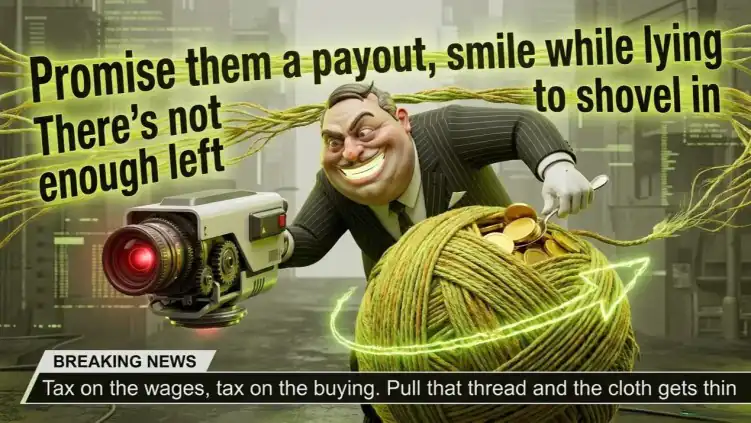
Tax on the wages, tax on the buying Pull that thread and the cloth gets thin Promise them a payout, smile while lying There's not enough left to shovel in
The Glass Child asked what schools trained.
Negative Value asked what firms priced.
The Mirror Has Learned to Speak asked what institutions had quietly learned to call strength.
The question here is what the state is actually made of.
The modern state is not only its constitution, its flag, its bureaucracy, or its monopoly on legitimate force. It is also a payment architecture wrapped around the metabolic worker. Wages flow. Payroll taxes attach. Consumption follows. VAT or sales tax attaches. Pension contributions attach. Medical systems, unemployment insurance, social grants, municipal rates, public transport models, school funding, infrastructure finance: all of them assume a broad base of humans earning, buying, aging, needing, and paying.
The cloth is woven from wages and consumption.
Pull that thread and the cloth gets thin.
This is why the AI displacement conversation becomes unserious whenever it jumps too quickly to payout language. A universal basic income may be morally attractive, politically stabilizing, or practically necessary in some form. A payout is still not a funding mechanism. It is a promise made downstream of a tax base.
If the tax base is the thing being hollowed out, the promise has to explain where the shovel is going to dig.
The State Assumes a Worker
Wage tax assumes wages.
Payroll contribution assumes payroll.
Consumption tax assumes consumers with income to spend, pension architecture assumes a working-age base large enough to support an aging population, and public health funding assumes the state can keep taxing the productive economy whose illness, injury, stress, pollution, and age it must then treat.
The metabolic worker sits underneath all of it.
Not because governments loved workers. (Often they did not.) The worker was the unit through which value moved visibly enough to tax. The human body was expensive, and it was also legibly taxable. It needed salary, housing, food, transport, school fees, clothing, care, entertainment, and rest. Its overhead created streams the state could intercept.
Non-metabolic intelligence changes the routing.
If more value is produced by capital-intensive AI systems owned by a narrower set of firms, and fewer humans receive wages in the middle of the system, the state does not automatically capture the abundance. GDP can rise while wage-linked revenue weakens, productivity can improve while household demand quietly hollows, and corporate margins can keep expanding right up until the social insurance architecture starts cracking under its own thinning base.
The official dashboard may still glow green.
The human dashboard may not.
Promise Them a Payout
The lyric is harsh because the promise is so easy.
Promise them a payout, smile while lying.
There are good-faith versions of the payout argument. If intelligence abundance makes many forms of paid work unnecessary, then society will need a mechanism for distributing access to the abundance. The old moral link between wage labor and survival cannot simply remain intact if the economy no longer needs enough wage labor to keep the population alive. A dividend, grant, public compute quota, or income floor may eventually become part of the humane architecture.
There is also a bad-faith version.
It says: let the engines concentrate ownership, let the labor share fall, let people lose bargaining power, then pacify the population with a managed allowance funded out of a tax base no one has actually rebuilt. It keeps the feudal structure and adds a stipend, redescribes passivity as protection, and writes dependency into the policy paper as inclusion.
That is not letting the people in.
That is paying them not to ask who owns the room.
The difference between a dividend and hush money is governance. Who owns the engines? Who verifies the benefit? Who can contest the metrics? Who can see the receipts? Who can refuse a definition of value that quietly turns human life into maintenance cost?
None of that gets answered here, and the proposal family comes next. What has to be clear first is why the payout sentence is not enough on its own.
Deaths of Despair and the Wrong Dashboard
The macro literature distinguishes the official dashboard from the human reality dashboard. That distinction is worth keeping.
The official dashboard knows how to measure output, asset prices, employment categories, inflation, productivity, and growth. These are not fake numbers. They matter. They can also remain legible while the social organism underneath them deteriorates.
Deaths of despair are a warning from the other dashboard.
They say a society can produce more and mean less. They say the wage was never only income. It was a recognition system, a time structure, a social identity, a reason to leave the house, a claim on adulthood, a place in the story. When the market removes that claim and the state replaces it only with a payment, the arithmetic may close on paper while the human system fractures around it.
The cheap anti-UBI move is worth resisting here. Payouts are not inherently insulting. The problem is that a payout without agency treats the human as a cost center to be stabilized rather than a participant to be included.
If the machine does the work and the human receives an allowance, who governs the machine? When the machine becomes the tax base and the human becomes the beneficiary, what happens to citizenship?
Those are not rhetorical flourishes. They are fiscal design questions.
South Africa as Worked Example
South Africa belongs in this episode because the abstraction gets too easy without it.
The fiscal junction is not theoretical there. It shows up in the Budget Review table where personal income tax is still the largest tax line, VAT is the broad consumption line, and social protection is one of the places the pressure has to land. In the 2025 Budget, National Treasury revised 2024/25 gross tax revenue to R1.846 trillion; personal income tax was R732.3 billion, about 40 per cent of gross tax revenue, and VAT was R459.9 billion, about 25 per cent. Social grants were revised to R267.3 billion in 2024/25, roughly 11 per cent of consolidated expenditure and 3.6 per cent of GDP, with Treasury projecting social grant beneficiaries rising from about 19 million in 2025/26 to 19.3 million in 2027/28. Stats SA's Q4 2025 labor survey put official unemployment at 31.4 per cent, with 7.8 million unemployed people and another 3.7 million discouraged job-seekers. The 15-24 unemployment rate, calculated from Stats SA's own age tables, is about 57 per cent. (Treasury revenue; Treasury spending; Stats SA QLFS Q4 2025.)
The country already lives with structural unemployment as a baseline condition rather than a temporary deviation from full employment. It already carries a social grant architecture that does enormous stabilizing work while remaining politically and fiscally contested. The tax base is narrow. Inequality is high. A large part of the population mediates economic participation through grants, informal work, remittances, debt, and care networks.
AI abundance does not arrive on a blank page there.
It lands on a state already trying to fund social cohesion through a constrained revenue base. It lands on young people already outside stable wage pathways. It lands on public institutions already stretched thin. It lands on a political economy where the promise of future jobs has been doing moral work the economy itself was never going to deliver.
Pull the wage thread in that cloth and the tear is not theoretical.
The argument here is structural, and the structural argument should not pretend a simple AI overlay explains a much older political economy. The line worth holding is narrower: AI intensifies the fiscal contradiction in states where the wage base was already too narrow to carry the promises made against it.
Three Futures
Three futures are worth naming here, and worth leaving unresolved until the proposal turn.
Digital Feudalism solves the tax-base problem by not solving it. A handful of firms own the engines. The public receives managed access, thin payouts, and rented agency. The cloth holds only where the owners permit patching.
The Great Fragmentation solves the same problem by hardening borders around data, compute, and national AI capacity. States panic. Trust evaporates. Algorithmic sovereignty becomes a cold-war grammar. The cloth becomes many smaller cloths, each one guarded, poorer, and more brittle than the single one it replaced.
Human Symbiosis is the only future that treats abundance as a design problem at all, rather than a threat to be enclosed. It asks how public value can be minted, verified, shared, and governed before the engine ownership pattern hardens beyond democratic reach.
That proposal gets walked next.
This episode leaves the reader at the edge of the tear.
The cloth is thin.
There is not enough left to shovel in unless the thing being shoveled gets fundamentally renamed.
Companions
- Lyric anchor: Feed the Rabbit, Pre-Chorus 2. Track context in Episode 122.
- Forward link: the proposal turn returns to Episode 74, Compute Credits as the canonical frame for public-benefit compute.
- Audio companion: The Plummeting Cost of Human Thought (especially the harbingers and the official-vs-human dashboard framing).
- Evidence anchor: National Treasury's 2025 Budget Review and Stats SA's Q4 2025 labour survey.