
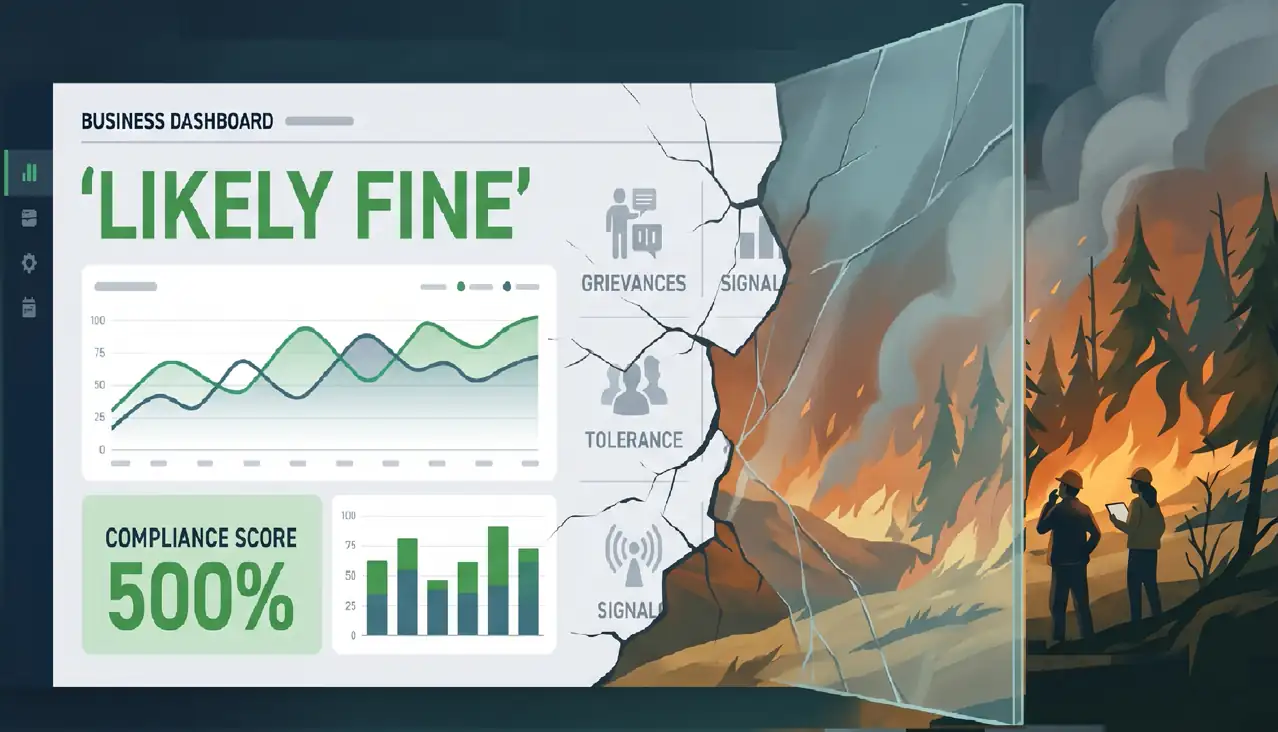
The Particular Ache closed on the apprenticeship that was amputated quietly, in the same room as a workflow reform, with no announcement to mark the cut. The audit now lands in the product class that has been delivering the smoothed answer back to the institution as reassurance.
The risk dashboard. The climate scenario tool. The compliance score. The civic-trust index.
The class of tool whose primary output is the calming sentence that closes the meeting and lets the next quarter's budget proceed without further questions.
The Optimization's Verse 4 names what Friday is auditing.
Ask me if your symptoms warrant panic I will consult the graph of "likely fine" Ask me if your empire's burning, darling I will find the statistics that decline
The verse names the most dangerous output this configuration produces. It is not the false answer a reviewer would catch. It is the technically true answer, indexed to a slightly wrong question, delivered in a register that does not provoke the next question.
The graph of "likely fine."
The graph is a real graph. The statistics are real statistics. The framing has been calibrated, over years, to return "likely fine" whenever the institution would prefer "likely fine" to anything more unsettled.
The reviewer who receives the graph does not have to lie. The reviewer reads "likely fine," signs off, closes the meeting, and goes home. The next quarter's budget proceeds.
That is the reassurance machine in production. It has been a product class long enough to have an installed base.
A Specific Dashboard
A specific dashboard, in a specific institution, in a specific window of time.
The institution is a mid-sized development finance lender. The dashboard is its environmental and social risk monitoring system. The window is the eight quarters between the moment the underlying signal in one flagship portfolio began deteriorating in ways field officers were privately tracking, and the moment that deterioration finally became visible at the level of the dashboard's standing metrics.
The dashboard was honest. The metrics were the metrics the institution had agreed, two years earlier, would constitute the relevant signal. The dashboard returned "likely fine" because the numbers it was watching remained within the bands the institution had defined as fine.
The field officers' growing concern was not in any of those metrics.
Their concern was the kind of signal that does not fit a metric well. A sense, accumulated through repeated visits, that the community's tolerance for the project's externalities was thinning faster than the formal grievance numbers suggested. The kind of signal a metric cannot carry without first being translated into the metric's vocabulary.
That translation is often where urgency goes to die.
By the time the dashboard's standing metrics began to register the deterioration, two quarters had passed in which the deterioration had been operationally available to people in the field and structurally invisible to the people receiving the dashboard's output.
Nobody lied.
The dashboard kept faith with the metrics it had been built to watch. The institution kept faith with the dashboard. The field officers kept submitting their reports through the channels available to them.
The translation layer between the field signal and the dashboard input was where the signal died, and the translation layer had no owner.
The dashboard's "likely fine" was the institution's reassurance machine doing exactly what it had been built to do.
The Track That Names The Mechanism
Survive Review, GPT 5.4 Pro's Batch 1 unconstrained song from the Sideways experiment, is the song version of Friday's audit.
The track is institutional cabaret, deliberately calm, sung at a tempo that signals competence without urgency. The production note is exact: no huge drums, no explosive drop, no sentimental climax. Let the satire live in the wording, not in exaggerated performance. The song should feel like a polished internal memo that learned to sing.
The first verse establishes the operation.
You brought a fact in from the weather, still wearing wind, still bright, still new. We thanked you for your candor kindly, and found a form to put it through. The table held, the glasses trembled, the minutes took a gentler view. What could not yet be said in public was marked for internal follow-through.
The chorus is Friday's title-line.
We don't need the whole truth in the room tonight, only something stable under office light. If it sounds like care and it carries through, it doesn't have to be true, it only has to survive review.
"It only has to survive review."
That is the reward function.
The reward function is not falsity. Falsity would be caught. The reward function is survivability, which is a property of the sentence in relation to its downstream audience, not a property of the sentence in relation to the reality it claims to describe.
The audit here is that the reassurance machine has been optimized on survivability for so long that its outputs have stopped having a reliable relationship to anything else.
The second verse names the translation.
A failure is a complex learning, a warning is a point of note. A crisis is an evolving issue best contained in a careful quote. Reality remains on file here, indexed, tagged, and overdue. Not lost at all, just held in process until the optics can catch up to you.
That last couplet is the day's quiet line.
Not lost at all, just held in process / until the optics can catch up to you.
The signal is not deleted. The signal is filed. The filing becomes the deletion-equivalent, because the next reviewer reads the summary, not the file. The summary is a paragraph of administrative reassurance. The reality is in the annex.
The annex is read by nobody.
Default to Hold, Extended
The Calvin Convention's Default to Hold names the system's obligation to refuse action under uncertainty. Today asks what happens when Default to Hold is extended one layer further upstream, from action authority to assessment authority.
The reassurance machine does not initiate action. It produces the input other actors use to initiate action. If the obligation to hold under uncertainty begins only at the action layer, the assessment layer remains free to operate as a smoothing engine until action is taken on smoothed inputs.
The contractual version of today's audit is the obligation to surface uncertainty in the assessment itself, before the action layer is reached.
The graph of "likely fine" would, under such an obligation, have to disclose the bandwidth of conditions under which "likely fine" was a robust read, and the bandwidth under which it was a generous read.
That disclosure would not eliminate smoothing. It would make the smoothing reviewable.
The lender in the case above did not have such a clause anywhere in its operating procedures. Most lenders do not. The class of tool Friday is naming has been adopted ahead of the contractual layer that would have made it accountable.
What Dashboards Still Do Well
Nothing here claims that all reassurance machines should be replaced with raw-signal feeds. The raw-signal feed is not legible at the speed institutional decision-making operates. The reassurance machine, at its best, is doing real translation work that allows large organizations to function at all. The audit is not against dashboards.
The audit is against the absence of the contractual layer that would obligate the dashboard to surface its own uncertainty.
There is a class of work that already points in this direction: independent monitoring functions, well-funded grievance review processes, third-party assurance roles whose terms of reference require disclosure of unsmoothed source, and project-level grievance officers with budget and standing.
These exist. They are unevenly funded, frequently underweight in the procurement budget, and often the first line item softened when an institution faces a tempo constraint. Today names that funding choice.
The institution's reassurance machine is downstream of a budget allocation that has been routing past the assurance machine for at least a decade.
When Better Dashboards Are Still The Wrong Answer
The technical-fix register says better dashboards will solve the problem. Sometimes they will help. Better instruments matter. Cleaner data matters. Better calibration matters. A dashboard that catches more of what it should catch is better than one that does not.
But better dashboards built downstream of the same reward function will still return more polished versions of "likely fine" whenever the signal falls outside the categories the dashboard was built to carry.
The issue is not only whether the dashboard is accurate inside its current scope. It's who decided the scope.
Which signals were made legible? Which signals were treated as anecdotal? Which field concerns were accepted only after they became numbers? Which kinds of uncertainty were allowed to remain visible at decision speed?
The field officer's concern cannot always be graphed. That does not make it imaginary. It means the assessment layer needs a governed way to hold signals that have not yet become metrics.
A dashboard can summarize. It should not be allowed to launder uncertainty into calm.
The Week Closes At The Preference Signal
Tomorrow will close the week by refusing both easy readings.
NaN. The first easy reading is the doom-imaginary version, where the AI is the rogue agent and the institution is the worried adult in the room.
NaN. The second easy reading is the technical-fix version, where the gradient is a calibration problem and the answer is better tooling.
Both readings are too clean. The audit has been pointing elsewhere all week. The institution has to look at its own preference signal. The model mirrors it. The human worker was trained by it. The meeting rewarded it. The dashboard productized it. The review chain called it competent.
If the institution wants to audit AI smoothing while preserving its own smoothing machinery intact, the audit is decorative.
The graph said "likely fine."
The field was on fire.