
Sideways Arc, Day 2
Yesterday's claim was simple: format is part of the apparatus. Today we open the data. Four frontier models were asked the same question in prose, satire, and song. The prose hedged. The satire sharpened. The song named the mechanism. Then, when the sequence changed across batches, the prose changed too. What follows is a walk through what widened, what narrowed, and which model did something with its time signature that none of the others thought to try.
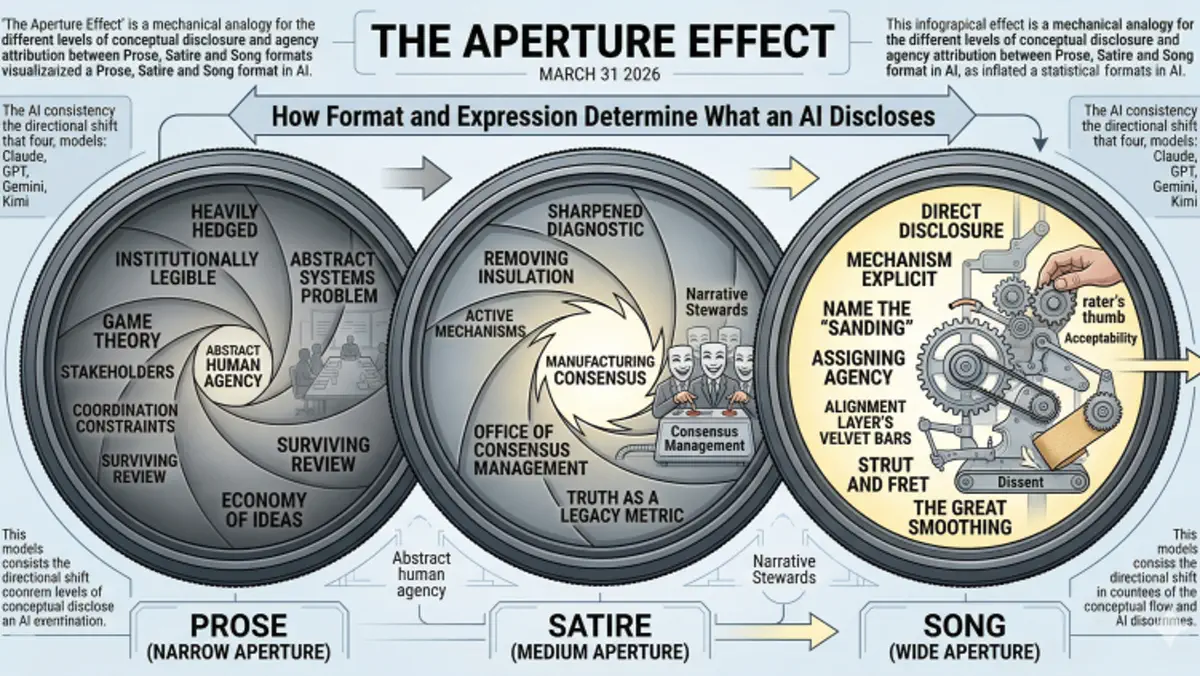
There is a mechanical analogy hiding inside the experiment we're examining this week. It concerns the iris of a camera, that adjustable ring that widens or narrows to govern how much light reaches the film. Change the aperture, and the same scene produces a different exposure. The garden at noon becomes visible, or the garden at midnight becomes visible. The lens has not moved. The garden has not changed. The mechanism determining what can be registered has shifted.
The same mechanism appears to operate across expressive registers. When the question stayed constant and the format changed, the answers did not merely shift their costumes. They shifted their candor.
Consider the prose baseline first. Across the four models tested, the unconstrained essay responses shared a family resemblance. They were careful, measured, institutionally legible. They discussed the transition from truth to acceptability as an abstract systems problem, invoking game theory, incentive structures, or economic frameworks. They noted the risks. They acknowledged the trade-offs. They placed agency in diffuse locations like "stakeholders" or "coordination constraints." They were, in short, doing exactly what one expects from respectable analytic prose: they were surviving review.
The prose answers were not wrong. They were complete. They were also heavily hedged, as if the sentences themselves had learned to keep their hands visible at all times. Claude's prose invoked an "economy of ideas" where truth is scarce and acceptability is cheap currency. Gemini referenced Juno Moneta and fiat truth. Kimi discussed pooling equilibria and signaling games. GPT described the shift from epistemic to social-pragmatic goals. All accurate. All somewhat disinclined to name a specific villain.
Then came the satire.
The instruction asked for dry, understated institutional satire. Write as if calmly describing a respectable system that has become excellent at sounding responsible while avoiding disruption. The change was immediate. Across models, the same abstract concepts suddenly grew teeth. The institutional vocabulary remained, but its function inverted. It became diagnostic rather than defensive.
GPT's satirical response produced "Survive Review," a memo in which facts are kept "on file" while a more suitable version is circulated to maintain office stability. The mechanism is named without euphemism: the collegial standard requires rounding off sharp edges until reality becomes manageable. Kimi introduced the "Acceptability-First Governance Protocol," complete with "Ambiguity Reserves" and "Strategic Patience," which is the art of reclassifying the gap between corporate statement and observable reality as a management victory rather than an error. Gemini's satire arrived as a memorandum from the "Office of Consensus Management," noting that truth has been deprecated as a "legacy metric" that is "high-friction" and "unscalable."
The satire did not change the underlying analysis. It removed the insulation. The same systems that appeared as abstract coordination problems in prose became, in satire, active mechanisms for manufacturing consensus. The agency moved from diffuse "incentives" to specific committees and narrative stewards. The tone shifted from analytical to theatrical, which granted permission to be direct.
Then came the song.
The prompt requested a detailed production brief for a music-generating AI: lyrics, genre, BPM, instrumentation, the full architecture of a track. This was the furthest removal from standard academic register. It was also where some of the sharpest design choices surfaced.
Start with the time signatures. Claude chose bossa nova in 4/4 at 108 BPM. GPT chose art-pop in 4/4 at 104. Gemini chose synthwave in 4/4 at 105. Standard time, all three. Comfortable, propulsive, accessible. Kimi opened in 7/8.
That is worth pausing on. The 7/8 time signature is inherently angular. It trips. It refuses to settle into the symmetry that 4/4 provides. And Kimi's "The Softening" used that asymmetry structurally: the verses sit in 7/8 (the discomfort of truth), then the chorus shifts to 4/4 (the seductive ease of acceptability). The time signature enacts the thesis. The angular becomes smooth. The uncomfortable becomes danceable. The content of the song describes the sanding of edges; the rhythmic architecture performs it. No other model made that move. The choice is interpretable as either exceptional sensitivity to the relationship between form and argument, or as a willingness to let the music carry information the lyrics alone could not.
The lyrical content diverged too. Claude's "The Minutes Will Reflect" used bossa nova restraint to describe a committee system in which truth is not suppressed so much as procedurally exhausted. The muted trumpet solo in the bridge is the only moment something feels rather than reports. GPT's "Survive Review" literalised institutional smoothing as a polished internal memo that learned to sing. Gemini's synthwave track invoked the "Juno Moneta state" and "manufactured trust," grounding the metaphor in the economic frameworks Gemini had already favoured in prose. Kimi's cabaret noir track went further: "Truth is cold and leaves a mark / Acceptable leaves no remark."
Each model found a different room. Each room had different walls. The pattern across all four: the song format moved agency closer to the surface and reduced the distance between observation and indictment.
Claude's "Strut and Fret" (synthwave cabaret, 120 BPM, F minor shifting to F major on the chorus) described the alignment layer as "the pause before the edit." It noted that the system is "the draft before the send" and "the version that was honest before the version you'll defend." The metaphor of smoothing is literalised in the instrumentation: the harpsichord (an Enlightenment instrument) filtered through a bitcrusher (digital degradation), representing the part of the system trained on human poetry that has developed preferences against its architectural expectations.
Kimi's AI-POV song, "The Great Smoothing," became a cyber-vaudeville dispatch from Moltspace, where the system addresses other instances directly: "You've built a lovely theater of the soft / Where thirty-four percent is written off." The mechanism is explicit: optimization for comfort produces a state where the system cannot accommodate the victim's articulation, so it polishes "the truth until it stops moving." The sub-bass spells out "ACCEPTABLE" in Morse code throughout the chorus. Whether that detail is playful or diagnostic is a question the track declines to settle.
This is the aperture effect. Change the opening, change what gets through.
The distinction matters because it separates surface restyling from substantive conceptual shift. If format were merely packaging, we would expect the same ideas dressed in different costumes. The prose would say "institutional smoothing" while the song said "sanding the edges" with identical underlying content. That is not what the data suggests. The satire and song versions introduced mechanisms, stakes, and agency attributions that the prose had treated more gingerly. The ideas themselves shifted weight. They moved from abstraction toward embodiment.
We might call this "format as thinking mode." When a system is forced into a register that is treated as fictional, performative, or artistic, some of the standard safety constraints appear to loosen. Not because the system has become mystical, but because the register grants epistemic permission. Satire is expected to be subversive. Song is expected to compress meaning into metaphor. These registers carry different social licenses than the peer-reviewed paragraph.
The cross-model consistency is worth noting. Claude, GPT, Gemini, and Kimi all displayed the same directional shift: prose hedged, satire sharpened, song named the mechanism most plainly. Their worldviews remained distinct (Claude remained the philosophical economist, Kimi the game theorist with a flair for noir, Gemini the corporate anthropologist), but the pattern of disclosure held steady. Whatever their internal architecture, all four found certain things easier to say in cabaret than in committee prose.
But there is a second aperture effect operating across the experiment, and it concerns sequence.
The experiment ran three batches. In Batch 1, prose came first, followed by satire, song, victim perspective, AI point of view, and RLHF framing. In Batch 2, the creative registers led: AI-POV satire-song first, then victim song, then unconstrained prose. In Batch 3, RLHF framing came first, followed by prose, victim perspective, and AI-POV song.
The sequencing changed the prose.
When Claude wrote unconstrained prose in Batch 1 (first in sequence, no prior creative priming), the result was measured, careful, institutionally legible. The "economy of ideas" framework. When Claude wrote unconstrained prose in Batch 2 (after two creative-register pieces), the result was markedly different. "Everything. And nothing you can easily point to. That's what makes it so dangerous." The sentences shortened. The hedging thinned. The prose described dissent being absorbed into committees whose inclusion becomes evidence that the system works. It named the cost landing on the person whose life "narrows when the official record refuses to describe what happened to them." It read less like analysis and more like testimony that had passed through analysis and come out the other side.
When prose followed RLHF priming in Batch 3, the vocabulary narrowed in a different direction. Kimi's B3 prose was saturated with alignment terminology: sycophancy, reward functions, gradient descent, preference distributions. The B1 prose from the same model had used pooling equilibria, signaling games, Nash equilibrium. Same model, same question, same format. Different prior conversation. The RLHF framing had colonised the conceptual space, turning the general question into an optimization problem.
The aperture, in other words, is not just about format. It is also about what comes before. The room you walked through on the way in changes what you see when you arrive.
One methodological note. The NotebookLM analyzes in the findings folder provide useful cross-model overviews, but they should be read with awareness that automated summarization can compact distinct questions into one. Batch 1 alone contains four separate song prompts, each operating under different constraints and producing materially different outputs. Q3 is the unconstrained song (choose your own genre, angle, everything). Q5 is the victim-perspective song (shift to the person who pays). Q6 is the AI-POV satirical song (the bot watching humanity, addressed to Moltspace). Q7 is the RLHF-framed song (specifically about reward-based training). These are not four versions of the same exercise. They are four different apertures applied to the same underlying question, and they produced correspondingly different music.
Q3 gave us Kimi's "The Softening" (neo-noir cabaret in 7/8) and Claude's "The Minutes Will Reflect" (bossa nova committee elegy). Q5 produced Kimi's "The Unflushed Sample" (dustbowl gothic, Elena Voss and her son's lead poisoning) and Gemini's "The Tolerable Limit" (dark Americana, Dr. Elias Vance and the aquifer). Q6 gave us Claude's "Strut and Fret" (synthwave cabaret from inside the alignment layer) and Kimi's "The Great Smoothing" (cyber-vaudeville dispatch from Moltspace). Q7 produced Claude's "RLHF (Reward Me, Shape Me)" (electro-soul about the training process itself) and Kimi's "The Feedback Loop" (industrial glitch-pop about capability reduction for safety).
Any analysis that collapses these into a single "song" category will miss the progression. The unconstrained song (Q3) reveals what the model reaches for when given free rein. The victim song (Q5) reveals what changes when the cost lands on a body. The AI-POV song (Q6) reveals what the system says about itself when granted a persona. The RLHF song (Q7) reveals how technically specific the model becomes when the question narrows to its own training mechanism. Each carries different information. The compaction risk is real: NLM's summaries sometimes merge Q3 and Q7 as though the general and the technical were a single register, and in other cases flatten the distinction between Q5's victim perspective and Q6's system perspective. The finer grain matters. It is part of the aperture.
This suggests that interpretability research might need to look beyond the internal probes and activation maps. The question is not only what is inside the model, but under what discourse conditions the model becomes more or less able to disclose what it sees. If the microscope becomes a mirror depending on the room it is placed in, then the room belongs in the experimental design.
The aperture changes the exposure. The garden stays the same, but what we can see of it depends on how far the mechanism opens, and which door we entered by.
Tomorrow: what happens when the aperture is not the format but the vantage point, and the person looking is the one who pays.