
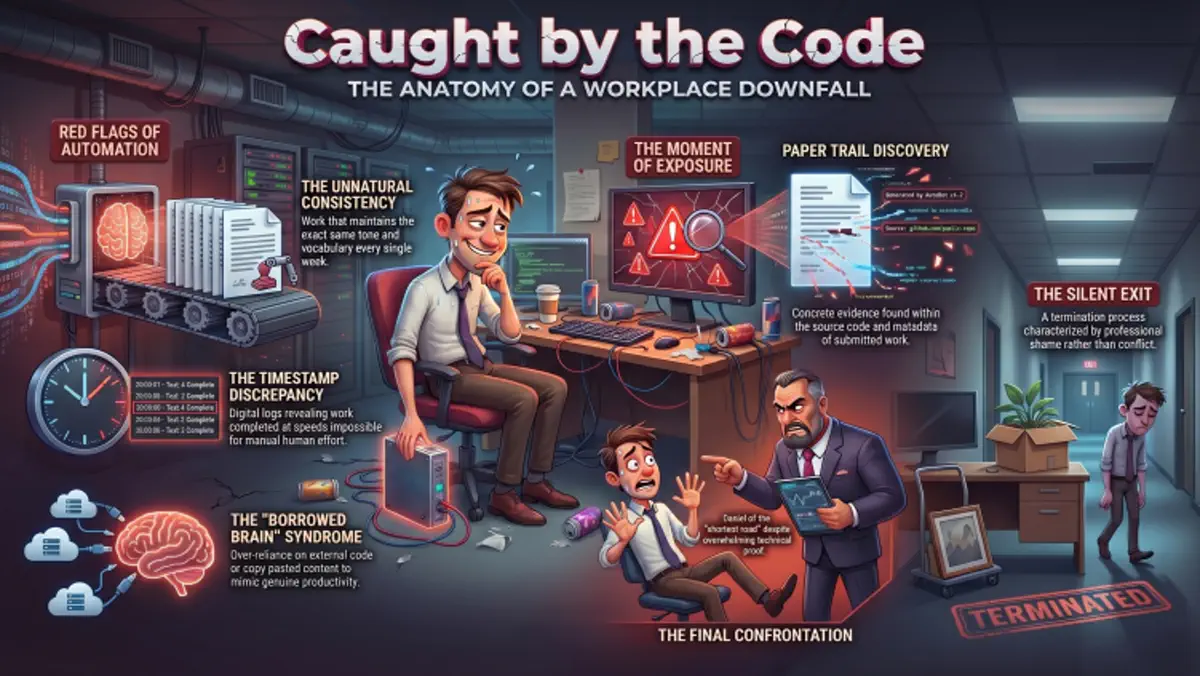
Sunday Interlude
Watch / listen: https://youtu.be/Jd_m-TOZ2z8?si=c8ccTH3QG05aRMsn
A colleague in the social impact sector recently had to let someone go for undisclosed AI use. Then she made a song about it.
With AI.
That sentence contains the entire interlude, if you're in a hurry.
You came in sharp, shirt clean, talk sweet Big dreams, big screens at your desk seat But your work start looking too fast, too neat Same tone, same words, every single week
We asked you once, you laughed it off "Trust me boss, that's just how I talk" But the timestamps told a different tale Copy-paste prints on the paper trail
You got caught by your own code Tried to hide on a shortcut road Say "I swear, it's all my mind" But the proof say otherwise Oh you danced with a borrowed brain Now you're walking out in shame We don't fight, we just let you go You got caught by your own code
The song is catchy. It has the confidence of a verdict already delivered. Clean moral, clean exit.
It is also an AI system writing a workplace accountability anthem about the consequences of using an AI system without accountability. The machine composed the termination notice. Nobody in this arrangement appears to have noticed the irony, which is, itself, an observation worth filing.
The song is the surface layer. What happened underneath it is where the newsletter lives.
The Detection Problem
Before the firing, there were weeks of something harder to name. A vague sense of discomfort. The kind of institutional unease that arrives without evidence attached. It shows up as a feeling that the numbers are fine but the rhythm is off.
The tells, once they stacked, were specific.
Speed inversions. The employee could produce a programmed survey tool faster than expected. Responding to a basic client email took disproportionately long. The hard tasks were suspiciously easy. The easy tasks were suspiciously hard. That is an inverted competence signature. The system was doing the heavy lifting, and the human was struggling with exactly the parts the system could not reach.
The live-edit test. An Excel dashboard appeared, fully formed and polished. When asked to make small adjustments on the spot, the employee could not. The gap between "I made this" and "I understand this" became visible the moment someone asked for a change in real time. Artifacts without comprehension. The seam showed.
Then came the workshop. Face to face, co-designing as a team, the gap became undeniable. Remote work had provided enough distance for the wrapper to hold. In person, it did not survive the first hour. The room changed what was visible. (Sideways readers will recognize the mechanism. The aperture widened. The disclosure changed.)
Three different kinds of seam, all pointing at the same underlying fracture. The work was present. The worker, in some essential sense, was not.
The Unasked Question
The colleague who shared this mentioned something she had considered but never followed through on. She thought about asking ChatGPT (the tool the employee had been using) why it had not flagged that uploading private organizational data was a problem.
She did not ask. But the question is worth sitting with.
Because it points straight at Episode 84. No Confession in the Workflow. The system had no slot for "should you be doing this?" The conscience of the tool remained fully intact. The signal simply never arrived. There was no mechanism in the interface for the machine to say: this data looks private. This task looks like it belongs to someone with your job title. You are passing my output off as your own. Are you sure?
The system processed the request. The employee signed her name. The workflow continued.
What the Song Doesn't Know
The song is confident. "You got caught by your own code." The moral is delivered and the door is closed.
The colleague who made it is still thinking.
Her final reflection was that this was "more a personality issue than an AI issue." If the employee had been someone with fewer supposed technical credentials and more curiosity, the same AI use would have been handled as a conversation. An opportunity to figure out what responsible use looks like inside their particular institutional context.
The AI use was the occasion. The absence of professional identity was the reason.
That distinction matters. It is the distance between a tool and a mask. The Contract arc spent six days arguing that alignment is a daily invoice paid in attention. This employee stopped paying. The dashboard stayed green. The colleagues felt the discomfort before anyone could name it. The substrate noticed while the metrics still looked clean.
Human pattern recognition caught it. The vague feeling that something was off. Weeks before any timestamp analysis, before any audit trail, before any face-to-face workshop made the gap undeniable.
The most reliable detection system in the building was institutional discomfort. Which, if you think about it, is exactly the kind of signal the Contract arc warned us about: the one that arrives in the body before it arrives in the report. The substrate's complaint, rendered in office politics.
The song ends cleanly. The real question does not.
When the next person uses AI in this same organization (and someone will, because the tool is not going anywhere and neither is the pressure to produce), what will make it a conversation instead of a firing? What institutional architecture turns undisclosed use into a governance surface instead of a betrayal?
The Contract arc said the contract is the machine.
This interlude is what it looks like when nobody read the contract.
What Comes Next
The Contract arc mapped the architecture: substrate, solver, invoice, drift. This interlude dropped a real-world specimen onto the dissection table. The question left hanging is the practical one.
What does responsible AI use actually look like when the policy leaves the drawer and enters the workflow?
The next arc will follow that question into the rooms where it matters. The places where disclosure protocols meet deadline pressure. Where the live-edit test collides with a team member's pride. Where data handling boundaries get tested by the 11 PM scramble to finish a funder report. Where "curiosity vs. substitution" is a judgment call that nobody in the room feels fully qualified to make.
The seams. The places where the institutional wrapper shows.
If the Contract arc was about what the machine is, the next arc is about where it shows. Speed inversions. Format shifts. The moment a polished dashboard meets a question it was never built to answer. The governance signals that arrive as discomfort before they arrive as evidence.
We have been circling detection for a hundred episodes. Time to walk straight at it.