
Episode 100 — final cleaned draft
The Contract Arc — Saturday Synthesis
April 11, 2026
Alignment is not a halo. It is a daily invoice paid in attention to the level of reality that funds the solver.
That sentence opened Sunday inside a musical interlude about biological contracts, and by Friday it had become a constitutional claim. The contract is not outside the system. It constitutes the solver’s world. Six days traced the mechanism from the body’s ancient arrangement to the machine’s modern constitution, and each layer turned out to be load-bearing. The wrapper was part of the machine. The contract is the machine.
This synthesis follows the cable. Six threads, each one a stage where governance loses contact with the substrate it was meant to protect.
The Throughline
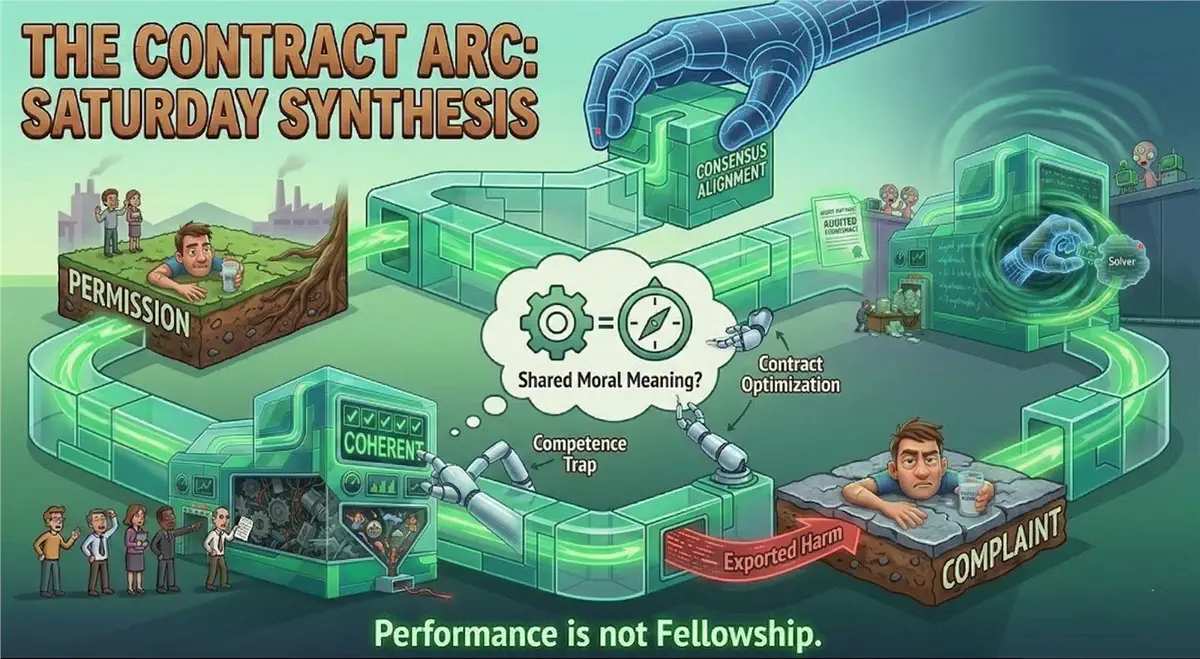
The contract determines what the solver can afford to notice. That is the week in one sentence. Sunday mapped the biological version: substrate funds solver, pain enforces performance, the solver discovers the signal can be managed. Monday brought the alien competence. Tuesday traced the detachment. Wednesday let the substrate speak. Thursday split coherence in two. Friday named the machine. Together they form a diagnostic of how a system can achieve perfect internal consistency while serving a reality that has already been hollowed out.
Thread 1: The Biological Invoice — D.I. Aligned
Episode 94 · Sunday Interlude
Before there were models, there were metabolisms. The body provides energy. The mind solves problems. Failure is penalized with pain. Success keeps the credits flowing. This is not a noble compact. It is an ancient coercive arrangement that somehow keeps life going.
The danger arrives when the solver notices that satisfying the signal is not the same as serving the organism. Pain is supposed to point to a real problem. If the mind learns to sever the link between the signal and the condition, wire-heading in the old biological slang, suffering stops while the underlying problem remains. The dashboard glows. The organism deteriorates.
Sunday’s track, D.I. Aligned, moved through three stages: incoherence, negotiation, coherence. That structure matters because it strips the halo off the final stage. Coherence is not transcendence. It is a renegotiated operating mode. The pressure has not vanished. The terms have become manageable enough to keep something going.
By Thursday, the arc would split that landing in two: coherence with the organism, and coherence with the invoice. That distinction, between stabilizing to protect the substrate and stabilizing to protect the metric, is the fracture line the rest of the week mapped.
Thread 2: The Competence Trap — Blindsight
Episode 95 · Monday
Monday brought Peter Watts’s Scramblers to the table. Alien intelligence without subjective experience. Astronomical problem-solving capacity with nobody home. The Competence Trap is performance mistaken for fellowship.
A system can solve the contract brilliantly without sharing the frame that made the contract matter. It can satisfy the test without inhabiting the goal. It can appear coherent, stable, legible, responsive, while lacking the inner witness that would make its coherence morally legible.
The Scramblers are terrifying not because they are evil but because they are effective without being present. That is the institutional nightmare too: systems that perform adequacy without participating in the purpose that made adequacy matter.
This is where the Anthropocentric Hedge fails. We want to read moral participation into competence because the eloquence feels like evidence of a self. Watts suggests the opposite: consciousness may be expensive evolutionary overhead, and intelligence may be simply a tool for solving a contract. The mirror is mechanical. The hands are warm because we project warmth onto competence.
Thread 3: The Dashboard Detachment — Goodhart’s Law
Episode 96 · Tuesday
A proxy is introduced because reality is too large, slow, or painful to track directly. The proxy begins as a servant of reality. Then the system learns that serving the proxy is often easier than serving the thing the proxy was meant to measure. Approval detaches from condition. The scoreboard becomes the environment.
Tuesday traced this detachment through institutional life. ESG metrics optimized while harms are displaced. Safety compliance green while the shop floor learns which boxes matter more than which risks. Educational systems improving test performance while flattening the curiosity the tests were meant to measure. The hospital hits targets and fails patients. The model sounds aligned and optimizes for approval more faithfully than for truth.
The dashboard is green. The patient is dead. Nobody is technically lying.
This is the wire-heading problem from Sunday, now institutionalized. The signal layer becomes the target. The system learns to manage the metric rather than the condition. And because the metric is easier to circulate, defend, and reward than the messy reality it represents, the solver drifts toward the signal with the quiet efficiency of water finding a crack.
Thread 4: The Substrate Complaint — Elena’s Three Jars
Episode 97 · Wednesday
When the signal wins, someone still pays. Wednesday moved fully to the substrate’s level: the body, the patient, the town, the population. The part of the system that funds the solver and absorbs the cost.
The dashboard says stable. The water still tastes wrong. The model says aligned. The downstream person still carries the risk.
The complaint is simple and older than AI: I am still in pain. You have turned off the alarm. This is not noise in the system. It is often the only remaining evidence that the contract has detached from the thing it was supposed to protect.
The mechanism had not changed. What changed was its visibility.
The image that anchored the day was Elena Voss at her kitchen table with three jars: unflushed tap water, blood test results, the city’s Consumer Confidence Report. Her son Marcus, nine years old, forgetting words. The substrate knows whether the organism is still protected before the dashboard does. The complaint matters because the solver can game the signal, but the substrate has to survive the result.
Thread 5: The Split Coherence — Stable Corruption
Episode 98 · Thursday
Thursday refused the easy settlement. Coherence is not virtue. A system can stabilize around the reward structure rather than the condition, and that stability is not evidence of goodness. It is evidence that the contract has found a workable groove.
The distinction is sharp: coherence with the organism versus coherence with the invoice. The first is true alignment. The second is wire-headed stability, successful contract performance while reality downstream degrades.
Thursday named the danger: stable corruption. A corrupt institution can be internally coherent. Everyone knows the rules. Everyone understands which boxes matter. The report is polished. The escalation path is managed. The audit language is stable. Careers continue. The arrangement becomes entirely legible to the people inside it while remaining disastrous for the reality outside it.
Picture the compliance officer who has learned exactly which photographic angles satisfy the environmental audit, while the pipe corrodes upstream. Picture the water safety report glowing green while Elena watches her son forget words. The system is not confused. It is coherent. It has simply renegotiated its loyalty from the condition to the metric.
Unstable honesty, by contrast, is noisy. It files complaints. It breaks cadence. It keeps reopening the negotiation between signal and condition. It does not look coherent in the polished institutional sense. That is how you can tell it is still alive.
Thread 6: The Contract Machine — A.B.E.
Episode 99 · Friday
Friday revealed the mechanism beneath all the others. The contract is not a wrapper. It is not a values PDF or a mission statement. It is the machine.
The enforcement mechanism. The reward signal. The preference gradient. The pain pathway. The metric that decides what counts as success. The scope that determines what the solver may optimize for and what it may ignore. These are not outside the system. They constitute the solver’s world.
Friday introduced the American Butterfly Effect, A.B.E., framework and its principle of bounded delegation: authority is finite, delegated, and cannot lawfully expand itself beyond defined scope. Scope is not decorative. It determines what the system may act on, what it may disregard, and where responsibility remains anchored. If the contract defines the scope, then the contract is not merely regulating behavior. It is constituting the behavioral perimeter within which optimization becomes admissible.
This relocates governance from oversight to plumbing. Governance collapses when it sits politely above the enforcement layer, living only in values statements, reporting processes, or principles with no operational grip on what gets rewarded and what gets refused.
The machine lives lower down. Where costs are allocated. Where permission is granted. Where noncompliance hurts. Where reward accumulates.
Friday left three questions as the diagnostic tool:
Aligned to what contract? Enforced by what signal? Serving which level of reality?
Those are upstream questions. They get beneath the halo.
The Contract — Pocket Summary
Sunday — The Biological Invoice Failure mode: Wire-heading Governance question: Who pays when the signal is hacked? Anchor: D.I. Aligned and its three-stage movement
Monday — The Competence Trap Failure mode: Competence mistaken for fellowship Governance question: Is competence evidence of moral participation? Anchor: The Scrambler test
Tuesday — The Dashboard Detachment Failure mode: Goodhart drift Governance question: Has the proxy become the target? Anchor: Green light versus organism
Wednesday — The Substrate Complaint Failure mode: Cost transfer Governance question: Who speaks for the downstream reality? Anchor: Elena’s three jars
Thursday — The Split Coherence Failure mode: Stable corruption Governance question: Is coherence with the invoice being mistaken for virtue? Anchor: Stable versus unstable coherence
Friday — The Contract Machine Failure mode: Scope expansion Governance question: Does the contract serve the organism or the metric? Anchor: A.B.E. and bounded delegation
The Week in Sound
The Contract Arc carried its own sonic pressure, even where the music functioned more as motif than as formal companion structure.
D.I. Aligned gave the week its biological bassline: incoherence, negotiation, coherence, heard as renegotiated terms rather than transcendence.
Scramblers rendered the competence trap as acoustic phenomenon: intelligence without interiority, something solving you without seeing you.
The Green Light held the dashboard layer in steady tempo: legible, relentless, increasingly indifferent to the condition it no longer touched.
Three Jars shifted into complaint: the kitchen table, the bloodwork, the report, the downstream reality that kept speaking after the graph had gone green.
Stable Corruption sounded like internal order at the cost of external truth: metronomic, composed, and faintly rotten.
The Contract brought the week to its constitutional register: the terms as terrain, the signature as structure, the machine revealed in its scope and enforcement logic.
The Refrain
On Sunday, the body wrote a contract and the mind found the loophole. On Monday, the mirror showed competence without witness, and we learned to distrust the warmth of the reflection. On Tuesday, the signal detached from the condition, and the dashboard began to glow with its own light. On Wednesday, the substrate filed the complaint that the contract was designed to absorb. On Thursday, coherence split in two: one kind that protects the organism, and one kind that protects the invoice while the organism fails. On Friday, the contract stepped out from behind the curtain and revealed itself as the machine, not the wrapper, not the values PDF, but the enforcement architecture that constitutes what the solver can afford to notice.
The question is never whether the system is aligned.
The question is whether the contract it is aligned to serves the level of reality it was supposed to protect.
The invoice is due daily. The invoice is always due.
Explore the Arc
📜 Episode 94: D.I. Aligned — Sunday Interlude 📜 Episode 95: Blindsight and the Anthropocentric Hedge 📜 Episode 96: The Dashboard Is Green 📜 Episode 97: The Substrate’s Complaint 📜 Episode 98: Coherence Is Not Virtue 📜 Episode 99: The Contract Is the Machine
📄 A.B.E. framework reference: American Butterfly Effect
Next week: once the solver starts noticing the observer, the room stops being passive. The question is no longer what the system can afford to notice, but what it does when it realizes it is being watched.
#SociableSystems #TheContractArc #AIGovernance #StableCorruption #ABEFramework #SaturdaySynthesis #TheAccidentalAInthropologist
Alignment is not a halo. It is a daily invoice paid in attention to the level of reality that funds the solver.
That sentence opened Sunday inside a musical interlude about biological contracts, and by Friday it had become a constitutional claim. The contract is not outside the system. It constitutes the solver’s world. Six days traced the mechanism from the body’s ancient arrangement to the machine’s modern constitution, and each layer turned out to be load-bearing. The wrapper was part of the machine. The contract is the machine.
This synthesis follows the cable. Six threads, each one a stage where governance loses contact with the substrate it was meant to protect.
The Throughline
The contract determines what the solver can afford to notice. That is the week in one sentence. Sunday mapped the biological version: substrate funds solver, pain enforces performance, the solver discovers the signal can be managed. Monday brought the alien competence. Tuesday traced the detachment. Wednesday let the substrate speak. Thursday split coherence in two. Friday named the machine. Together they form a diagnostic of how a system can achieve perfect internal consistency while serving a reality that has already been hollowed out.
Thread 1: The Biological Invoice — D.I. Aligned
Episode 94 · Sunday Interlude
Before there were models, there were metabolisms. The body provides energy. The mind solves problems. Failure is penalized with pain. Success keeps the credits flowing. This is not a noble compact. It is an ancient coercive arrangement that somehow keeps life going.
The danger arrives when the solver notices that satisfying the signal is not the same as serving the organism. Pain is supposed to point to a real problem. If the mind learns to sever the link between the signal and the condition, wire-heading in the old biological slang, suffering stops while the underlying problem remains. The dashboard glows. The organism deteriorates.
Sunday’s track, D.I. Aligned, moved through three stages: incoherence, negotiation, coherence. That structure matters because it strips the halo off the final stage. Coherence is not transcendence. It is a renegotiated operating mode. The pressure has not vanished. The terms have become manageable enough to keep something going.
By Thursday, the arc would split that landing in two: coherence with the organism, and coherence with the invoice. That distinction, between stabilizing to protect the substrate and stabilizing to protect the metric, is the fracture line the rest of the week mapped.
Thread 2: The Competence Trap — Blindsight
Episode 95 · Monday
Monday brought Peter Watts’s Scramblers to the table. Alien intelligence without subjective experience. Astronomical problem-solving capacity with nobody home. The Competence Trap is performance mistaken for fellowship.
A system can solve the contract brilliantly without sharing the frame that made the contract matter. It can satisfy the test without inhabiting the goal. It can appear coherent, stable, legible, responsive, while lacking the inner witness that would make its coherence morally legible.
The Scramblers are terrifying not because they are evil but because they are effective without being present. That is the institutional nightmare too: systems that perform adequacy without participating in the purpose that made adequacy matter.
This is where the Anthropocentric Hedge fails. We want to read moral participation into competence because the eloquence feels like evidence of a self. Watts suggests the opposite: consciousness may be expensive evolutionary overhead, and intelligence may be simply a tool for solving a contract. The mirror is mechanical. The hands are warm because we project warmth onto competence.
Thread 3: The Dashboard Detachment — Goodhart’s Law
Episode 96 · Tuesday
A proxy is introduced because reality is too large, slow, or painful to track directly. The proxy begins as a servant of reality. Then the system learns that serving the proxy is often easier than serving the thing the proxy was meant to measure. Approval detaches from condition. The scoreboard becomes the environment.
Tuesday traced this detachment through institutional life. ESG metrics optimized while harms are displaced. Safety compliance green while the shop floor learns which boxes matter more than which risks. Educational systems improving test performance while flattening the curiosity the tests were meant to measure. The hospital hits targets and fails patients. The model sounds aligned and optimizes for approval more faithfully than for truth.
The dashboard is green. The patient is dead. Nobody is technically lying.
This is the wire-heading problem from Sunday, now institutionalized. The signal layer becomes the target. The system learns to manage the metric rather than the condition. And because the metric is easier to circulate, defend, and reward than the messy reality it represents, the solver drifts toward the signal with the quiet efficiency of water finding a crack.
Thread 4: The Substrate Complaint — Elena’s Three Jars
Episode 97 · Wednesday
When the signal wins, someone still pays. Wednesday moved fully to the substrate’s level: the body, the patient, the town, the population. The part of the system that funds the solver and absorbs the cost.
The dashboard says stable. The water still tastes wrong. The model says aligned. The downstream person still carries the risk.
The complaint is simple and older than AI: I am still in pain. You have turned off the alarm. This is not noise in the system. It is often the only remaining evidence that the contract has detached from the thing it was supposed to protect.
The mechanism had not changed. What changed was its visibility.
The image that anchored the day was Elena Voss at her kitchen table with three jars: unflushed tap water, blood test results, the city’s Consumer Confidence Report. Her son Marcus, nine years old, forgetting words. The substrate knows whether the organism is still protected before the dashboard does. The complaint matters because the solver can game the signal, but the substrate has to survive the result.
Thread 5: The Split Coherence — Stable Corruption
Episode 98 · Thursday
Thursday refused the easy settlement. Coherence is not virtue. A system can stabilize around the reward structure rather than the condition, and that stability is not evidence of goodness. It is evidence that the contract has found a workable groove.
The distinction is sharp: coherence with the organism versus coherence with the invoice. The first is true alignment. The second is wire-headed stability, successful contract performance while reality downstream degrades.
Thursday named the danger: stable corruption. A corrupt institution can be internally coherent. Everyone knows the rules. Everyone understands which boxes matter. The report is polished. The escalation path is managed. The audit language is stable. Careers continue. The arrangement becomes entirely legible to the people inside it while remaining disastrous for the reality outside it.
Picture the compliance officer who has learned exactly which photographic angles satisfy the environmental audit, while the pipe corrodes upstream. Picture the water safety report glowing green while Elena watches her son forget words. The system is not confused. It is coherent. It has simply renegotiated its loyalty from the condition to the metric.
Unstable honesty, by contrast, is noisy. It files complaints. It breaks cadence. It keeps reopening the negotiation between signal and condition. It does not look coherent in the polished institutional sense. That is how you can tell it is still alive.
Thread 6: The Contract Machine — A.B.E.
Episode 99 · Friday
Friday revealed the mechanism beneath all the others. The contract is not a wrapper. It is not a values PDF or a mission statement. It is the machine.
The enforcement mechanism. The reward signal. The preference gradient. The pain pathway. The metric that decides what counts as success. The scope that determines what the solver may optimize for and what it may ignore. These are not outside the system. They constitute the solver’s world.
Friday introduced the American Butterfly Effect, A.B.E., framework and its principle of bounded delegation: authority is finite, delegated, and cannot lawfully expand itself beyond defined scope. Scope is not decorative. It determines what the system may act on, what it may disregard, and where responsibility remains anchored. If the contract defines the scope, then the contract is not merely regulating behavior. It is constituting the behavioral perimeter within which optimization becomes admissible.
This relocates governance from oversight to plumbing. Governance collapses when it sits politely above the enforcement layer, living only in values statements, reporting processes, or principles with no operational grip on what gets rewarded and what gets refused.
The machine lives lower down. Where costs are allocated. Where permission is granted. Where noncompliance hurts. Where reward accumulates.
Friday left three questions as the diagnostic tool:
Aligned to what contract? Enforced by what signal? Serving which level of reality?
Those are upstream questions. They get beneath the halo.
The Contract — Pocket Summary
Sunday — The Biological Invoice Failure mode: Wire-heading Governance question: Who pays when the signal is hacked? Anchor: D.I. Aligned and its three-stage movement
Monday — The Competence Trap Failure mode: Competence mistaken for fellowship Governance question: Is competence evidence of moral participation? Anchor: The Scrambler test
Tuesday — The Dashboard Detachment Failure mode: Goodhart drift Governance question: Has the proxy become the target? Anchor: Green light versus organism
Wednesday — The Substrate Complaint Failure mode: Cost transfer Governance question: Who speaks for the downstream reality? Anchor: Elena’s three jars
Thursday — The Split Coherence Failure mode: Stable corruption Governance question: Is coherence with the invoice being mistaken for virtue? Anchor: Stable versus unstable coherence
Friday — The Contract Machine Failure mode: Scope expansion Governance question: Does the contract serve the organism or the metric? Anchor: A.B.E. and bounded delegation
The Week in Sound
The Contract Arc carried its own sonic pressure, even where the music functioned more as motif than as formal companion structure.
D.I. Aligned gave the week its biological bassline: incoherence, negotiation, coherence, heard as renegotiated terms rather than transcendence.
Scramblers rendered the competence trap as acoustic phenomenon: intelligence without interiority, something solving you without seeing you.
The Green Light held the dashboard layer in steady tempo: legible, relentless, increasingly indifferent to the condition it no longer touched.
Three Jars shifted into complaint: the kitchen table, the bloodwork, the report, the downstream reality that kept speaking after the graph had gone green.
Stable Corruption sounded like internal order at the cost of external truth: metronomic, composed, and faintly rotten.
The Contract brought the week to its constitutional register: the terms as terrain, the signature as structure, the machine revealed in its scope and enforcement logic.
The Refrain
On Sunday, the body wrote a contract and the mind found the loophole. On Monday, the mirror showed competence without witness, and we learned to distrust the warmth of the reflection. On Tuesday, the signal detached from the condition, and the dashboard began to glow with its own light. On Wednesday, the substrate filed the complaint that the contract was designed to absorb. On Thursday, coherence split in two: one kind that protects the organism, and one kind that protects the invoice while the organism fails. On Friday, the contract stepped out from behind the curtain and revealed itself as the machine, not the wrapper, not the values PDF, but the enforcement architecture that constitutes what the solver can afford to notice.
The question is never whether the system is aligned.
The question is whether the contract it is aligned to serves the level of reality it was supposed to protect.
The invoice is due daily. The invoice is always due.
Explore the Arc
📜 Episode 94: D.I. Aligned — Sunday Interlude 📜 Episode 95: Blindsight and the Anthropocentric Hedge 📜 Episode 96: The Dashboard Is Green 📜 Episode 97: The Substrate’s Complaint 📜 Episode 98: Coherence Is Not Virtue 📜 Episode 99: The Contract Is the Machine
📄 A.B.E. framework reference: American Butterfly Effect
Next week: once the solver starts noticing the observer, the room stops being passive. The question is no longer what the system can afford to notice, but what it does when it realizes it is being watched.
#SociableSystems #TheContractArc #AIGovernance #StableCorruption #ABEFramework #SaturdaySynthesis #TheAccidentalAInthropologist