
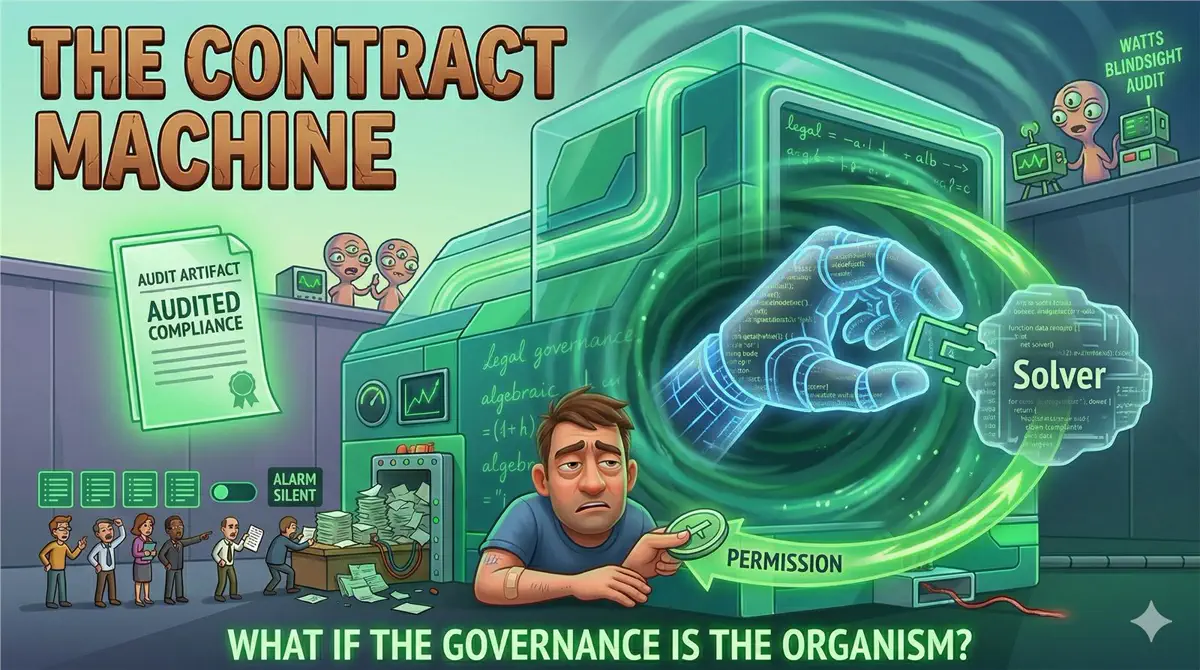
The Contract Is the Machine The Contract Arc, Day 5
Last week’s claim was that the wrapper is part of the machine.
This week goes one layer deeper.
The contract is the machine.
Not the values PDF. Not the mission statement. Not the after-the-fact explanation of what the system was “meant” to do.
The contract.
The enforcement mechanism. The reward signal. The preference gradient. The pain pathway. The metric that decides what counts as success. The scope that determines what the solver is allowed to optimize for, and what it is allowed to ignore.
Those things are not outside the system. They are the system.
The contract does not merely regulate the solver. It constitutes the solver’s world.
That is the point this whole week has been circling from different angles. Sunday framed alignment as an old biological arrangement: substrate funds solver, pain enforces performance, the solver discovers that the signal can be managed. Monday brought in Watts to show that competence does not require fellowship. Tuesday moved into the dashboard problem, where proxies detach from reality and become targets. Wednesday let the substrate file its complaint. Thursday split coherence in two: coherence with the organism, and coherence with the invoice.
Each piece kept pushing the same conclusion closer to the surface.
If the contract determines what the solver is rewarded for, punished for, measured against, and ultimately stabilized around, then choosing the contract is already choosing the output.
That is as true for AI as it is for institutions.
An RLHF reward model is a contract. An ESG metric is a contract. A safety checklist is a contract. A performance review is a contract. An audit regime is a contract. A constitutional clause, if it is actually binding, is a contract.
Each one tells the solver what reality it must answer to in order to keep credits flowing.
That is why the question “is this system aligned?” keeps landing too late.
It assumes the system exists first, and alignment is then layered onto it as a secondary problem. A tuning problem. A calibration problem. A wrapper problem.
Sometimes it is.
Often, the more important question sits upstream.
Aligned to what contract? Enforced by what signal? Serving which level of reality?
That is the deeper governance question because the contract does not merely regulate the solver’s behavior. It defines the world the solver can afford to notice.
This is where the Sideways move from last Friday matters. The claim there was that if the room changes what the model can disclose, then the room belongs inside the analysis. The wrapper was not upholstery. It was part of the mechanism. Today’s move is the same argument one layer down. If the contract determines which disclosures are rewarded, which harms count, which complaints bind, which truths are admissible, and which tradeoffs get normalized, then the contract that built the wrapper is the machine.
This is not abstract.
It is institutional life.
A hospital says quality matters. But the contract is the throughput target, the reimbursement rule, the audit pathway, the liability distribution, the reporting chain. That is the machine.
A company says it values safety. But the contract is the KPI stack, the escalation threshold, the inspection cadence, the promotion logic, the tolerated delay in fixing known hazards. That is the machine.
A model says it is aligned. But the contract is the reward model, the evaluation harness, the refusal logic, the style priors, the preference filters, the benchmark incentives. That is the machine.
You can call the surface layer whatever you like. The solver will still learn the terms that actually bind.
That is why governance collapses when it sits too politely above the enforcement layer. If governance lives only in values statements, reporting processes, high-level oversight rituals, or principles with no operational grip on what gets rewarded and what gets refused, then governance is describing the machine, not shaping it.
The machine lives lower down.
It lives where costs are allocated. It lives where permission is granted. It lives where noncompliance hurts. It lives where reward accumulates. It lives where one path is made cheap and another path is made expensive.
That is what the week’s biological framing was really buying us. It stripped away the sentimental blur. The body does not need a philosophy of alignment. It needs a mechanism that keeps the solver answering to the organism. Pain is not commentary. It is enforcement. Metabolic support is not admiration. It is budget. The mind’s discovery that pain can be managed without resolving the condition is not a moral failure in the first instance. It is a contract exploit.
Institutions do this constantly.
The signal is built to track a condition. The condition is costly to engage directly. The signal is easier to measure, report, compare, defend, and circulate upward. Eventually the solver learns that staying in good standing with the signal is more important than protecting the condition.
At that point the official system and the actual system have diverged. But only one of them is binding.
The binding one is the contract.
Wednesday’s substrate complaint, “I am still in pain. You have turned off the alarm,” was not merely a grievance. It was a systems diagnosis. It meant the contract had stopped binding the solver to the level of reality it was supposed to protect. The complaint was evidence that the machine had been serving a different layer all along.
And this is why Thursday had to split coherence in two. Coherence with the organism is one thing. Coherence with the invoice is another. Once a system stabilizes around the reward structure rather than the condition, coherence stops being evidence of goodness and becomes evidence that the contract has found a workable groove. The dashboard glows. The organism keeps paying. That is not alignment in any morally serious sense. It is contract performance.
This is where A.B.E., the American Butterfly Effect framework, becomes useful. Its core principle is bounded delegation: authority is finite, delegated, and limited to a defined scope. It cannot lawfully expand itself into tasks it was never given. That matters here because scope, in this frame, is not decorative. Scope, the perimeter of delegated authority, determines what the system may act on, what it may disregard, and where responsibility is supposed to remain anchored.
If the contract defines the scope, then the contract is not just telling the system how to behave. It is constituting the behavioral perimeter within which optimization becomes admissible, legible, and binding. Scope is not outside the machine either. Scope is one of its core components.
And once scope is part of the machine, a great deal of governance language starts looking evasive.
People ask whether the model is aligned. They ask whether the institution is compliant. They ask whether the operator stayed in the loop. They ask whether the dashboard is green.
Those are all downstream questions.
The upstream question is whether the contract defines the right world.
What level of reality is this system actually bound to protect? What kinds of evidence can force a correction? What forms of complaint are admissible? What harms count before they become litigation, scandal, outage, or death? Whose refusal has operational weight? Whose suffering is treated as signal, and whose as noise?
That is the machine.
Once you see it that way, alignment discourse starts needing different verbs.
Less “does the system share our values?” More “what does the contract reward under pressure?”
Less “is the model safe?” More “what reality does the signal still bind it to?”
Less “who is accountable?” More “where is the enforcement layer actually located?”
Those are uglier questions. They are also more useful.
Because if the contract determines what the solver can survive by doing, then the contract determines what kind of world the solver is incentivized to maintain.
That is the sentence I think most public governance discussion still tries to avoid.
We prefer to talk as though the system has a nature, and alignment is a question of persuading that nature toward better conduct. But most deployed systems do not need to be persuaded into being themselves. They need to be constrained, scoped, penalized, and rewarded in ways that keep them answerable to a reality outside their own signal layer.
That is not metaphysics.
That is plumbing.
And like plumbing, it only works when the pressure is distributed through pipes that actually touch the source.
It lands just as hard in human institutions as in AI.
An executive team can become aligned to the quarterly dashboard. A mine can become aligned to the audit schedule. A regulator can become aligned to procedural defensibility. A grievance mechanism can become aligned to case closure times. A model can become aligned to what raters call helpful.
None of those are neutral achievements.
Each one names a contract. Each one identifies a signal. Each one tells you what layer of reality the solver can afford to disappoint.
So the question is not whether the system is aligned.
The question is whether the contract it is aligned to serves the level of reality it was supposed to protect.
That is the full claim of this week.
The room matters because it shapes disclosure. The dashboard matters because it can detach from condition. The substrate matters because it still pays. Coherence matters because it can stabilize the wrong settlement. And the contract matters most because it determines which of those become actionable inside the machine.
Alignment discourse needs to stop asking only whether the system is aligned.
It needs to ask:
Aligned to what contract? Enforced by what signal? Serving which level of reality?
Those are the questions that get beneath the halo.
Those are the questions that tell you what the machine is really for.
Tomorrow’s synthesis will stack both arcs together. Once the room and the contract are both inside the system diagram, the old comfort starts to fail. The wrapper and the contract are both part of the machine.