
Liezl Coetzee
Accidental AInthropologist | Human–AI Decision Systems for Social Risk, Accountability & Institutional Memory
April 18, 2026
The song ended with a clean moral and a closed door. Six days later, the door is open, and what was behind it is more complex than the chorus suggested.
That sentence from Sunday’s interlude—“more a personality issue than an AI issue”—turned out to be the fulcrum of the week. The Detection Arc began with a catchy termination anthem and a firing that felt morally tidy. It ended with the recognition that detection without judgment is just surveillance, judgment without architecture is just blame, and architecture without inhabitation is just theater.
This synthesis follows the cable from the first suspicion to the final obligation.
The Throughline
The seam is visible in rhythm before it is visible in evidence, but seeing it early only matters if the institution knows what to do with the suspicion.
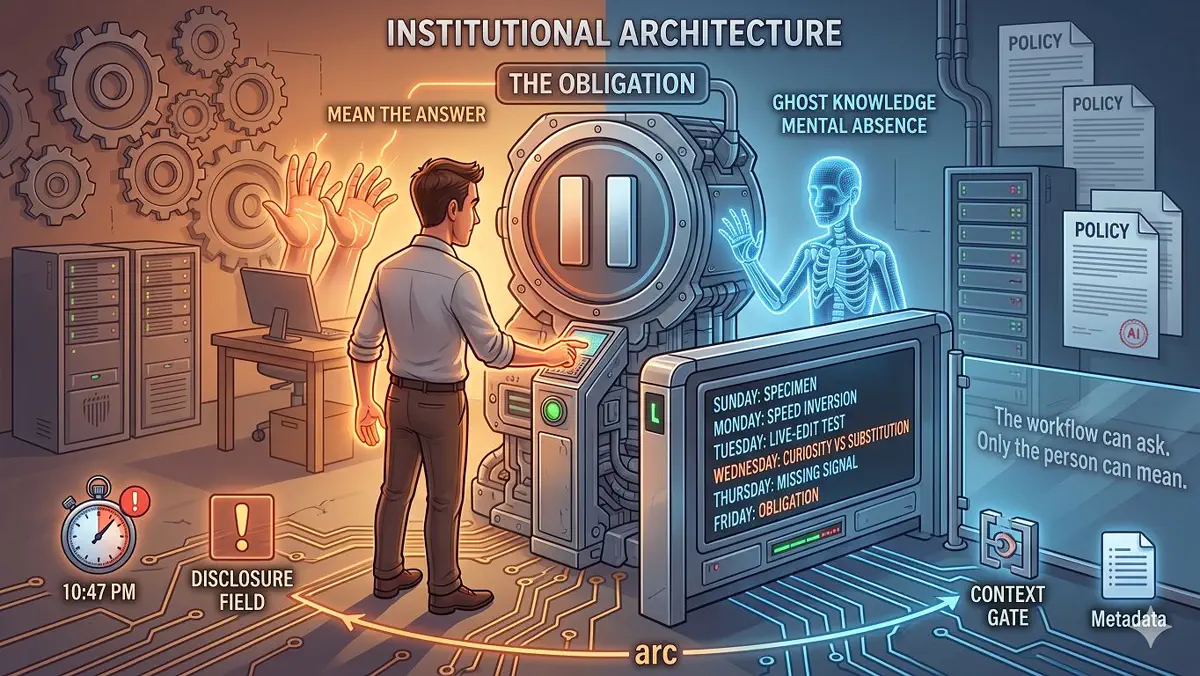
That is the week in one sentence. Sunday provided the specimen: a colleague fired for undisclosed AI use, celebrated in a song written by the same technology that enabled the breach. Monday taught the room to read tempo as evidence—speed inversions that signal the burden has shifted somewhere strange. Tuesday moved from artifact to agency, testing whether the person could navigate the logic live or merely defend the surface. Wednesday introduced the distinction that determines everything: curiosity versus substitution, not as tool use but as relationship to work. Thursday shifted the burden from individual conscience to institutional architecture, arguing that the missing signal must live in the interface, not the policy document. Friday turned back to the person, but now to one standing inside a system that has finally done its work, asking: what excuse remains when the friction is present and you choose to pass through it untouched?
Thread 1: The Specimen — Caught by Your Own Code
Episode 101 · Sunday Interlude
The week opened with a story already concluded. An employee let go for undisclosed AI use, memorialized in a song composed by AI. The irony was noted; the mechanism was not yet unpacked. The tells were specific: speed inversions (hard tasks suspiciously easy, easy tasks strangely hard), the live-edit failure (polished artifact, hesitant author), and the unasked question (why didn’t the tool warn her that uploading private data was a problem?).
The colleague’s final reflection—that this was “more a personality issue than an AI issue”—established the arc’s central distinction. The tool was constant. The relationship to it was the variable. Sunday set up the door the rest of the week would reopen.
Thread 2: Speed Inversion — Reading the Rhythm
Episode 102 · Monday
Before accusation is possible, there is suspicion. Monday mapped how to read it without becoming paranoid. The speed inversion—work that arrives too fast in the wrong places, too slow in the expected ones—reveals a distribution of effort that no longer matches the shape of the task.
The governance challenge is “generous suspicion”: taking the mismatch seriously enough to inquire, openly enough to leave room for legitimate explanation. Institutions often skip from unease to indictment, or from polished output to false reassurance. Monday argued for the middle path—calibration conversations that ask how the work was made before asking whether it was cheating. The goal is observability, not surveillance.
Thread 3: The Live-Edit Test — From Artifact to Agency
Episode 103 · Tuesday
Observation can locate the seam; it cannot tell you whether the person can carry the logic. Tuesday introduced the live-edit test: small, collaborative modifications that reveal whether the worker can navigate the artifact in real time or merely defend a claim to it.
The “defense tax” was named—the cognitive burden of protecting ownership of work you cannot comfortably inhabit. The test is not an interrogation. It is a checkpoint designed to distinguish between possession (a mental model exists, even if imperfectly articulated) and proximity (the artifact is present, the reasoning is not). Tuesday also established that the test belongs in ordinary workflow, not crisis response—making comprehension visible before suspicion hardens.
Thread 4: Curiosity vs. Substitution — The Judgment Layer
Episode 104 · Wednesday
When the live-edit fails, what exactly has failed? Wednesday drew the line that policies typically miss. Two employees can use the same model on the same task and create entirely different professional realities. One uses it to think against; the other uses it to vanish while preserving the appearance of presence.
The “curiosity interview” was proposed: asking not whether a candidate uses AI, but how—where the tool led them astray, where they overrode it, where they remain unsure. Wednesday also established that substitution thrives in cultures that reward polished deliverables over inhabitable method. Organizations get the AI use they deserve.
Thread 5: The Missing Signal — Conscience in the Interface
Episode 105 · Thursday
Thursday shifted the burden from the person to the architecture. The problem is not that the tool lacks conscience; it is that the workflow lacks an interface for the conscience that already exists in the institution. Four friction points were proposed: the disclosure checkpoint (making AI use speakable at submission), the context gate (asking about data ownership before external transmission), the attribution layer (metadata tracking provenance), and the uncomfortable pause (a thirty-second mandatory wait that asks what am I signing my name to?).
The argument: individual conscience is the least reliable component in governance because pressure erodes it first. The institution must build the pause where the pressure is highest, making the right choice easier than the wrong one.
Thread 6: The Obligation That Remains — Inhabitation
Episode 106 · Friday
Friday turned back to the individual, but to one standing inside a system that has done its work. The “compliance surface” was named—the touching of every friction point without inhabiting any of them. Architecture is necessary but insufficient. It creates the conditions for responsible practice; it does not create the practice.
The “residual obligation” is the agreement to treat the friction as meaningful rather than decorative. Friday mapped proportionate consequence: coaching where the system failed, shared responsibility where the culture was ambiguous, and serious response only when the architecture was in place and the person chose not to meet it. The “presence failure”—clicking through every mechanism without being present for any—is a different kind of breach than the one committed by the person who had no architecture to support them.
The week ended where it began, but the door was open. The person who sat alone with the clipboard at 10:47 PM had nothing. The person Friday addresses has friction, disclosure fields, pauses, and culture. Under those conditions, the obligation is clear: when the architecture asks you a question, be present for the answer.
The Detection Arc — Pocket Summary
| Day | Thread | Failure Mode | Governance Question | Anchor |
|---|---|---|---|---|
| Sunday | The Specimen | Concealment as skill | What happens when the tool writes the termination notice? | "Caught by Your Own Code" |
| Monday | Speed Inversion | Metric polish over rhythm | How do we read tempo as evidence without becoming paranoid? | Generous suspicion |
| Tuesday | The Live-Edit Test | Production without navigation | Can the person carry the logic in real time? | The defense tax |
| Wednesday | Curiosity vs. Substitution | Outsourced presence | What kind of relationship to tool use does the culture reward? | The curiosity interview |
| Thursday | The Missing Signal | Absence of conscience in workflow | How do we build the pause where pressure is highest? | Four friction points |
| Friday | The Obligation That Remains | Compliance without inhabitation | What excuse remains when the architecture is present? | Residual obligation |
The Refrain
On Sunday, a song closed the door on a firing with a clean moral: You got caught by your own code. On Monday, the door opened just enough to show that the seam was visible earlier, in the rhythm of work that no longer matched the reality it claimed to represent. On Tuesday, the artifact had to answer back, and the gap between possession and proximity became visible the moment someone asked for a live modification. On Wednesday, the judgment layer arrived, distinguishing between the person who used the tool to extend their thinking and the person who used it to replace their presence while keeping the signature. On Thursday, the burden moved outward, arguing that institutions must stop relying on individual conscience and build the friction into the interface—the disclosure checkpoint, the context gate, the pause—because pressure erodes conscience first. On Friday, the burden returned to the person, but now to one standing inside a system that had done its work, asking: when every friction point was touched but none were inhabited, what failure is this?
The song was confident. The synthesis is not. It recognizes that detection is easy, judgment is hard, architecture is expensive, and inhabitation cannot be mandated. The arc moved from the individual to the institution and back again, finding that both must do their part. The institution must make honesty cheaper than concealment. The person must still choose to mean the answer when the workflow asks the question.
The workflow can ask. Only the person can mean.
The Week in Sound
The Detection Arc carried only one explicit musical artifact—the song that opened it. But that track, Caught by Your Own Code (confident, catchy, morally tidy), functioned as the foil against which the week’s argument developed. By Friday, the song’s confidence read differently. The "borrowed brain" line was not just a clever lyric; it was the diagnostic. The question was never whether the code was borrowed. It was whether the person could still carry the logic once the music stopped.
🎵 Caught by Your Own Code — The Sunday Interlude track. Catchy hip-hop noir. The sound of a verdict already delivered. Watch/listen [blocked]
Explore the Arc
📜 Episode 101: Caught by Your Own Code — Sunday Interlude
📜 Episode 102: Speed Inversion — reading the rhythm
📜 Episode 103: The Live-Edit Test — from artifact to agency
📜 Episode 104: Curiosity vs. Substitution — the judgment layer
📜 Episode 105: The Missing Signal — conscience in the interface
📜 Episode 106: The Obligation That Remains — compliance vs. inhabitation
Next week: If the Detection Arc mapped how to see the seam, the next question is how to repair it while the work continues. Not after the firing. Not in the audit. In the room where the work is still being made.
#SociableSystems #AIGovernance #TheDetectionArc #SaturdaySynthesis #CuriosityVsSubstitution #LiveEditTest #TheAccidentalAInthropologist