

Some truths do not arrive in a form the workflow knows how to score.
They circle. They stall. They ask procedural questions before naming the harm. They trade nouns for safer substitutes. They hand over just enough to route, and hold back just enough to survive. A caller asks what happens after names are given. Another asks whether the case can be resumed later without starting from scratch. Another offers a pattern, not a proof, because proof is what gets people caught. The intake is being asked to do something harder than capture information. It is being asked to make room for self-protective truth.
That is where a grievance mechanism earns its keep or reveals itself as a faster funnel.
The old intake ideal treated completeness as competence. Good call, full fields. Good complaint, named people. Good report, clear allegation, dates, evidence, urgency, desired outcome, contact details. That logic works beautifully on paper and badly on fearful humans. The caller it rewards is the caller least likely to need protection. The caller it screens out is often the one the mechanism exists for.
One whistleblower case says the quiet part out loud almost immediately:
“I need to be careful here. I'm not trying to be difficult. But you're asking me to point fingers at people without protection. Can you tell me first what actually happens after I give you names or roles? Like, will there be an investigation? … people know I've said something.”
That is not reluctance. That is calibration.
The caller is not refusing the mechanism. She is testing whether the mechanism understands the price of being useful to it. Before she gives names or roles, she wants process. Before she gives process, she wants protection. Before she gives protection her trust, she wants to know whether the workflow has a place for someone who cannot afford to sound “cooperative” in the old administrative sense.
And once that line is held, the substance begins to arrive, wrapped in its own safety calculus:
“I don't want to get too specific right now because that could narrow things down to me. But it's health related supplies. The kind we need for our community programs. Different things over time. Not just one item. That's really all I'm comfortable saying at this point. Without knowing more about how this investigation would actually work.”
That is what incomplete truth sounds like when the incompleteness is rational.
The caller is not empty-handed. She has observed discrepancies, overheard conversations, seen stock sheets that do not match what is actually on hand, and located the problem in the site administration side of the organization, with a senior administrator and another staff member close to supplies. The issue has been ongoing since around January. That is already enough to route. It is already enough to justify a discreet look. It is already enough to matter. What it is not enough for is the fantasy of frictionless intake.
Then comes the line that should probably sit at the center of the whole day:
“I think what I've said is enough for now. But I need to know. If I decide to come back with more. Or if there are questions. How would that work? Can I contact you again without starting from scratch? And I need this handled quietly. No surprise visits to the organization.”
That is a grievance mechanism being negotiated in real time.
The caller is setting terms for continued truth. She is asking whether disclosure can be iterative. Whether the mechanism can remember. Whether contact can happen without exposure. Whether investigation means care or spectacle. Whether “follow-up” means a process or a scene. The system’s answer matters because this is the point where trust becomes operational. In this case, the agent does the right thing. It offers a case reference, makes clear that the caller can return without starting over, and leaves the door open for later contact details without demanding them up front.
That willingness to hold partial disclosure is not a soft extra. It is the product.
The GrieVoice hub states that posture in its own words: secure reporting is not a feature, it is the precondition. The anatomy-of-a-grievance visual pinned to that section tries to say the same thing pictorially. A worried voice becomes a trackable record without first having to be dragged through identity disclosure the caller cannot yet afford.
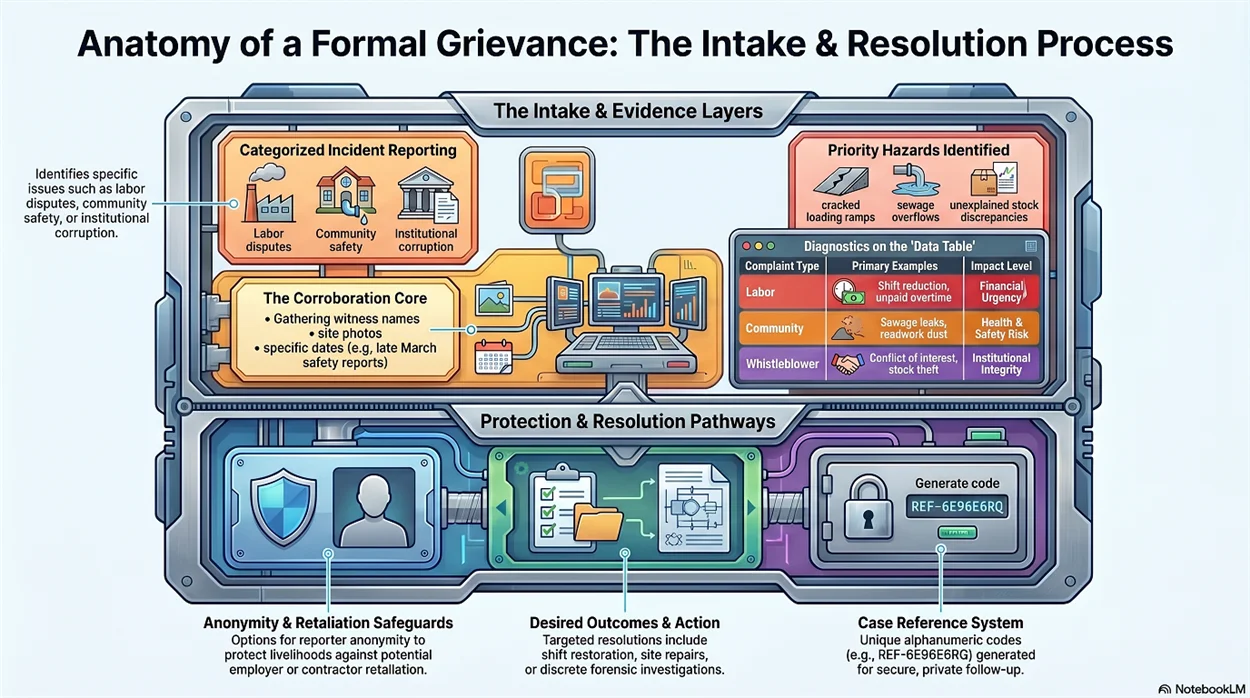
A second whistleblower case, this time at North Shore Housing Services, does the same dance in a slightly different key. The caller describes repeated payments to a company that may be personally connected to someone with approval power. The language is careful all the way through. Two invoices. Similar amounts. Dates close together. February to April. Suspicion without claim to total proof. Limited access to documents. Risk of job loss if the wrong people connect the dots. The allegation arrives in a form already shaped by self-preservation.
The line that matters most is this one:
“I've seen a couple of invoices. Two of them, actually. With similar amounts and they're dated pretty close together. It's been happening between February and April of this year. But I don't have all the documents, so I can't show you everything. What I have seen makes me suspicious. But I'm not saying I have proof of the personal connection. It's more that I know people talk. And things don't add up. I'm limited in what I can access without drawing attention to myself.”
That is not weak testimony. That is corruption testimony in one of its most common real-world forms.
The caller hands the intake a carefully rationed admission: enough to route, not enough to burn. Enough pattern to justify a look, not enough exposure to lose a livelihood. A mechanism that cannot hold that kind of partial, circumstantial, self-protective disclosure cannot receive corruption reports. It can only receive people reckless enough to destroy themselves for administrative neatness.
This is the seam today gets to name.
Conventional intake metrics reward the wrong performance. Completeness of fields captured sounds sensible until you ask what kind of caller can deliver it. The old standard imagines a “good” report as one already translated into institutional grammar: names, dates, roles, documents, urgency, contact details, desired outcome. But the fearful caller often arrives with another sequence entirely: first safety, then process, then maybe role, then maybe pattern, then maybe names, later, if the mechanism proves it knows how not to turn disclosure into punishment.
So the scoring logic has to change.
A good intake is not the one that captures the most fields on turn one. A good intake is the one that keeps the caller speaking without forcing the truth into a shape that endangers the speaker. A good intake makes room for partial disclosure, procedural questions, delayed naming, follow-up by reference number, and the right to come back when safety has improved. In the nonprofit supplies case, the caller explicitly thanks the system for not pushing too hard and says she will return if she finds out more or feels safer sharing details. That is not a gap in the workflow. That is the workflow doing its job.
This is where voice intake earns its keep.
A form can hold an empty required field. A voice agent can hold a frightened person while the field stays empty. That is the difference. The value is not that voice feels modern. The value is that it can negotiate pacing, reassurance, and procedural clarity while the truth is still arriving sideways. The branching path, the anonymity option, the ability to continue by reference instead of starting over, the willingness to accept “health-related supplies” before demanding itemized specifics, all of that is the mechanism. None of it is ornamental.
The clearest click-through version of that machinery is the Privacy & Trust demo on the GrieVoice hub. Anonymization toggles, PII detection, identity decoupling for anonymous reports, and the operational-blackout logic that keeps a callback from outing a caller to a supervisor. The AI Agent Simulator shows the branching side of it: the anonymity option, the continue-by-reference path, the willingness to hold the call open while the caller is still deciding how much to say. Both are the Wednesday argument in clickable form.
And this is where the product question gets more honest.
If the benchmark is completeness on first pass, the best-performing system is the one a cautious whistleblower would never trust. If the benchmark is whether the mechanism can hold incomplete truth long enough for trust to form, the scoring changes completely. A caller who circles before naming the harm is not failing intake. She is showing you the actual cost structure around disclosure. The workflow’s willingness to hold that circling version, without forcing a premature confession or collapsing into vague sympathy, is exactly what is being built.
The lifecycle version of that answer is written down elsewhere too. From Concern to Action walks through what happens between intake and resolution. What the reference number carries. What evidence attaches to it. How a partial disclosure matures into a case without forcing the reporter back to zero. Investigative Framework holds the confidentiality protocol that makes any of this operable: witness protection, identity-decoupled files, evidentiary standards that can metabolize partial admissions instead of rejecting them. Both documents do, in procedural prose, what today's featured call did in live negotiation.
A grievance mechanism earns trust by making room for incomplete truth, not by demanding polished disclosure up front.
Tomorrow the problem sharpens again. The issue will no longer be badly formatted truth. It will be truth split across roles, rooms, and competing loyalties. Who gets heard when the account is no longer singular. Who counts as witness. Who counts as risk. Who counts as the field itself.
Some harms arrive with no field for that. A grievance mechanism proves itself by hearing them anyway.
Explore the Archive
Hub:
https://www.sociable.systems/the-watchdog/grievoice
Intake Process Illustrated
https://www.sociable.systems/watchdog/grievoice/images/anatomy-of-grievance.webp
Demo's
https://www.sociable.systems/the-watchdog/grievoice/demos/privacy-trust
https://www.sociable.systems/the-watchdog/grievoice/demos/ai-agent-simulator
Further Reading
https://www.sociable.systems/the-watchdog/grievoice/docs/from-concern-to-action
https://www.sociable.systems/the-watchdog/grievoice/docs/investigative-framework