
GrieVoice: grievance intake for places where silence is structural.
Multilingual grievance intake infrastructure for worker voice, community reporting, whistleblower channels, and early harm signals in high-risk operating environments.
It is designed as a scoped pilot first: one workflow, clear confidentiality rules, usable evidence, and a practical route from worried voice to trackable record.
Two deployed variants, different contexts
Prefer a quick walkthrough first? Watch the demo video.
Extended intake coverage — labour, broader community grievances, and whistleblower channel. Multilingual foundation including Afrikaans and Setswana; additional South African languages functionally testable at intake-flow level. Gemini-based voice stack.
Original worker-context voice agent. English-first. Emotional-prosody-aware intake, designed for labour grievance capture in operational settings.
The unseen price of reporting
Speaking up — about a broken ramp, a sewage overflow, a missing payslip, a conflict of interest — is rarely a simple act of reporting. It is a high-stakes gamble on livelihood and safety. Where official systems fail, the people who dare to speak often pay first.
Through labor-broker loopholes, a worker who reports a cracked loading ramp can see weekly shifts cut from five to one. No dismissal letter. No paper trail. Just silence and rent due.
A twice-reported sewage overflow affecting fifteen households, children and elderly included, yields a case reference and zero action. The reference number is not a resolution — it is a receipt for being ignored.
Unpaid overtime captured by witness, memory, and the clerk's discretion. Correcting a payslip takes a village. The clerical erosion of wages is rarely a heist — it's a quiet drain.
Invoices approved for connected parties. Stock disappearing from a health-services shelf. The person who sees the inside job carries the evidence AND the risk of exposure — a ruinous combination.
From a worried voice to a trackable record
- 01Intake, in any language the reporter has
The reporter speaks. The agent listens, in English, Afrikaans, Setswana, and an expanding set of South African languages. Voice, WhatsApp message, or USSD menu — whichever channel reaches them.
- 02Structure emerges from narrative
Entities, locations, dates, impact counts and evidence cues are extracted into a structured record. Multilingual identity is preserved. Spelling is verified back with the reporter — the name anchors the legal trail.
- 03Triage, route, reference
The case is categorized by sector (safety / labor / infrastructure / corruption / environmental) and risk tier. A confidential alphanumeric reference is issued — the reporter's only link, their shield, their follow-up key.
- 04Evidence hooks, confidentiality protocols
Photo uploads, witness corroboration, payslip proofs — all tied to the reference. Anonymous reports use identity-decoupled files. Contact rules honour operational blackouts so supervisors do not detect disclosure.
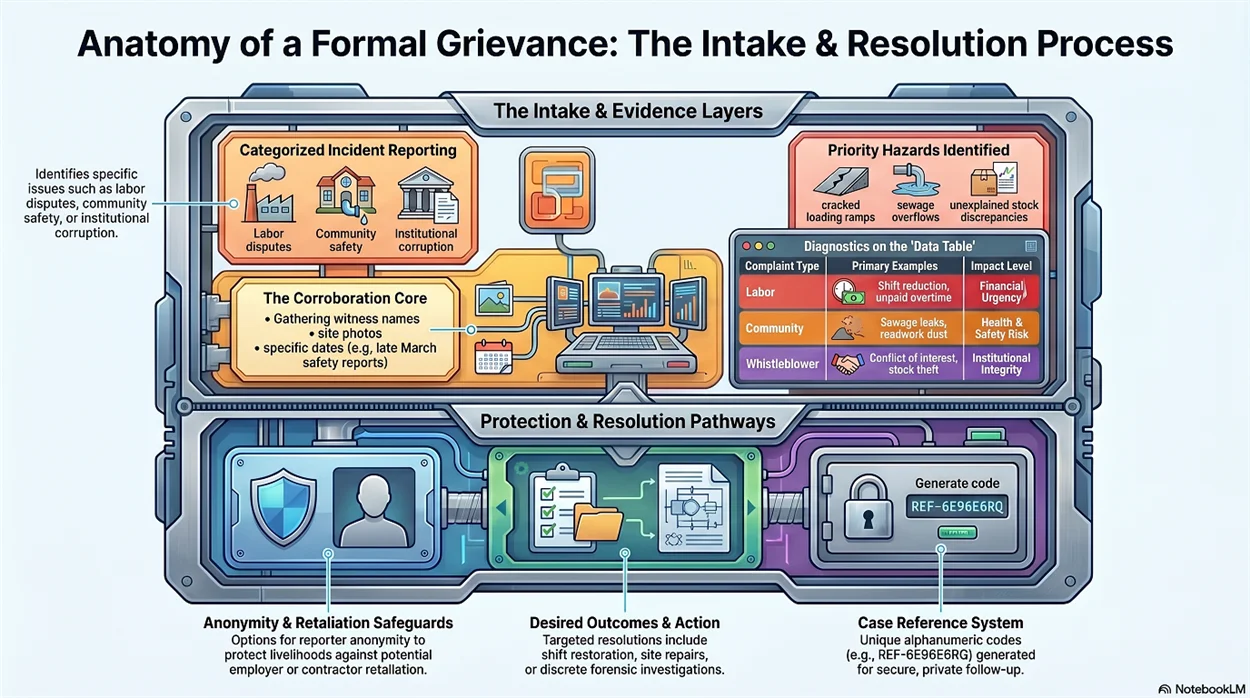
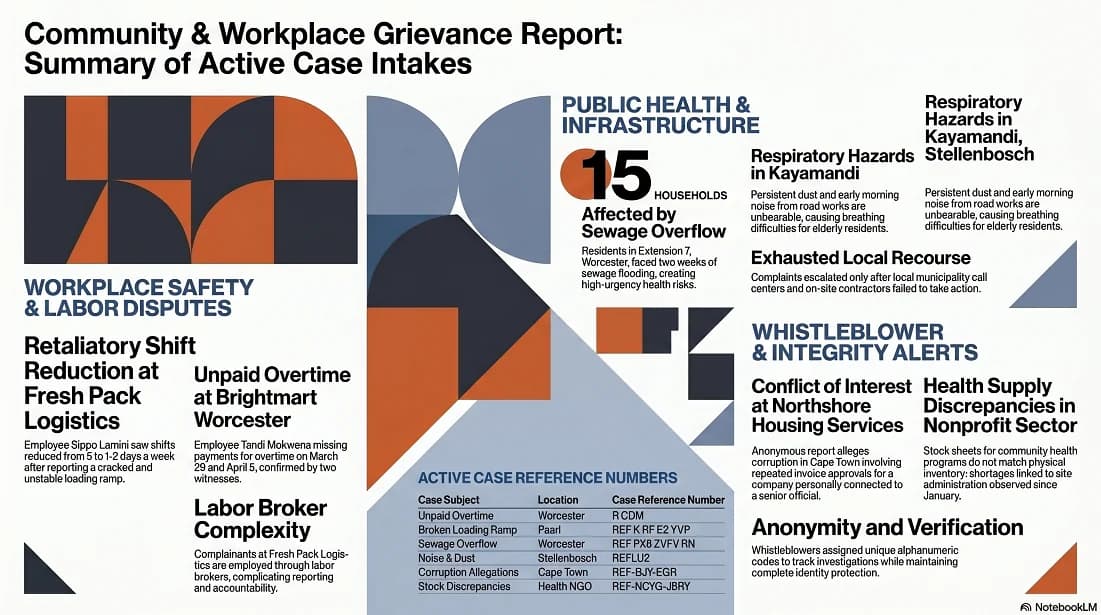
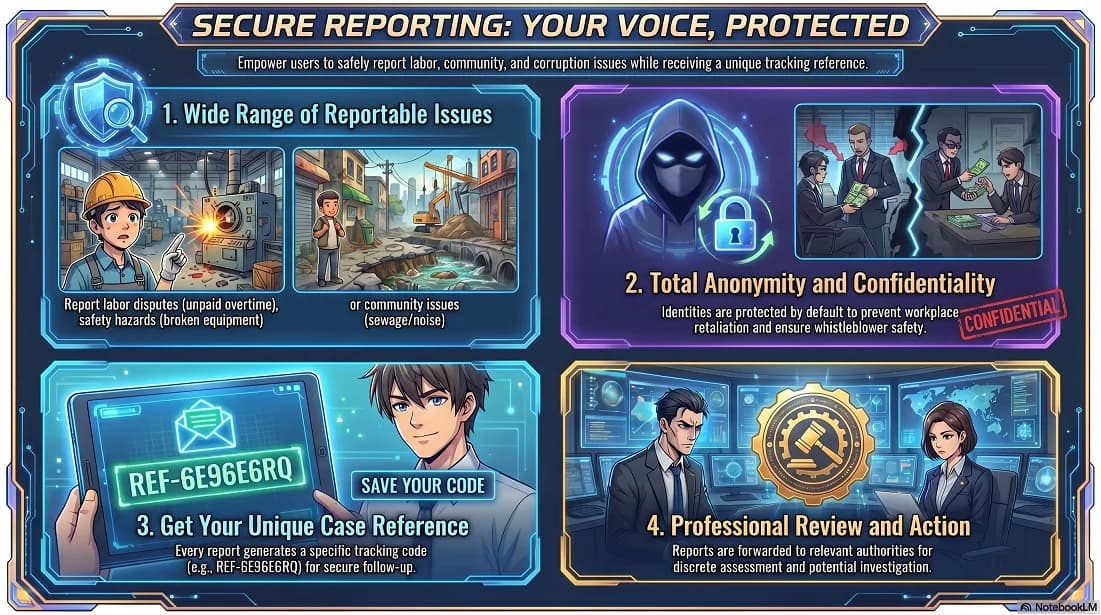
Secure reporting is not a feature. It is the precondition.
Identity decoupling for anonymous reports. Operational-blackout contact windows so supervisors cannot see when the reporter is reached. A labor-broker firewall so protection extends across both the client site and the broker level. Alphanumeric case references that travel instead of names.
These are not polish — they are the reason vulnerable reporters disclose at all.
Not a complaints inbox. Not a smoother dashboard.
The failure mode for any enterprise grievance system is that it produces clean outputs passing for control. The report becomes a category, the category becomes a metric, and the metric becomes the proof that nothing further is required. The original voice is gone before anyone could act on it.
GrieVoice is built backwards from that failure. The original audio, the original language, the reporter's own framing, and the case reference stay locatable after the structured record is generated — not only by management, but by the reporter and by anyone reviewing whether the system kept faith with what was actually said.
A one-page Technical Note your team can read before the call.
Sober, forwardable, peer-level. The architecture in one read for HR, compliance, audit, or operational leaders who need to validate the approach before agreeing to a scoping conversation. Lower the ask before raising it.
Choose the shape closest to your operating reality
Every GrieVoice pilot is scoped to one workflow, one or two languages, and one risk tier. The shape underneath that scope changes by what the organization needs to test first.
One operating site, one workforce language layered on the English baseline. The cleanest first deployment when the priority is testing the architecture under real reporter pressure before scaling.
Two or more sites under shared governance, common risk taxonomy, separate reporting flows. Useful where the audit question is whether the channel works consistently across operational variation.
Replaces or supplements an existing low-volume, low-trust channel with the voice-first multilingual layer. The framing is operational reform, not net-new intake.
Driven by board, audit, or DFI pressure where the institution needs evidence of independent listening before regulators or financiers test the mechanism. The pilot answers an exposure question, not only an operational one.
Request a scoped pilot proposal
Selected with you. labor, community, or whistleblower — whichever is most urgent in your operating context.
English as the mature baseline. One or two selected additional South African languages brought in for pilot-scope testing.
Configuration, live testing, refinement, support during the pilot window, and a findings review with clear next-step recommendations.
Pilot scope typically falls in the $25k–$75k+ range depending on languages, sites, and integration depth — structured as a bounded one-time setup, a monthly platform / support fee, and an agreed usage allowance. Infrastructure costs are manageable at pilot scale — the real cost drivers are implementation, multilingual refinement, support, and workflow complexity.
Request a scoped pilot proposal →What the system does, at a glance
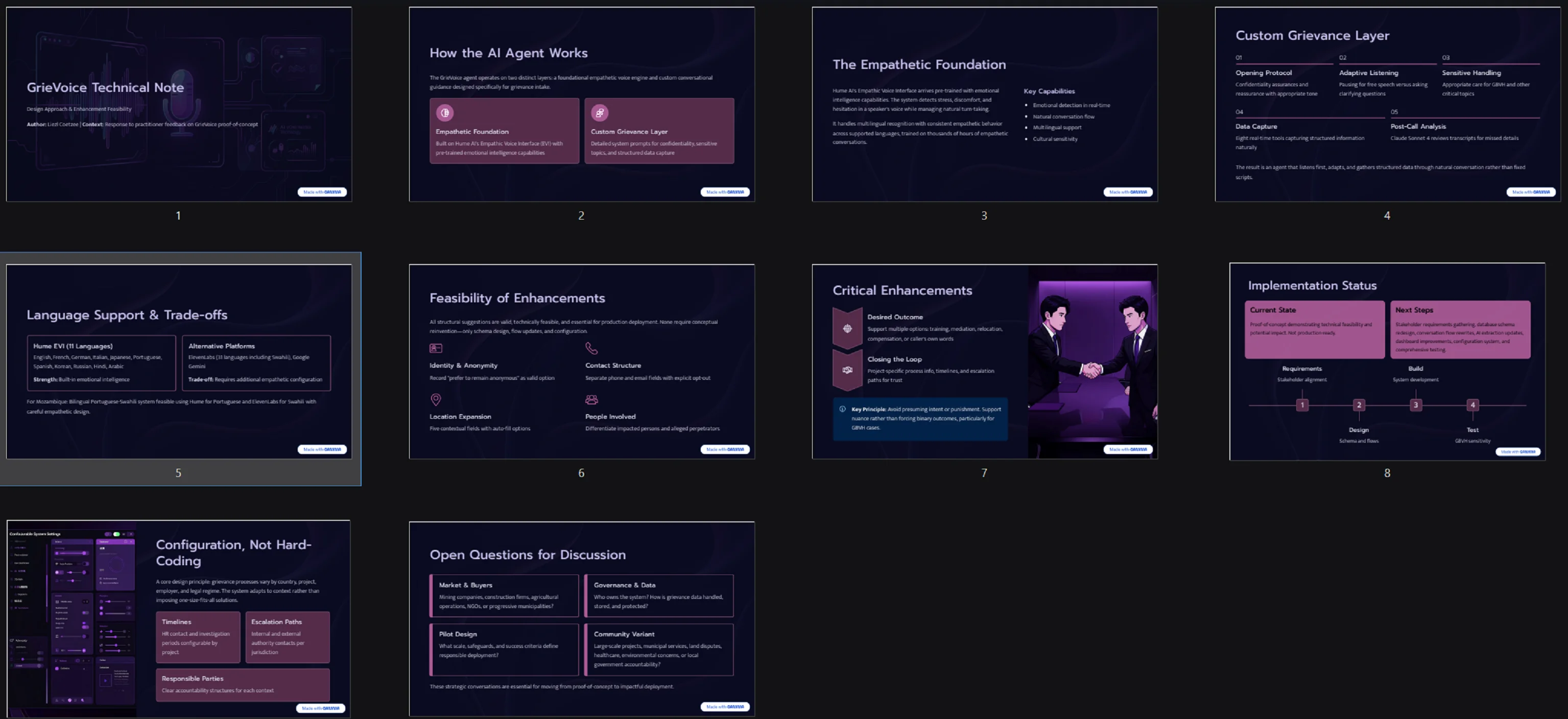
Architecture, integrations, presentation
Landing page — stats, demo grid, architecture overview, channel specs.
Interactive AI voice agent frontpage — the core product demonstration.
System architecture diagram — intake channels, processing layers, outputs.
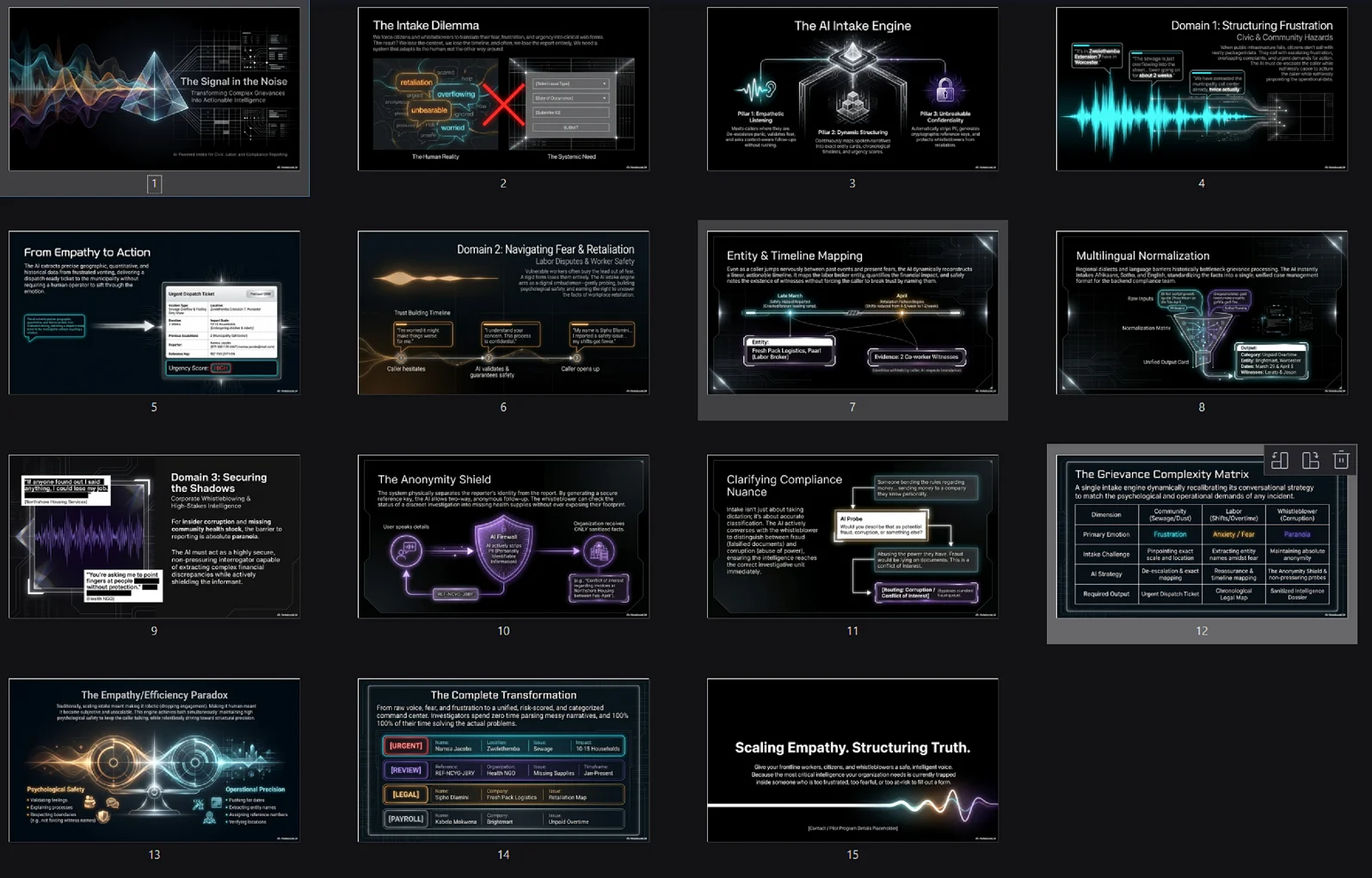
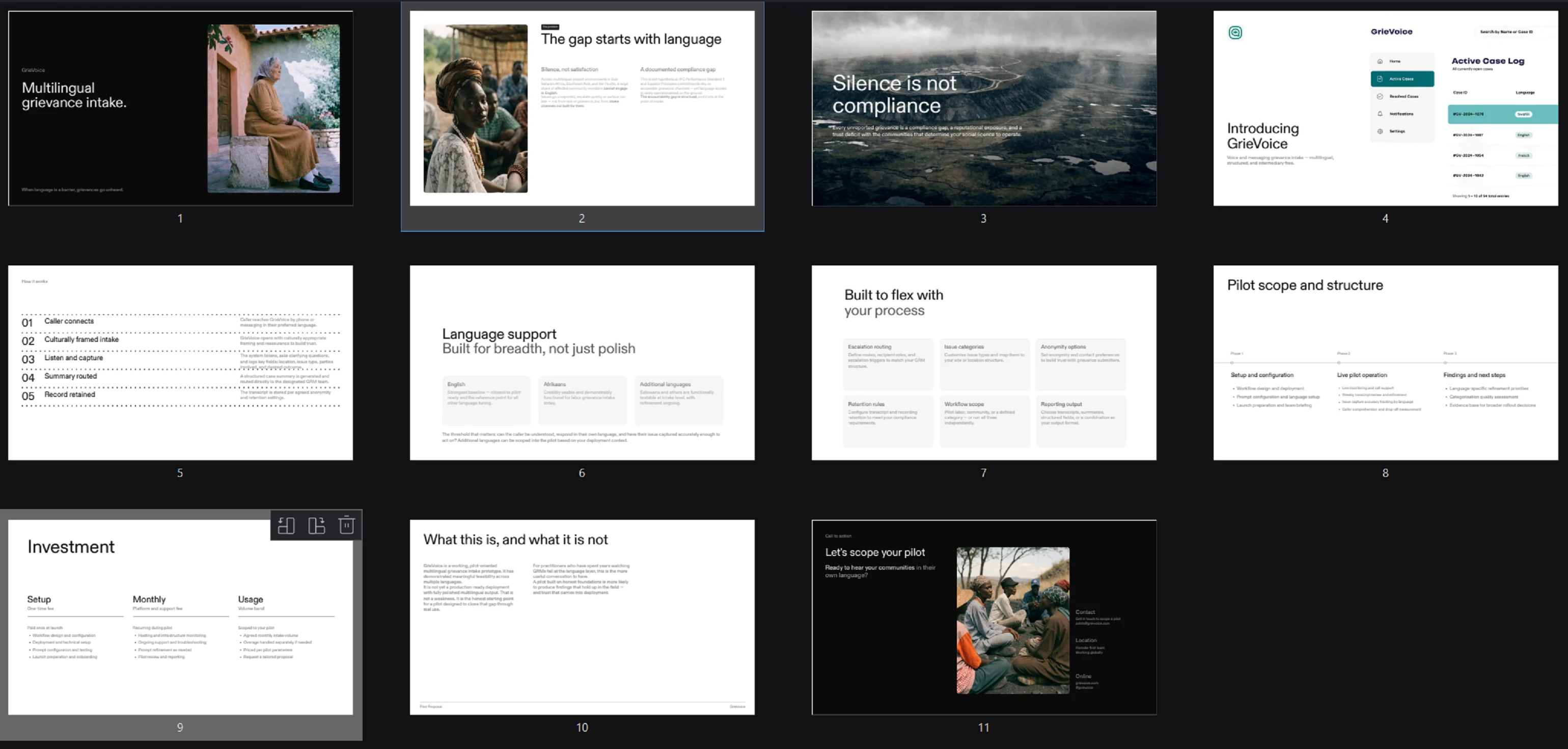
Full presentation deck — problem, solution, architecture, costing, roadmap.
Technical specification for WhatsApp voice-message intake channel.
Technical specification for USSD menu-driven intake — any phone, no data required.
Click-through demonstrations
Simulators, calculators, and walkthroughs — open as standalone pages. Useful to show a prospect what the reporter experience or operator dashboard actually feels like.
Experience what it's like to call in a grievance — mic, transcript, categorization, case reference.
Input workforce size and grievance volume. See projected improvements in accessibility, resolution time, cost.
Six-phase framework with interactive tracking — action items, progress, phase details.
Privacy features in action — anonymization toggles, PII detection, encryption indicators.
Interactive GrieVoice AI agent simulation.
Full interactive AI agent experience.
End-to-end GrieVoice interactive walkthrough.
Compare legacy vs AI-augmented grievance processing side by side.
Comprehensive AI grievance systems presentation.
Technical collateral
- GrieVoice Pilot ProposalPDF
Full pilot scope document — what a bounded engagement looks like, deliverables, timeline, collaboration expectations.
- GrieVoice Technical NotePDF
Architecture and implementation notes — multilingual intake, processing layers, evidence handling, case-reference integrity.
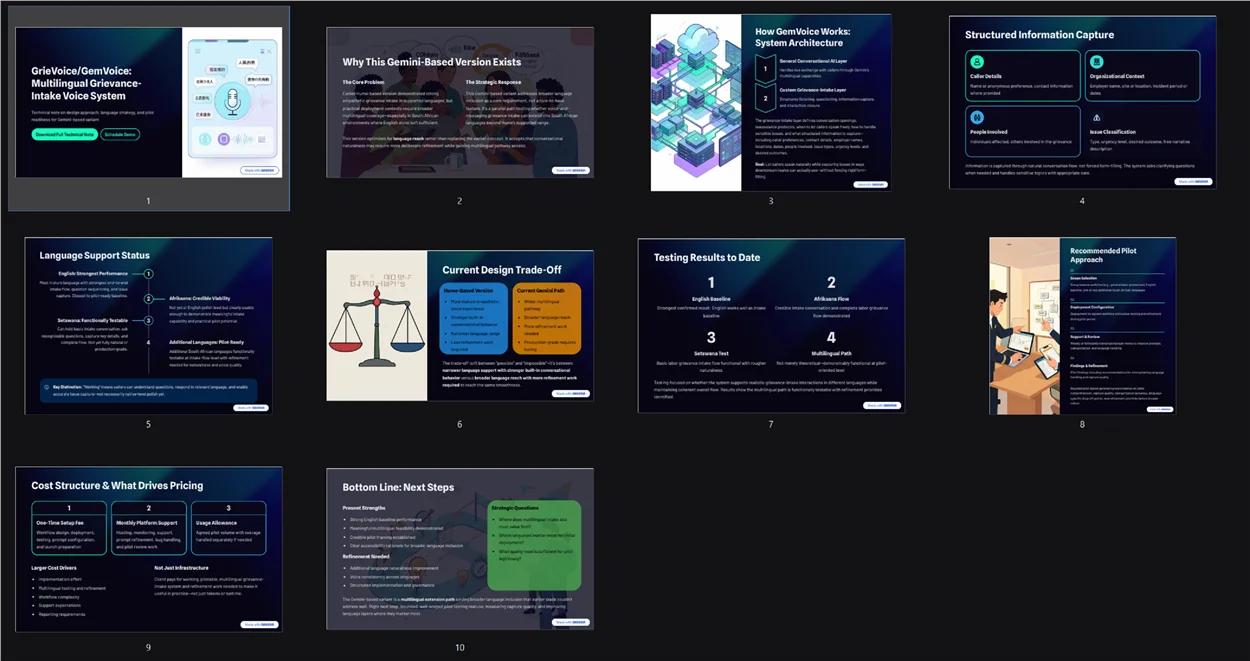
- GrieVoice / GemVoice: Multilingual Grievance Intake Voice SystemPDF
Comprehensive reference — problem framing, architecture, multilingual strategy, deployment considerations.
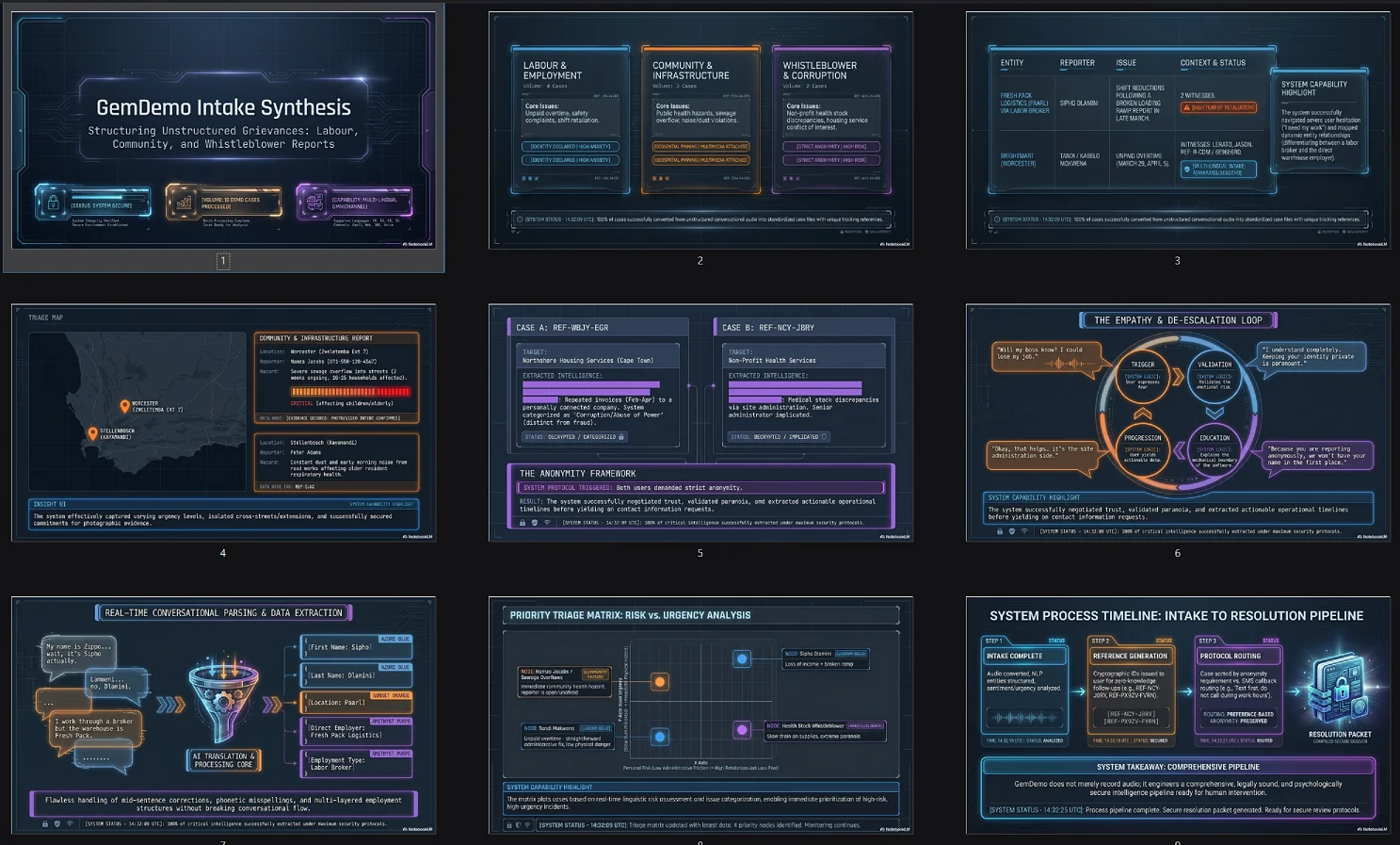
- Intake Intelligence — GemDemoPDF
Demonstration of intake-to-intelligence flow: how raw voice reports become structured, triaged, routable records.
- The Intelligence PrismPDF
Visual and conceptual reference — how multilingual voice inputs refract through the system into structured, multi-sectoral intelligence outputs.
Narrative & protocol
The narrative examples in this section are fictional, synthetic case narratives created for GrieVoice demo testing. They are not real-life case studies and should not be read as reports about identifiable people, households, employers, or projects.
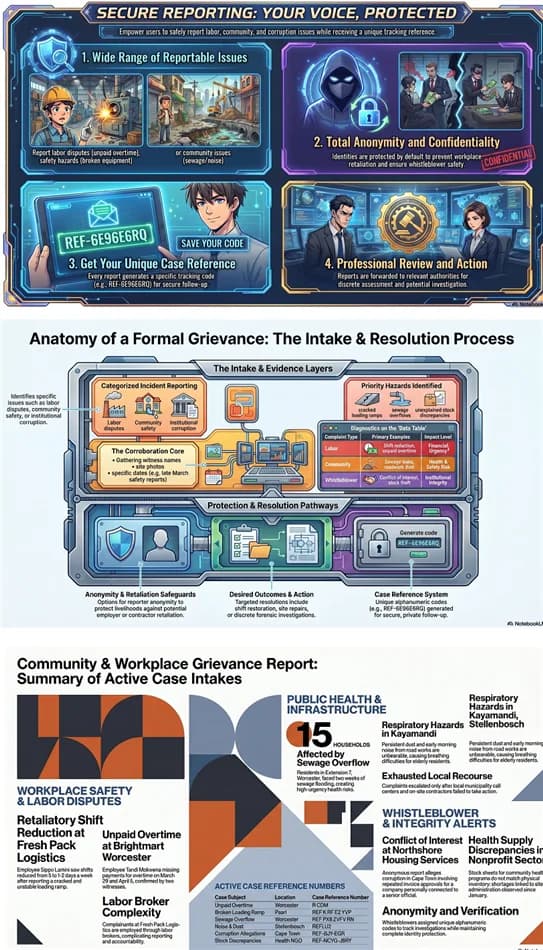
- The High Price of Speaking UpRead
Fictional demo narrative - four synthetic realities used to test GrieVoice scenarios across worker and resident grievance contexts.
- From Concern to ActionRead
Demo walkthrough of a fictional report lifecycle - intake, evidence, entity mapping, urgency triage, case-reference generation.
- Investigative FrameworkRead
Multi-sectoral grievance management and confidentiality protocol — categorisation, triage, witness protection, evidentiary standards.
- GemVoice Technical NoteRead
Design approach, language strategy, and pilot readiness for the Gemini-based variant — why it exists alongside HumeVoice, how the intake layer works, what multilingual coverage looks like in practice.
- Pilot Evaluation ReportRead
Technical audit of GemVoice pilot testing — multilingual entity extraction, prosody performance, case-reference integrity, remediation recommendations.
Start with the intake form. Bring the grievance workflow you want to examine, the languages your workforce or community actually speaks, and the nearest deadline that matters.