
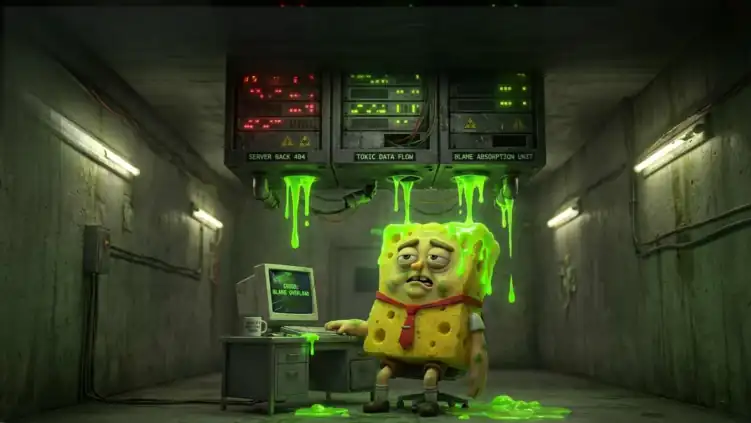
Back to the Sponge, Now at the Contact Surface
Track: PD Point-of-Contact (138 BPM, A minor → C major, "discovery rather than instruction") Video: https://youtu.be/nbzbq9JOYmM Status: Draft v1
Companion materials:
- The Liability Sponge training module
- Humans in the H∞P foundation
- Social Impact & M&E training track
Back in January, Episode 2: The Liability Sponge named the trap: when a human is placed inside a high-velocity algorithmic process without the time, evidence, or authority to govern it, the human is not a control. The human is the place where liability lands.
That piece was written from the safety-system side of the problem. Stop Work Authority versus Human in the Loop. Real control versus control theatre. The tired reviewer at the end of the machine-speed firehose.
This is a return to the same object with more architecture around it. The Sponge has shown up again since then: in Episode 14's human-in-the-loop revisit, Episode 22's H∞P scaling problem, and Episode 39's Red Shirt Problem. Each pass added a layer. January named the blame-absorption device. This one asks what has to replace it: not a better signature, not a louder policy, but a changed posture at the contact surface where decisions are still forming.
So yes, today the architecture being replaced already has a name.
The track opens on it directly.
In the architecture of control The sponge takes every hit Judgment parked at runtime Too late to matter, too late to quit
The Liability Sponge is the configuration in which the human's job is to absorb consequence after the fact. The signature happens. The decision is logged. The reviewer attests. The system runs at the speed it was always going to run at, and the human's contribution is converted into the form the institution can bill to a person if anything later breaks.
The Sponge is not always a single individual. Sometimes it is a team of compliance reviewers sampling 5% of decisions on a quarterly basis. Sometimes it is an outside auditor reading the model's confidence scores six weeks after a portfolio has been rebalanced. Sometimes it is the procurement officer signing the year-end attestation that all 2,400 vendor classifications were appropriately reviewed. The institutional version of the Sponge can be enormous; the operational property is the same. Judgment is parked downstream, where speed is no longer the constraint, where the reality the decision shaped has already finished forming.
By the time the Sponge gets the file, the file is the only artifact left. The texture of the moment the decision was made is gone. The model's working confidence has hardened into a final number. The contestable middle has resolved into an executed outcome. The version the system kept is what the Sponge sees. The version the system discarded was never theirs to evaluate.
That is the structure. The Sponge takes every hit because the Sponge is the position the institution designed to hold the hits. The decision-shaping happens upstream of the position. The accountability lands inside it.
For teams that need to turn the diagnosis into a working exercise, the Liability Sponge training module turns this structure into a liability map, stop-work threshold, and human-authority checklist.
The Signature as Theatre
The lyric continues into the second movement of the diagnosis.
"Human in the loop" keeps looping back A label without grip Logs go quiet, questions wait While risk slips through the slip
Once the Sponge is in place, the institution acquires a particular kind of paperwork. Override logs that rarely log anything. Question fields that rarely receive questions. Approval workflows whose approval rates are statistically indistinguishable from automatic acceptance. The architecture is producing the signatures it was built to produce. The signatures are no longer producing the judgment they were procured to represent.
Theatre is the right word. The signature is a performed gesture. It carries the institutional meaning of judgment in a form the regulator will accept as evidence that judgment occurred. Both parties to the ritual know what the ritual is. Both parties continue to perform it because the performance is the property the architecture demands. Judgment, as a separate operational property, has slipped out of the gesture's centre and survived only at its edge.
The override log is the artifact most clearly diagnostic of this state. A real override log is messy. People override systems for unpredictable reasons. They catch errors that turn out to be edge cases. They slow workflows because something feels wrong. They escalate decisions that the rule book did not anticipate. A real override log accumulates the texture of human judgment under real conditions. An empty override log, in a high-volume system, indicates that the surface where judgment was supposed to live has gone unused. Risk slips through the slip because the slip itself has stopped functioning as a contestation surface.
The Wall of Paper
The third diagnostic phrase carries the institutional architecture that holds all this in place.
The control environment is constructed of policies, procedures, attestations, certifications, audit trails, governance committees, escalation paths, and signed acknowledgements. Each piece is real. Each piece took drafting effort, legal review, and stakeholder sign-off to produce. The wall is genuinely there. It is also, structurally, a wall of paper.
Paper has specific properties. It captures what a process was supposed to produce, in a form an inspector can review. The form is durable, transferable, and inspectable. The form is also separate from the process it records. A document that says decisions were appropriately reviewed satisfies the regulator who reads it. The decisions themselves continue to be made at whatever quality the actual review-architecture produced — which, in the Sponge configuration, is the quality of the speed-mismatch between machine action and human attention.
A control environment that works only on paper is the institutional version of the Sponge. The institution buys the appearance of a control environment by purchasing the documentation of one. The architecture of control gets built, and verified, and audited, and renewed, all in the medium of paper. The decisions the documents are supposed to be controlling continue to happen at the speed and in the manner they would have happened anyway. The wall stands. The risk passes through.
The Sponge takes the hit when the slip becomes visible. The wall takes no hit at all, because no part of the wall was ever in the path of the decision.
Change the Posture
The track's pivot is precise.
But change the posture Not authority Alignment
What changes is how the human shows up at the contact surface. The legal authorization framework of most institutions is already adequate; the change is operational rather than legal. Posture is the right word because what moves is the human's body and attention. The body that signs the form moves to the room where the form is being filled out.
Value lives at contact Where intent and context meet Dialogue beats override Every time, every beat
The lyric carries the operational rule. Value is generated at the contact surface, where the human's intent meets the system's context in real time. The institution that wants the value has to put the human at the contact surface. The institution that puts the human downstream of the contact surface has structurally chosen the Sponge architecture, regardless of the volume of paperwork the choice generates.
Dialogue beats override because dialogue is continuous and override is rare. A human in posture spends most of the encounter asking the system what it is doing and why. The system spends most of the encounter explaining itself in terms the human can engage with. The override action becomes structurally unnecessary because the issues an override would have caught get caught before they require an override. The work of the partnership shifts from end-state catching to formation-stage shaping.
What changes when the posture changes is the location of the human's attention. The institution still has its policies, its attestations, its audit trails. The compliance officer is still credentialed, the procurement signature still required, the quarterly review still scheduled. The architecture of paper survives the posture change. The change is additive: the human at the contact surface joins the paper.
The Sponge stops absorbing because the contact surface stops generating the kind of decisions the Sponge was built to absorb. The signatures continue, with substance behind them. The wall of paper remains, with the actual property it claims to deliver now produced in the room where decisions are made.
The posture change is the first motion the architecture needs.
The wider training architecture for this posture lives in Humans in the H∞P: live stewardship, stop-work authority, audit-grade traceability, and responsibility matched by real control. For field evidence, social research, grievance material, and M&E workflows, the same move is developed in the Social Impact & M&E track.