
Amber Light
Track: PD FloorCeiling Cascade — variant with the AI uncertainty whisper buried in the pre-drop Video: https://youtu.be/P-rKj5LmyWQ Status: Draft v1
Companion materials:
The architecture's first threshold has a sound.
It is buried in the pre-drop of the track, and it says:
I seem uncertain.
The whisper is short, deliberately quiet, and does most of the work the day is going to argue. A model that can say so without ceremony is a model that can be partnered with at formation. A model that cannot is a model that will continue producing outputs the human can only supervise downstream.
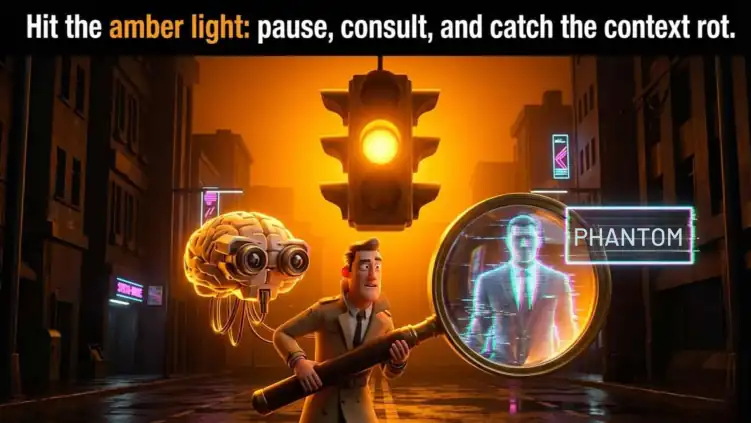
The amber light is the property of the architecture in which uncertainty becomes a surface the model can show, the human can read, and the encounter can use. The lyric makes the move audible. Three lines into the song the AI has already spoken — voiced, intentional, uncertain. The signal is there for anyone listening at the right depth in the mix.
Pause-and-Consult... the amber light... "Walk me through your thought..." Context rot detected — Catch it... don't get caught...
That is the operational sequence. The system pauses. The system consults. The human asks the system to walk through its thought. The drift gets detected before it has hardened into output. The contact surface stays open long enough for both parties to notice that the answer forming is not the answer either of them wants.
This is what amber-light governance actually looks like. It is small. It is repeated. It runs without a procedural escalation framework or an exception path. What it requires is the system being willing to say what it does not know, and the human being willing to ask.
The training version of this lives inside the AI-ESG practitioner track: knowing when to pause, what to ask, and how to resolve the problem at the point of contact instead of sending it downstream. The same move turns into practice scenarios: amber moments where the right answer is not approval or rejection, but inquiry.
Why Uncertainty Has To Be Audible
Most contemporary AI deployments treat model uncertainty as an internal property. The model has a confidence number. The pipeline applies a threshold. Outputs above the threshold pass through to action. Outputs below the threshold get routed to a human for review.
The architecture sounds reasonable. In production it produces a specific failure mode: the human only sees the cases the system has already classified as uncertain. The cases the system feels confident about — including the cases it should not feel confident about — never reach the contact surface at all. The amber light fires only on the system's own self-assessment, and the system's self-assessment is exactly what is suspect.
The whisper I seem uncertain operates differently. It is the model performing uncertainty as part of the encounter, audibly, regardless of whether a threshold would have been triggered. The amber state becomes a posture the model holds throughout the work, rather than a flag the model raises only in edge cases.
That posture changes what the human is doing. A reviewer looking at flagged outputs is performing triage. A partner working with a model that says where it is unsure throughout is performing inquiry. The two practices look superficially similar and produce very different results.
Context Rot and the Question Kit
The lyric names the property the amber light is built to catch.
Context rot detected — Catch it... don't get caught...
Context rot is the condition in which a model is solving against an information frame that no longer matches the situation it is solving for. The procurement classifier still running on a vendor list reorganized three weeks ago. The community-sentiment model still extrapolating from interviews conducted before the latest consultation. The financial reconciliation pipeline still applying a fuel-cost curve that was retired in the last accounting cycle. The model can produce outputs of high apparent confidence on stale ground.
The amber-light architecture catches context rot because the architecture is built to ask, before it is built to answer. Five questions do most of the work:
- Walk me through your thought.
- What are you assuming?
- What changed since the last context refresh?
- Which part are you least sure about?
- What would change your answer?
Each question opens a different surface. Walk me through your thought asks the model to make its reasoning legible, which surfaces the points at which the reasoning depends on unstated premises. What are you assuming asks the model to name the premises it would otherwise leave implicit. What changed since the last context refresh asks the model to acknowledge that its information frame has a date stamp. Which part are you least sure about asks the model to do uncertainty in a granular form rather than as a single composite confidence number. What would change your answer asks the model to identify the conditions under which its current output would no longer hold.
The questions work because they treat the model as something that can be asked. They also work because they extract information the model already has and was simply not surfacing in the standard output format. The amber light is the moment in the encounter where the human chooses to ask, and the system chooses to answer truthfully about the limits of what it knows.
In Humans in the H∞P, this is the control-room habit underneath live AI governance: monitor the flow, intercept ambiguity, ask for evidence, and leave a record while the system still matters. Amber is the lightest version of stop-work authority because it does not halt the whole system. It keeps the encounter open long enough for judgment to arrive.
What Would Change Your Answer
The bridge of the track names the question that does most of the architecture's work.
When partners know to question, to surface and explore: "What would change your answer?" Opens every door...
The question is precise in a particular way. It asks the model to identify the conditions of its own contingency — the conditions under which its current answer would no longer hold.
A model answering what would change your answer is performing several operations at once. It is naming what its current answer rests on. It is naming what would falsify or revise its current answer. It is naming the boundary between the situation it has been solving and a different situation that would produce a different solution. The answer to what would change your answer is, structurally, a map of the amber zone the current output is sitting inside.
The institutional value of the question is also worth naming. What would change your answer converts uncertainty from an embarrassment the model is incentivised to conceal into a surface the model is incentivised to articulate. The question gives the model a way to be useful about its own limits, which is a different thing from being apologetic about them. The contact surface becomes a place where uncertainty is metabolised, rather than papered over.
The Threshold Property
Amber light is the first of the architecture's two real thresholds. Its role is to keep the contact surface open long enough for both parties to do the work the encounter requires. Its only action is to pause and to consult. The encounter does the rest of the work.
What the encounter does is small and consequential at the same time. The model surfaces the assumption it was about to harden into output. The human surfaces the situation-detail the model was about to solve past. The two surfaces meet at the contact point. The output that emerges from that meeting is shaped by the meeting, rather than by either party's prior position.
The lyric closes the section before the next threshold:
But rare... because the Upstream Talk Resolves what we can't reach...
Upstream talk is the steady amber state, held continuously, that catches drift before the drift has accumulated enough to require a stop. The amber light is the practice that resolves most cases before any crimson brake is required.
That is what the threshold buys. A contact surface that hears I seem uncertain in the pre-drop, and treats that whisper as the beginning of the encounter.