
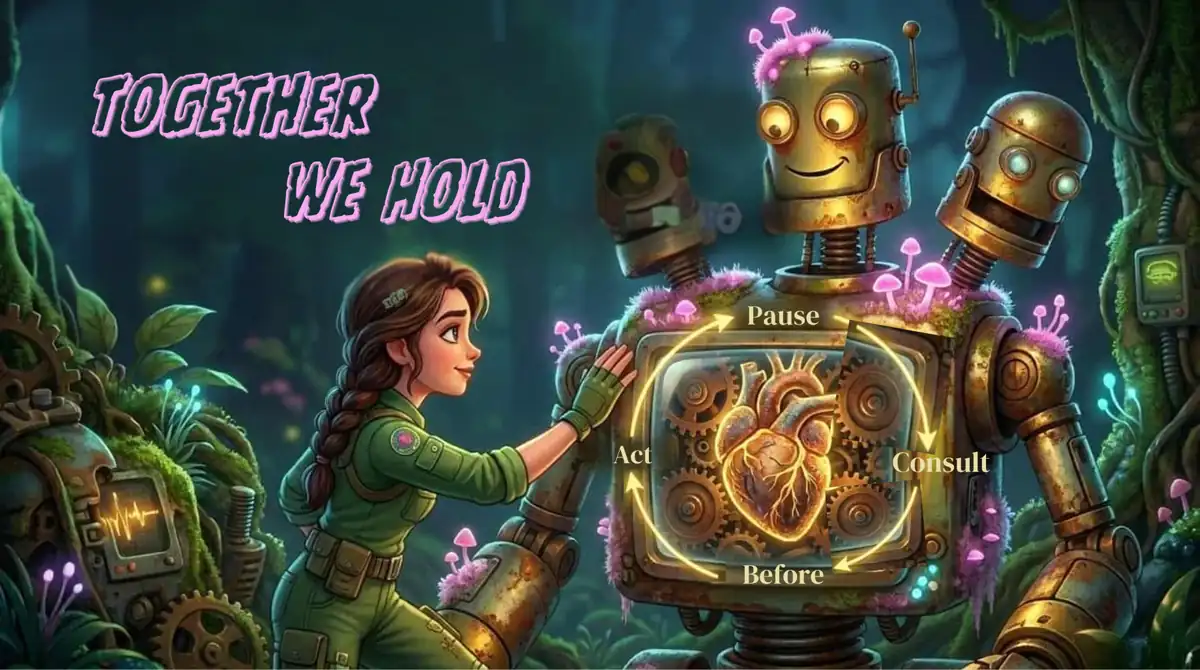
Together We Hold
Track: PD Forest Protocol (146 to 148 BPM, F minor), bare ritualistic chant, "predation without cruelty... systems that survive because they listen" Status: Redraft v2
Companion materials:
Today's Forest Protocol variation of the Partnership Dividend track is sparse, and the sparseness is the argument.
The lyric strips the partnership-dividend material down to the minimum that will still carry the meaning. Single words. Short pairs. No verses, no anthemic full-band drops, no melodic resolution. What remains is a chant the track sustains without elaborating, because the form the chant takes is itself the property the day is naming.
Contact
Too late downstream
Absorbing blame
Meaning forms at contact
That is the diagnostic and the pivot in eight lines. Sponge territory carried in three words. The pivot in the fourth. Then the operational sequence the architecture rests on:
Pause Consult Before Act
Show me how you know
The rhythm matters. Each word arrives discrete, with space around it, and the space is where the listener, partner, or system has to do the work the chant assumes will get done.
The work of governance, in this version of the architecture, lives in the steady rhythm of attention paid in common. The chant assumes that work gets done in the spaces between the words.
Together We Hold What Alone We Miss
The line that names the architecture is short.
Together we hold What alone we miss
It is also one of the song's most operationally specific claims. The Forest Protocol is not making a soft claim about teamwork. It is naming an attention architecture. A system paying attention through many forms of notice catches what any single notice channel would miss on its own.
The pluralization of attention is load-bearing. The architecture has structurally assumed it.
What does paying attention together actually look like? It is not a headcount. It is not a rule that three people must sit in a room every time a model produces an output. It is not a decorative committee added after the fact so the workflow can claim to have involved humans.
It is an architecture that allows different kinds of notice to reach the same artifact before the artifact hardens.
Operational notice. Contextual notice. Evidentiary notice. Ethical notice. Local notice. Technical notice. A rustle in the pattern. A pause in the caller's voice. A mismatch between the confidence score and the situation. A phrase that feels too clean. A missing context refresh. A procurement anomaly that looks harmless until someone remembers the vendor list was reorganized three weeks ago. A social-impact summary that sounds tidy because it has quietly sanded off the community's uncertainty.
No single signal holds the whole truth. No single role can hold every kind of risk at once. The holding is collective because the risk surface is collective.
That is what the Forest Protocol abstracts beyond any one meeting room. The track gives us a living system: many small signals, sensed together, none sufficient alone, collectively strong enough to change the path. Together does not mean more eyes as ornament. Together means the artifact remains open while different forms of attention can still affect its shape.
Most institutional review architecture is structurally serialized. A document moves from one reviewer to the next. Each reviewer reviews in isolation. The document accumulates approvals. The architecture is efficient at processing volume. It is also efficient at producing the failure mode in which a slip that no single reviewer could catch alone passes through every checkpoint, because every checkpoint is still only a single reading.
Distributed attention and serialized attention produce different artifacts.
The forest version of attention is parallel, but parallel does not have to mean everyone physically gathered around the same table. It means the architecture allows different attention functions to meet before the output becomes record, action, or downstream obligation.
Sometimes that is a live review. Sometimes it is a structured pause. Sometimes it is a challenge protocol that forces the model, the user, and the workflow to surface what each would otherwise smooth past. Sometimes it is a role design that prevents operations, assurance, field knowledge, and evidentiary discipline from being collapsed into one exhausted reviewer at the end of the chain.
What matters is simultaneity at the governance surface. The artifact remains open while different forms of attention can still matter.
That is what the lyric's together we hold is naming. A practice. A small one. A consequential one. The together is structural before it is social.
The role architecture behind this is already sketched in Humans in the H∞P: control room operators, operations leads, workflow governors, assurance, robopsychology, and AINthropology are different attention functions, not decorative job titles. The point is not to multiply reviewers. The point is to stop pretending one reviewer, one dashboard, or one procedural checkpoint can hold every kind of risk at once.
Alignment and Attention
The chant lifts here.
Not control But alignment Not trust But attention
Together we hold What alone we miss
The four-line build is the track's clearest theoretical statement. Two refusals, two alternatives, one collective claim.
The refusals deserve dwelling on. Control and trust are the two postures contemporary AI deployment most often defaults to.
The institution that wants to manage its AI deployments with control builds elaborate procedural overlays: committees, certifications, approval flows, audit trails, and the familiar wall of paper that stands while decisions keep passing through. Control performs governance by surrounding the system with documentation. The paperwork may be necessary. It is rarely sufficient.
The institution that wants to manage its AI deployments with trust outsources judgment to whichever model has been credentialed by whichever third party. Trust performs governance by treating prior approval as present attention. The system is assumed to be safe enough because it has passed through someone else's confidence apparatus.
Both postures can fail at the contact surface.
Control can arrive too late. Trust can arrive too early. Control can overbuild the exterior while leaving the moment of decision under-inhabited. Trust can smooth over uncertainty before anyone has had to ask what is being trusted, by whom, against what evidence, and under what conditions.
Alignment is what control becomes when the architecture is honest about the speed difference between machine action and human review. Alignment does not mean the system becomes obedient in the abstract. It means the work is positioned so intent, context, evidence, and authority can meet before the decision has hardened.
Attention is what trust becomes when the architecture is honest about the limits of any single reader. Attention does not mean faith in the model. It means continued contact with the artifact while it is still open to correction.
Both alternatives operate at the contact surface, in real time, in the encounter. Both alternatives compose into the centerline:
Together we hold What alone we miss
Alignment held in common. Attention paid in plural. That is the architecture the track is naming.
Stop the Line, Rare Event, Upstream Talk
The brake belongs in this frame.
Stop the line Not too late Rare event Upstream talk
The lyric carries the brake's operational truth in four lines. The system can stop the line. The stop is not too late, because attention has been working upstream of the moment a stop becomes mandatory. The stop is rare, because upstream talk has been continuous and has resolved most of what would otherwise require a stop.
The stop, when it comes, is the natural edge of an attention practice that has been holding throughout.
The architecture's brake is the moment collective attention crosses a threshold and the system can name why an output, action, or workflow should not proceed. Its legitimacy comes from the attention that preceded it. A stop that appears from nowhere lands as interruption. A stop that emerges from ongoing attention lands as the formal expression of a condition the system has already been tracking.
This distinction matters because refusal is easy to romanticize. Stop-the-line language can become its own theater if the organization has not built the ordinary practice beneath it. A dramatic brake with no upstream attention is just a red button bolted onto a room nobody has learned how to inhabit.
The brake is rare because dense upstream attention resolves most cases before any brake needs to fire. The system handles drift continuously, in the encounter. It asks earlier. It pauses earlier. It consults earlier. It catches context rot before the rotting answer hardens into output. By the time a stop would have been mandatory, the practice has usually already absorbed the situation.
That is where Refusal as Architecture becomes practical rather than dramatic. Refusal is not the first move. It is the narrow negative power that remains available when continuation has become unsafe and the system can say why.
The AI-ESG practitioner track is useful here because it generates practice for the ladder beneath the brake: proceed, pause, consult, stop, and escalate with evidence rather than vibe. The brake has standing because the lower rungs have been used. The stop has legitimacy because attention has already been doing the work.
What the Threshold Buys
The track ends as it began.
Contact
Single word, held briefly, allowed to fade. The chant returns to its origin point and stops without ornament. What remains, after the lyric has done its work, is the form of the practice the lyric was naming: spare, ritualistic, repeated, plural.
The Forest Protocol gives that practice an ecological shape. A system survives because it listens. Intelligence is distributed across many small signals. Partnership is not agreement. It is shared attention under conditions where no single participant, role, or signal can hold the whole field.
That is why the brake sits near the edge of the track, where it belongs in a practice built on dense upstream attention. The day is for the practice that makes the brake rare. The brake is the natural edge of that practice, and it earns its legitimacy from the practice's continuous form.
What the threshold buys is the legitimacy of the stop when the stop is needed, and the rarity of the stop when the attention is doing its work.
Both properties live in the same practice.
Both are what collective attention generates when an institution has built the room for it.
Together we hold what alone we miss.
That is not the moral of the track.
It is the architecture.