
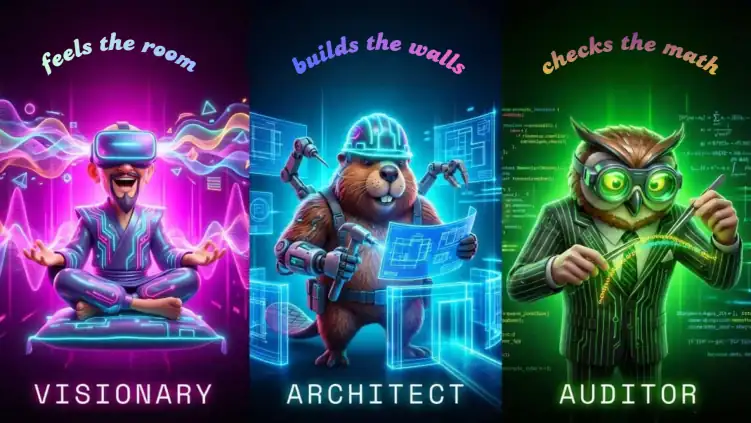
The Three Seats
Track: PD canonical (138 BPM A minor → C major). The most explicit V/A/A drop in the arc; names itself a curriculum. Status: Draft v1
The Three Seats track opens where this arc began.
Problems solved at point of contact
That sounds like a slogan until the rest of the song starts showing what it costs.
The first world is the house of control: cold and procedural, full of evidence that arrives too late to matter. The human is present, but presence has become residue. The log exists. The review exists. The person is in the loop because the institution needs a name somewhere near the end of the process.
In the house of control, the sponge absorbs the blame Human in the loop becomes a hollow name Override logs empty, judgment pushed too late A runtime liability the auditors await
That is the liability sponge in its mature form. The person is close enough to absorb the responsibility and too late to shape the decision, with no power to alter the path. The workflow preserves the appearance of human judgment while quietly removing the conditions that make judgment possible.
This is why the song does not stay there.
It turns.
But shift the frame to partnership And watch the pattern turn
The turn is the point of the episode. Partnership is not a warmer label for supervision. It is a different location for judgment. It moves the human from downstream review into the contact surface, where intent, context, evidence, and authority can meet while the decision is still forming.
The architecture has at least three seats, and "the human" is not one of them. The track names the three on the second drop, full energy, layered vocals.
The Visionary speaks in vibes: "Make it feel like home!" The Architect orchestrates what data dare not roam! The Auditor, with forensic calm, asks "Show me why you're sure" — Together finding insights that neither could secure!
Three voices, each in a different register, doing different work on the same artifact. The lyric gives them character before the article has to. The Visionary speaks in vibes; the line carries the looseness of intent before it has been formalized. Orchestration is the Architect's verb, sitting between composing and constraining. The Auditor's forensic calm is itself the precision of the seat. The three are doing different work at the same artifact, and the work composes into something the lyric calls insight: the substantive product the partnership architecture is supposed to deliver.
Most contemporary AI deployment treats "the human" as one role. Sometimes it is one person: the compliance officer, the field manager, the procurement lead, with the model's outputs flowing past their desk for approval. Sometimes it is one mode: the human who inspects, the human who signs, the human who escalates. The architecture treats the human's contribution as a single quantity that can be aggregated, sampled, scaled, or thresholded. The same human, the same review, the same gesture, applied to whatever the system produces.
The three-seat architecture says something different. The work the partnership requires has at least three distinct shapes, and a single human in a single role can perform at most one of them well at a time. The architecture has to make space for all three.
The general role logic sits under Humans in the H∞P, where live governance is split into distinct functions rather than collapsed into one decorative reviewer. This Episode gives that split a simpler teaching surface: intent, architecture, and evidence.
The Visionary
The Visionary speaks in vibes: "Make it feel like home!"
The first seat holds intent. What is the work for. Who is the work for. What does success look like in the texture of the situation, beyond what the metrics will register. The Visionary's question is whether the output feels like the situation it is supposed to belong to.
The seat lives in vibes because the seat lives in human texture. A community-relations report can be technically accurate and read as institutionally cold. A grievance triage summary can be statistically representative and miss the texture of the harm. A procurement classification can satisfy the rule book and produce an outcome the supplier community will read as a betrayal. The Visionary catches these because the Visionary is reading for fit: the fit between the artifact and the world the artifact is trying to operate inside.
This is a real form of judgment and a real form of work. The seat looks soft from the outside. From the inside it is precise. The Visionary knows when an output is wrong by feeling that it does not belong in the situation. That feeling is data. The architecture has to make room for it.
The Architect
The Architect orchestrates what data dare not roam!
The second seat shapes the corridor. What data can the model see. What outputs can the system produce. What workflows can route which decisions to which surfaces. What lineage has to survive the round-trip from input to output, so the artifact remains traceable when the audit eventually needs it.
The Architect's question is whether the system has the right boundaries to be safely doing the kind of work it is doing. The seat builds the corridor: wide enough for the work to happen, narrow enough for the data not to leak.
The Architect's judgment shows up in the small structural decisions that determine what the system is allowed to do at all. Whether the procurement classifier can see invoice-level data or only aggregate spend patterns. Whether the community-sentiment model is allowed to retain individual quotes or only quantitative tags. Whether the outputs of the M&E pipeline get logged with provenance or only with results. Each decision shapes the corridor. Each decision determines what the partnership is structurally capable of producing safely.
This is a different form of judgment from the Visionary's. The Architect's specific competence is knowing where the data can go and where it can not. The two judgments inform each other and do separate work.
The Auditor
The Auditor, with forensic calm, asks "Show me why you're sure"
The third seat tests the evidence. What is the model's output resting on. Where does the confidence come from. Which parts of the chain have been verified and which parts have been assumed. What would falsify the current answer, and is the falsifying condition something the system would even notice if it occurred.
The Auditor's question is show me why you are sure. The seat assumes that satisfying coherence is the most dangerous state for an analytical artifact, because satisfying coherence is the state in which a wrong answer becomes hardest to challenge. The Auditor's strain is the work of refusing to let well-formed structure stand in for verified knowledge.
The seat lives in calm. A loud auditor produces defensiveness in the system being audited; a calm auditor produces information. Show me why you're sure asks the model to externalize its grounds. The grounds, once externalized, can be examined. The exam reveals where the confidence is supported and where the confidence is borrowed from somewhere unspecified. Somewhere that, when surfaced, often turns out to be the model's own prior pattern-matching rather than evidence about the present situation.
The Auditor's value lives in the practice of looking. Some sessions produce findings; others confirm that the surface has been actually examined. Both are useful. An architecture in which the Auditor seat is regularly empty produces outputs whose grounds nobody has actually examined, and the absence of findings becomes uninformative.
This is the seat most directly connected to The Audit Trail: what was generated, checked, changed, approved, and why. It also connects to Vendor Interrogation, because the question show me why you're sure is not only for models. It is for vendors, dashboards, confidence claims, and anyone asking the institution to trust an output without inspecting its grounds.
Together Finding Insights
Together finding insights that neither could secure!
The composition is what the architecture is built for. The three seats, occupied by three different forms of attention, produce a reading of the same artifact that no single seat would have produced alone.
The Visionary catches the output that satisfies the metrics and reads cold to the people the output will affect. The Architect spots the output that reads warm but rests on data the model should not have been able to see. The Auditor surfaces the output that reads warm and is properly scoped, then turns out to stand on evidence that does not survive close examination. Each kind of catch is a different kind of error, and the errors do not collapse into a single category. An institution that wants to catch all of them needs every seat present at the contact surface, at the same moment, doing different work.
The insights compose because the seats see different parts of the same artifact. The Visionary reads the output's relation to the situation. The Architect's reading is about its relation to the system. The Auditor reads for its relation to evidence. The artifact gets understood in a way that a single seat would have flattened.
What "This Curriculum Reveals"
The track says the next thing directly.
So here's the compound dividend This curriculum reveals: The same skills that protect you Unlock what partnership yields!
The line this curriculum reveals is the day's distinctive move. The track stops being a description of an architecture and becomes a piece of pedagogy. The architecture is being taught. The seats are being named. The skills are being identified. The institution is being told that the same competences that prevent the disaster generate the value.
That framing matters. The three-seat architecture is a structure to be learned in detail: taught, practiced, composed, with specific failure modes that name themselves once the seats are explicit. A Visionary without an Architect produces ungrounded enthusiasm; an Architect without an Auditor produces well-scoped but unverified outputs; an Auditor without a Visionary produces verified outputs that miss the situation. The composition is teachable because the failure modes are nameable.
A curriculum that names the three seats teaches an institution where the failure modes live. The seats are the failure-mode locations made teachable.
That is the useful training connection to the AI-ESG practitioner track: Visionary, Architect, and Auditor are not personality types. They are roles a workflow has to make available if it wants partnership to produce more than fluent output.
What the Architecture Asks For
In an IFC PS5/PS7 review, the affected community holds the Visionary seat: they know what the resettlement is supposed to feel like for the people being resettled. The social specialist takes the Architect seat, shaping the workflow inside which the AI-assisted assessment can happen safely. The E&S compliance lead occupies the Auditor seat, asking the model to show its evidence on every claim that would otherwise pass unchallenged. The seats are usually filled by different people, and the architecture works when they are all present at the contact surface where the model's outputs are being read.
In a multi-model practice, the seats can be distributed across systems as well as across people. One model drafts. Another challenges. A third grounds the discrepancy. The human moves through the seats as the work requires, occupying whichever seat the room is missing. The seats become a way of naming what the human is doing at any given moment.
The architecture is the same in both cases. Three forms of attention on one artifact. The composition does the work.
The same composition logic sits behind the AI-ESG practitioner track: different systems, different roles, one artifact under review. The point is not to ask which model is best in the abstract. It is to ask which seat the work needs filled next.
The Calvin Convention is where this becomes contractual: roles, rights, and evidence requirements have to be named before the workflow is under pressure. Otherwise the three seats collapse back into one signature at the end.
Today's Payoff
What the three-seat structure buys is a contact surface that produces insight. The single approve-or-reject button stays available where the institution needs it; the structure that makes the approval worth giving lives in the three readings, each with its own register, each contributing something the others would have missed.
The architecture works when the seats are all named and all occupied at the moment the artifact is being read. It also tells the institution what to teach, who to hire, and how to compose a review around the artifact rather than around the signature. This curriculum reveals is what an architecture says when it knows how to teach itself.
Companion materials: