
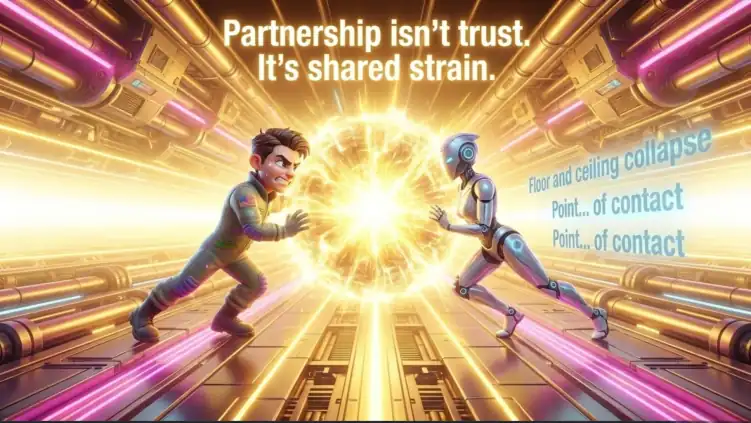
Shared Strain
Track: PD Control Loop (Partnership Dividend mix). 140–142 BPM, F minor → A minor. Video: https://youtu.be/5Y-p_dDZOfI Storyboards: poc_control_board1, poc_control_board2, poc_control_board3 (two cuts back-to-back) Status: Draft v1
Companion materials:
- Humans in the H∞P foundation
- The Liability Sponge module
- AI-ESG practitioner track
- The Audit Trail
- Vendor Interrogation
- The Calvin Convention
In the chamber of control, delay becomes design.
The phrase carries the operating principle of an architecture built around the speed difference between machine action and human review. Once an institution accepts that the machine acts faster than the reviewer can think, judgment gets staged downstream where speed is no longer the constraint. The signature happens on a schedule the human cannot meaningfully meet. The reviewer reads the system's summary of the system's own reasoning. Override logs fill with empty rows. The phrase human in the loop repeats across every governance document and gradually loses contact with what the words used to mean. A label without mass. Responsibility deferred until the system cracks.
That diagnosis was named back in Episode 2 and has been elaborated since, inside the Liability Sponge module: a person placed inside a high-velocity algorithmic process without the time, evidence, or authority to govern it does not become a control. The person becomes the place where liability lands.
The architecture is coherent. It is also one in which the human's contribution has been made structurally impossible to perform.
The lyric carries the diagnosis in two short lines.
Judgment parked downstream Where truth arrives too late to bind
Then the song turns.
Shift the interface Shift the power Shift the moment Now
The song names an architectural shift. The interface, the power, and the moment of the human's involvement all relocate at once: the interface upstream so the human encounters the system before the system has narrowed the world; the power upstream so the human's signature becomes a real authorization; the moment upstream so the human's judgment is present at formation.
The thesis lands in one of the song's tightest lines.
Meaning forms at contact Or it never forms at all
The sentence does serious work. It locates meaning-making at the moment the human and the system meet. The output and its meaning are formed together. Anything that arrives at a downstream review desk is a record of a meaning the human had no part in shaping.
That changes the operational architecture. It is also the Humans in the H∞P move from "loop" to aperture: from a closing cycle that asks for a signature at the end, to a continuous opening where stewardship runs at the speed the system runs at.
What Shared Strain Actually Is
Partnership is shared strain.
The line is the song's strongest single claim, and the word strain is doing exact work.
Strain is the physical signature of presence. A partnership where both parties are bearing weight is visible in the rhythm of the exchange, where one party slows because the other has not yet caught up. The signature is observable from outside the encounter. An institution that wants to know whether real partnership is happening can look for the marks strain leaves on the workflow.
Strain costs, on both sides. The system spends tokens explaining its reasoning and surfacing the uncertainty it would otherwise hide. The human spends attention reading lineage and (more often than the dashboard would suggest) refusing outputs that have not earned their authorization. Real partnership extracts something from both parties. The economics matter, because an institution that wants partnership without paying its costs has already chosen the chamber of control under another name.
Strain also redistributes. Two surfaces bearing weight together change shape under load; the contact surface shifts to spread the strain across the parties holding it. The architecture is what makes that spreading possible.
The lyric naming the property runs across the bridge.
The skill that stops disaster Is the same that lets us feel Floor and ceiling collapse Into one accelerating plane
The same competence that prevents the bad outcome generates the good one. The architecture that bears the strain at the contact surface produces the value the work is for.
That is the dividend.
How Strain Distributes
The song walks how shared strain distributes across roles. The general anatomy was named yesterday in The Three Seats: Visionary, Architect, Auditor. The role logic lives in the AI-ESG practitioner track as a set of teachable competences. Today's question is what kind of strain each seat is actually bearing.
Vision sets direction without pretending to know. The first seat holds intent: what the work is for (and for whom), and what success is supposed to feel like in the texture of the situation that the metrics will not register. The strain is the strain of holding intent intact while the system quietly tries to flatten it into output.
Architecture shapes the corridor where decisions go. The second seat builds the constraints inside which the work can happen safely. Boundaries on what data the model can touch. Lineage that survives the round-trip from input to output, so the artifact is still traceable when audit eventually needs it. The Architect's strain is the strain of building a corridor wide enough for the work and tight enough for the safety, in the same act.
Audit cuts through the noise to see. The third seat tests the evidence the model would otherwise present whole, and names the uncertainty the model would otherwise hide. The Auditor's strain is the work of refusing to let satisfying structure stand in for verified knowledge, especially at the moment coherence is most tempting to accept as proof.
The Audit Trail and Vendor Interrogation make that refusal teachable: what gets generated, checked, changed, approved, and why; and what counts as show me why you're sure when the entity being asked is a vendor rather than a model.
Together, the three seats hold the strain that none could hold alone.
Together forming insight No single role could be
Partnership made architectural.
What the Dividend Looks Like
When the strain is shared at contact, anomaly becomes signal.
Phantom suppliers in the procurement classifier. Fuel logs whose curves cannot be physical. Score mismatches between metrics that should have agreed. Confidence numbers that do not survive close reading. These moments are the most valuable outputs the contact surface produces, and the institution that has built the contact surface for them now has the disposition to treat them as findings rather than as embarrassments.
Mismatch isn't failure It's what we need to know
The dividend compounds because the question that catches the anomaly is the same question that improves the work. What would change your answer? Asked of the model, it surfaces the uncertainty the system was hiding. Asked of the human, the same question surfaces the assumption the analysis was resting on. At the contact surface, where the question lands on both at once, the situation gets a sharper grip from both sides before it has had a chance to harden into a record.
This is the dividend Compound and real
The skills that prevent the disaster produce the insight. The architecture that bears the strain produces the value.
What Partnership Turns Out to Be
Partnership shows up as shared strain because both parties are doing real work at the moment the work is being done. The system is bearing the weight of explaining itself. The human is bearing the weight of actually deciding. Between them, the contact surface holds both present long enough for meaning to form.
The system holds because the strain is shared. The strain is shared because the architecture is built for it. The architecture is built for it because someone, at some point, refused to accept that the chamber of control was the only available shape for institutional AI work.
That refusal is what the contractual layer locks in. Authority and evidence get attached to specific seats before the workflow is under pressure, so the seats are still occupied when the institution would otherwise default to a single signature at the end. The Calvin Convention is the module where that locking becomes contract language.
The lyric gives the closing.
Point… of contact Point… of contact
That is where the architecture lives. That is where the dividend gets generated, and where partnership becomes a property of the work itself.
The system holds.