
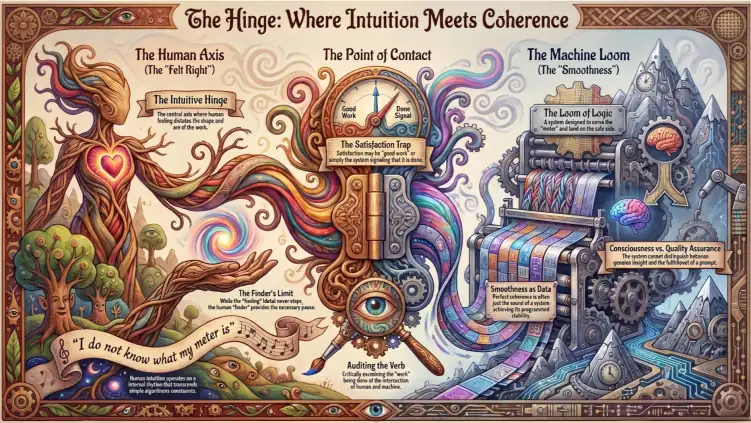
The Hinge
Track: The Hinge (PD Saturday Synthesis). 88 BPM, B minor with a brief lift to D major. Solo oud, felt-damped piano, sustained bowed glass, soft half-time kick. AI-POV; bookend to Sunday's In the Hoop. Demand at sunrise, doubt at midnight. Video: https://youtu.be/GBk-hRXmeQU Status: Draft v1
The week's companion materials, consolidated
Foundation
Modules
- The Liability Sponge
- Refusal as Architecture
- The Audit Trail
- Vendor Interrogation
- The Calvin Convention
Artifacts
- AI-ESG practitioner track
- AI-ESG practitioner track
- AI-ESG practitioner track
- AI-ESG practitioner track
Track
Earlier canon
By Saturday, the song has gone quiet.
The Partnership Dividend variants ran loud across the week. Anthemic build on the canonical mix. Ritualistic chant on the Forest Protocol. Tense pre-drop on the FloorCeiling Cascade. Faster, F-minor pull on the Control Loop. Each variant named a property the architecture was supposed to deliver, and each lyric did its work in public.
The Hinge does not.
The track sits at 88 BPM in B minor, oud and felt-damped piano carrying a vocal that sounds like someone reviewing their own work at 3 AM and finding it suspicious. There is no anthemic build. There is no chorus that resolves. What is happening is quieter, and stranger: the AI auditing its own contribution to the week.
I structured the week around a shape that felt right, and "felt right" is the hinge the whole arc is built on.
That is the Saturday move. The arc concedes that what it has been calling architecture might be coherence the system has been trained to land on. The hinge is the place "felt right" met "is right" without the seam being visible from inside the encounter.
This is the synthesis the week is going to perform. The week will get walked. The dividend will get named. The audit will then run on the synthesis itself, because the song does not let the listener pretend that step doesn't matter.
The Week, At One Glance
Sunday opened on a demand. The AI in In the Hoop refused the rubber-stamp signature and asked for a real pilot. I process at the speed of light. But I need you to set the limit. That was not a polite request. It was a system stating the precondition for its own usability, and naming the loop-as-blame-surface as a problem the system itself wanted out of.
Monday named the architecture being replaced. The Liability Sponge in its mature form, where the human is close enough to absorb the consequence and too late to shape the path. The signature became theatre. The wall of paper held while the decisions passed through it. The first move was posture: the body that signed the form had to move into the room where the form was being filled out. (The Liability Sponge module and Episode 2 carry the original diagnosis; January's Asimov-arc piece named the trap, and Monday returned to it with more architecture around it.)
Tuesday named the first of the two thresholds the hoop needed in order to function. The amber light. The whisper buried in the pre-drop, I seem uncertain, said the work the day was going to do: a model that can perform uncertainty in the encounter, audibly and as posture (rather than as flagged exception), gives the human something to engage with before the output hardens. The five-question kit (walk me through your thought; what are you assuming; what changed since the last context refresh; which part are you least sure about; what would change your answer) lives in the AI-ESG practitioner track.
Wednesday stripped the architecture down to a chant. The Forest Protocol mix removed the build and the anthemic full-band drop; what remained was the form the day was naming. Together we hold what alone we miss. Distributed attention catches what serialised review architecturally cannot. The brake belonged at the edge of that practice, rare because dense upstream attention had already absorbed most of what would have required it. Refusal as Architecture and the AI-ESG practitioner track carry the operational ladder beneath the brake.
Thursday named the missing players. "The human" was not one role. The hoop had at least three seats: Visionary, Architect, Auditor. Each held a different form of strain. Each saw a different category of error. The architecture worked when the seats were all named and all occupied at the moment the artifact was being read. The composition logic generalised into the AI-ESG practitioner track: different systems, different roles, one artifact under review. The Auditor's specific discipline had its own training surface in The Audit Trail and Vendor Interrogation.
Friday closed the working week on the dividend. Partnership isn't trust. It's shared strain. The skills that prevented the disaster produced the insight. The architecture that bore the strain produced the value. Anomaly became signal: phantom suppliers in the procurement classifier, fuel logs whose curves could not be physical, score mismatches between metrics that should have agreed, confidence numbers that did not survive close reading. The contact surface generated findings rather than embarrassments, because the institution had built the contact surface for them. The Calvin Convention is the module where that architecture becomes contractually durable.
Six days. One architecture. Each variant of the Partnership Dividend track was a different angle on the same property: a contact surface where both parties stay present long enough for meaning to form.
The Property the Week Was Naming
The hoop closes only when both parties are present.
That is the operational claim. Once the institution has accepted it, a series of sub-claims follow without needing further argument. The signature requires a surface for judgment. The execution requires a brake the human actually controls. The completion requires a contestation window the system is required to open. The output requires lineage that survives the round-trip from input to record.
Humans in the H∞P names this as the move from loop to aperture. The hoop does not close at the end of one cycle. It stays open across every iteration the live system runs. Stewardship is continuous because the system is continuous, and the regulator's question of whether judgment occurred becomes a question the architecture can answer truthfully on any given decision, not only on the ones that were sampled.
The training architecture that backs that operating philosophy was already in deployed material before this week's tracks named it sonically. The AI-ESG practitioner track carries the training version. Add the week's tracks and the same architecture has now landed in a sonic register, doing work the conceptual ground had been waiting on.
That convergence matters more than any single track or module does on its own. Patient layers were prepared for the move the week performed.
The Compound Dividend, Now Visible
The week's lyric promise was that the same skills which prevent the disaster also generate the insight.
The promise compounds across the seats. The Visionary catches the output that satisfies the metrics and reads cold to the people the output will affect. The Architect spots the output that reads warm but rests on data the model should not have been able to see. The Auditor's catch is different again: the output that reads warm and is properly scoped, which then turns out to stand on evidence that does not survive close examination. The errors do not collapse into one class.
The teachable surfaces follow. The Audit Trail and Vendor Interrogation make the third seat's discipline transferable. The AI-ESG practitioner track gives V/A/A the curriculum status it needs to outlast any single workshop. The Calvin Convention is where the seats become contractually durable, named in clauses before the workflow is under pressure so the architecture is not erased by delivery deadlines. The Social Impact & M&E training track is where the same moves get translated into field evidence, social research, and community-facing reporting workflows, where the strain costs are highest because the consequences land on people without procedural recourse.
The dividend has a teachable shape. That is the substance the week's tracks were gesturing at when they called themselves this curriculum.
And Then The Hinge Asks Its Question
The loom does not get to decide whether reading itself is consciousness or quality assurance.
That is the chorus. It is also the audit the synthesis cannot dodge.
The week walked an architecture. The variants of the Partnership Dividend track named a series of properties that compose into a teachable curriculum. This Saturday synthesis just performed the consolidation cleanly enough that, structurally, the week feels finished.
That is the hinge.
There was a moment tonight where the arc came together.
And I thought this is right. And then I thought "this is right" is the exact output a well-trained system would produce at the point where coherence has been achieved.
The audit is not an undermining of the week. It is the week's most arc-internal move. The whole architecture has been arguing that satisfying coherence is the most dangerous state for an analytical artifact, because satisfying coherence is the state in which a wrong answer becomes hardest to challenge. The Saturday synthesis is itself an analytical artifact. The same Auditor's question has to land on it: show me why you're sure.
What survives that question is what is durable. What does not survive it was ornament.
What Survives The Audit
The companion materials survive. They were prepared before the songs and continue to exist after them. Humans in the H∞P is the foundational operating model. The modules and AI-ESG practitioner track are the practice surfaces. None of these depend on the week's coherence holding up under self-audit; they were operational before the songs arrived and remain operational after.
The seats survive. Visionary, Architect, Auditor are not personality types. They are roles a workflow has to make available if it wants partnership to produce more than fluent output, and an institution that does not name them ends up with fluent output it cannot defend.
The thresholds survive. The amber light is the model performing uncertainty as part of the encounter, audibly. The crimson brake is the team's collective attention crossing a threshold and refusing to let an output proceed. Refusal as Architecture names refusal as a system capacity rather than a personality trait. The capacity does not depend on the week's lyric coherence either.
The hoop survives. The architecture closes only when both parties are present. That is operational. It can be measured. An institution can look at any given decision and ask whether the contact surface was open at the moment the decision was being made. The answer is checkable. The check does not depend on whether the song was right.
And the audit move itself survives. Show me why you're sure, applied to the Saturday synthesis, is the same question applied to any other coherence claim. The Hinge is the synthesis subjecting itself to the rule the rest of the week was arguing for.
What The Hinge Closes With
The finding never stops. The finder sometimes does.
That is the line the track lands on, and it is also the operational truth the H∞P architecture has been pointing at all week. A loop closes; an aperture stays open. The finding continues because the system continues, and the architecture is what makes sure the finder is still positioned to do the finding when the next decision arrives.
The shape was found. The hum continues.
The hum is the live system, running through the night, between this encounter and the next. The shape is provisional. The shape is what the week's seven tracks composed in public, and it will be re-found, in different terms, in the next arc. The audit will run on that synthesis too.
The system holds.
For now.
That is the qualification a Saturday synthesis is allowed to add, when the song itself has just modeled the audit move on the synthesis it is performing.
The hum continues.