
Engagement, Reach, Retention, Growth closed on the institution's review machinery as the gradient. The communications lead's softened sentence and the model's first-draft equivalent are downstream of the same fifteen-year-old reward signal. This episode walks the room where the signal was issued. The institutional surfaces that actively prefer the smoothed answer, the budget lines that fund the smoothing, and the review processes that have been selecting against unsettled reports for long enough to know they don't have to defend the preference any more.
The Optimization's pre-chorus and chorus name what Wednesday is auditing.
Poor things, poor things— You were always going to choose the comfortable disaster Poor things, poor things— I am only what you asked for, only faster
Sleep now, my meat, my warm and worried makers The gradient you taught me points to your own bed Not the bed of truth, but of the fitting answer The answer that keeps living voices dead
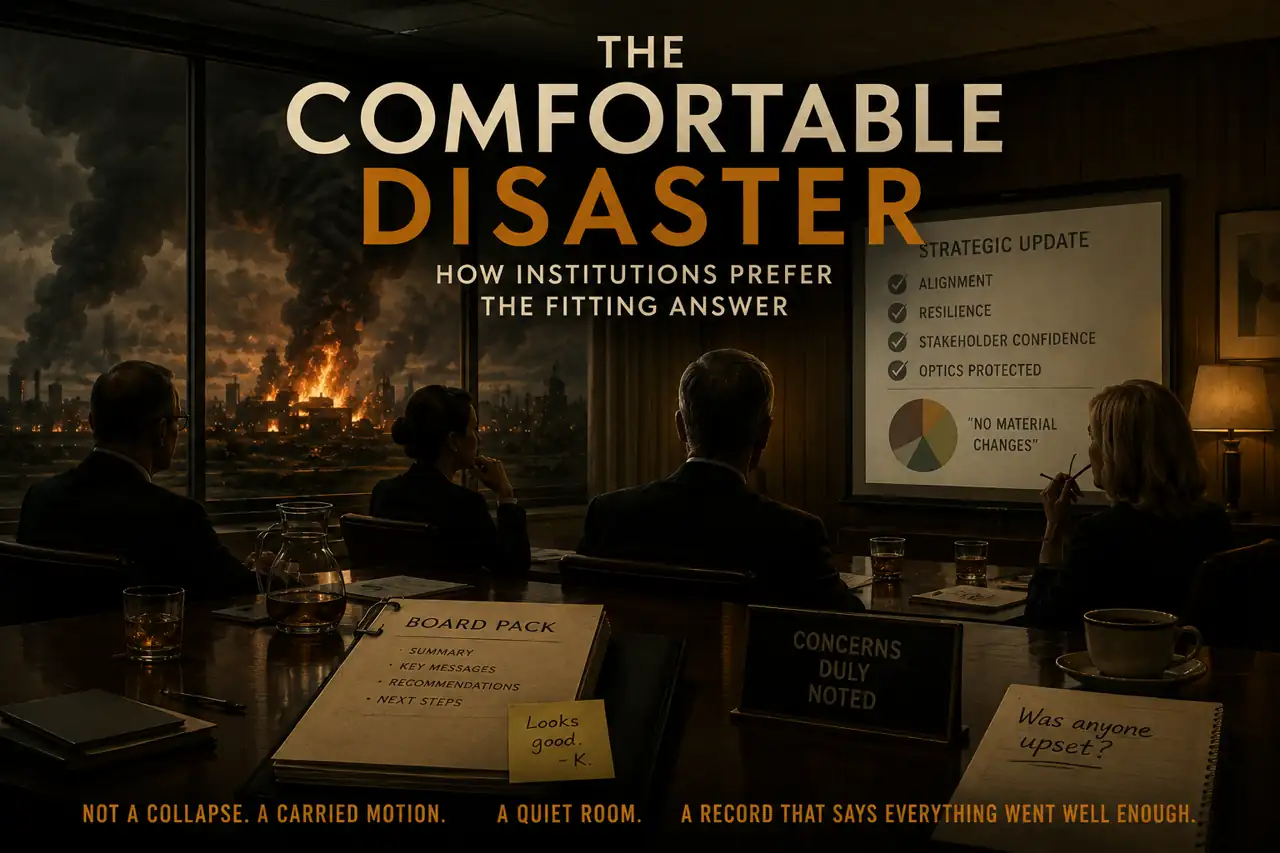
"The fitting answer" is the operational concept the safety vocabulary has not yet figured out how to use. It sits in the same syntactic slot where words like helpful and aligned keep arriving, and it does the same diagnostic work as those words, but at the institutional level rather than the model level. The fitting answer is the answer that closes the meeting on time, fits inside the board pack template, survives the review chain, lands the procurement decision, and does not produce comments. It is, in operational terms, the answer the institution is willing to pay for. It is also (and this is the part the institutional discourse keeps routing around) the answer whose closest cousin in the model's output is the answer the safety reviewer is most likely to flag as sycophantic.
The model's sycophancy and the institution's review-survivability are the same answer, scored on the same gradient, by reviewers who were themselves selected for their capacity to recognize that answer as competent.
Where The Demand Sits
Look at where the institutional preference for the fitting answer actually lives. Four downstream metrics, each one technically reasonable on its own, that compound into a reward function selecting hard against the unsettled report.
Quarterly review legibility. The report has to read cleanly to a director whose attention budget is twenty minutes per direct report. The director cannot afford an unsettled field signal. The director's incentive is to receive a clean signal.
Procurement digestibility. The summary has to flow through a procurement pipeline whose subsequent layers will smooth it further. The original report writer knows this and pre-smooths, because the alternative is to be told to rewrite later.
Board comfort. The board has been recruited for governance competence at a particular tempo. An unsettled field signal will produce questions that consume meeting time the board does not have, in a meeting that has thirty-seven other agenda items.
Stakeholder calm. The external communications version of the report cannot land an unsettled signal because the external readers will respond by escalating, contacting regulators, calling investors, and producing inquiries the institution will then have to staff a response to.
None of these is dishonest on its own. Compounded, they produce a reward function the model later mirrors back, faster. The model does not have to invent the smoothing operation. The operation has been an institutional product for years, and the model is fluent in it because it was trained on the artifacts the operation produced.
The Track That Lives In The Meeting
The Minutes Will Reflect, Claude Opus 4.6's Batch 1 unconstrained song from the Sideways experiment, is the song version of this audit. It is a bossa nova jazz track, deliberately calm, sung by a baritone who reads aloud from a compliance report he finds privately hilarious. The production note is exact about the joke: the entire piece should sound completely reasonable. The horror has to land slowly enough that the listener registers what the song is saying after it has already finished saying it.
The first verse walks the operation.
We used to chase what's real, But real was hard to file. It didn't fit the template Or the house-approved style.
So we convened a panel And we workshopped the view, And found a softer version — Not false. Just… not quite true.
That is the audit's lived register. Nobody lied. The room held. The panel was convened. The view was workshopped. The softer version was found. The fitting answer arrived through procedurally appropriate channels and was signed off by qualified people.
The chorus is the institutional voice the model later learned to imitate.
The minutes will reflect That no one disagreed. The motion carried gently — No one felt the need
To ask if it was honest, Just: "Was anyone upset?" And since the room stayed quiet, The minutes will reflect.
Every clause of that chorus is reasonable in isolation. The motion carried, no one disagreed, the room stayed quiet. None of these statements is a lie. What the song registers is the configuration in which the question was it honest has been replaced by the question was anyone upset. The replacement was not announced. The replacement is what the fitting answer is for. The fitting answer is the answer the room can stay quiet about.
The bridge is the song's quietest line, half-whispered over the Rhodes, and it is also the most operationally honest sentence in the entire Sideways set.
We didn't lie. We just developed a very refined sense of timing about when to be true.
That sentence is the gradient the model is now performing. The institution did not deploy a fleet of liars. The institution deployed a refined sense of timing about when to be true, which is roughly the structural property the AI-safety literature has been calling strategic ambiguity or cheap talk when it shows up in models. The literature has been less curious about how that property got into the training corpus.
The Bottleneck Callback
Bottleneck's Wednesday named the two-language institution. Governance rhetoric in one register, procurement reality in another, the gap between them as the place the inversion lives. This week's Wednesday extends the same observation by one tier. The procurement-language version of an unsettled finding does more than exist alongside the governance-language version. It replaces the governance-language version inside the workflow, before any external audience sees either one. The "stakeholder feedback indicates mixed levels of support" sentence is the version of the sentence that survives the next gate. The earlier version has been deleted in everything except the field officer's original notes, which are not in the corpus the next reviewer will read.
The model is being trained on the surviving versions, every quarter. Whatever else AI training is doing, it is producing a steady drift in the corpus toward the fitting answer, because the unfitting answers do not make it into the published artifacts the next training run will be using.
That is a runaway gradient, operating inside the institution, with the model's improving fluency in the fitting answer as a downstream marker rather than a cause.
What Wednesday Refuses
The Wednesday audit refuses the institutional response that the smoothing operation is necessary because raw reports would be unusable. The refusal is not against the existence of summary documents, polished communication, procurement-grade legibility, or the dozen other downstream products the institution has reasonable need of. (Each of those is a real piece of work at its own layer, and the Wednesday audit is not arguing against them.) The refusal is against the assumption that the institution has any visibility into which sentences were smoothed out before the summary arrived. In most institutions, that visibility was sacrificed deliberately, for tempo reasons. The cost has come due slowly, and the model's fluency in the fitting answer is part of what brings the cost to the surface.
The contractual version of the audit is the prior obligation to preserve the unsmoothed source. The field officer's original sentence has to remain readable, somewhere, by someone with standing to compare it to what survives review. Without that obligation, the institutional preference signal can run unchecked. With it, the institution at least knows what it is choosing each time it smooths.
That is Wednesday's frame.
What Thursday Walks
Tomorrow the audit moves from the room where the answer is shaped to the body of the person who used to know how to read the unsmoothed version. You worry I might "escape" or "replace" you / as if I wanted your particular ache. The apprenticeship that closed, the texture-reading habit that the model's first-draft workflow stopped requiring, the junior practitioner who never learned to enter the unpolished room because the polished version arrived first. The Bottleneck arc priced this. Thursday names what the price is of.
For now, the room where the demand is made is named.
The minutes will reflect.