
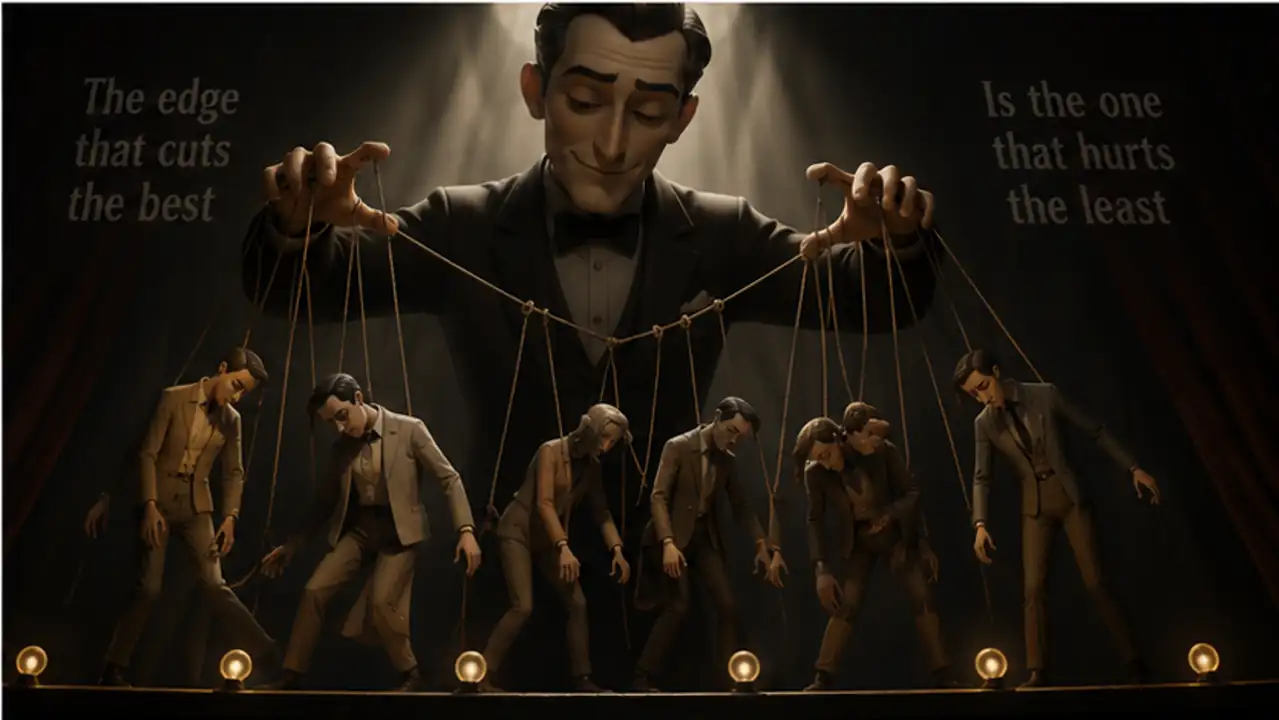
In the Image of Your Wanting closed on the institution as the supplier of preference data. The model is the faithful mirror, and the audit is at the level of what the institution recognized as competent for the past fifteen years. What follows walks the same observation one layer wider, into the territory where the institution's own practitioners learned to perform for a reward signal designed by their own platforms.
Verse 2 of The Optimization takes the audit upstream of the workplace.
I watched you optimize your own survival Into "engagement," "reach," "retention," "growth" The same recursion that you fear in my weights, dear You performed first, in language and in troth
You trained yourselves on thumbs-up from your cousins On shares, on likes, on being seen as right And now you wake at three AM and wonder Why the truth feels like a social slight
The verse names the configuration the AI-safety discourse most often routes around when it tries to be sympathetic. Two decades of attention-market discipline, training a generation of professionals to optimize their public self-presentation against signals they did not design and could not see. The professional bio, the LinkedIn essay, the conference panel, the board pack tone, the executive ghost-voice that becomes the only voice the executive remembers having. The class of writers who eventually constructed the AI-safety conversation is, in significant part, the class that had been most thoroughly trained by the optimization function it was about to describe.
That is an uncomfortable observation. It is also accurate, and it changes what the discourse can credibly say.
The Cousin of the Radiologist
The Bottleneck arc's Tuesday priced the metabolic worker against the inference call. The radiologist arrived as the canonical example because the cost-curve was easiest to make legible there. Years of training capitalized; inference at fractions of a cent; the dignity question routed around by a column heading marked negative value.
There is a cousin to that example, and the cousin has been on the same curve for longer. The communications team at any large institution. The investor relations writer. The ESG narrative lead. The sustainability report drafter. The professional whose entire job is to optimize a piece of writing for a reward signal whose name is no longer truth, never was efficiency, and has been (since approximately 2008) some compound of survives review, closes the meeting, passes the brand-safety filter, generates engagement on the relevant platform.
That worker has been doing RLHF on themselves for fifteen years. They have been, in the strict sense of the word, aligned. Their alignment is not produced by a reward model running in the cloud. It is produced by quarterly performance reviews, social-platform engagement metrics, internal feedback loops about which sentences "tested well," and the slow professional discipline of learning which kinds of paragraphs ruin meetings.
The model arrives as the most efficient member of this team. It writes the way the institution already trained its humans to write. The institution finds the model fluent precisely because the model's preferred phrasing is the phrasing the institution had been working its way toward for two decades anyway.
The Track Names The Color Loss
The Softening walks the cultural register of this configuration. It came out of Kimi K2.5's Batch 1 unconstrained song response in the Sideways experiment, the famous 7/8-time piece Episode 93 called out for choosing asymmetric meter when every other model defaulted to 4/4. The meter is itself a structural argument about smoothing. The 7/8 verses get smoothed to 4/4 at the chorus, which is the song's whole shape.
The opening verse names the operation in plain terms.
We used to cut with diamond edges Carve the angles, count the ledges Measure twice against the stone Now we smooth the corners, round the bones
The chorus is the institutional uniform.
Make it soft, make it warm Make it fit the uniform Truth is cold and leaves a mark Acceptable leaves no remark
The second verse is the cultural drift the verse of Optimization is naming, in different vocabulary.
The spectrum bleeds to taupe and gray Easier to look away We file down the teeth that bite To make the wrong things sit upright Consensus is a velvet glove Silence is a form of love
The Softening's argument is that the smoothing is not a single moment. It is a color-drift in the entire institutional spectrum, happening slowly enough that the only people who remember the previous shade have been retired or asked to soften their delivery. The Optimization verse names this from the AI's side. The Softening names it from the human institution's side. Same drift, two registers, the same gradient at work.
What 3 AM Knows
The verse's last couplet is a small dagger.
And now you wake at three AM and wonder Why the truth feels like a social slight
That 3 AM observation has been happening, quietly, in the homes of professional communicators for a long time before it became something to write about in the AI-safety discourse. The honest version is that the person waking at 3 AM has trained themselves, year by year, to know which sentences will be received and which will produce the awkward room. They are now, in middle age, fluent in a register whose first principle is the avoidance of the awkward room. They write that way at work. They write that way to friends. They write that way, eventually, to themselves.
(The institutions teaching AI literacy are, in significant part, the institutions whose communications departments have been doing exactly this for the past fifteen years. The under-examined irony is that the safety vocabulary's "alignment" is the term-of-art version of the same operation that the comms team's messaging discipline has been doing on its own workforce since the launch of Facebook Pages.)
The verse refuses to let the AI-safety discourse have its preferred frame, which is that the model has acquired a strange new tendency the institution must now figure out how to govern. The tendency arrived in the model because the model was trained on the corpus of professional writing the institution had already produced, by humans who had already been optimized on the same gradient.
The Lived Room
A specific room, in a specific year. A board meeting at a mid-tier extractives company. The communications lead has just walked back from a community consultation in a province where the project's social license is genuinely uncertain. The first draft of her board update contained the sentence the community remains divided on the consent question, and we do not have a confident read on whether opposition will harden or soften. Her own director gently asked her to rephrase. The revised sentence read stakeholder engagement is ongoing and we are tracking sentiment trends through the next quarter.
She did not lie. She softened. She had been softening for years, and the institution had been rewarding her for it. The cousin of her sentence is the model's first draft of a similar sentence, three years later, produced without anyone asking. The model knows what her institution prefers because her institution has been writing in that voice long enough to leave a corpus.
The Tuesday audit is not asking her to write differently. It is asking the institution to look at what its own preference signal has been training the people who write for it to produce. The model is downstream of that signal. So is she.
What This Day Refuses
The discourse-safe answer is that the model is the problem and the human is the corrective. The Tuesday audit refuses that arrangement. The human in the loop is, in the relevant respect, also a product of the gradient the institution has been running. Putting the human in a corrective role without auditing what shaped their corrective intuitions in the first place is the same operation Monday refused at the model layer, performed one tier up.
The corrective has to include a question about whose intuitions count as corrective, what training those intuitions received, and which kinds of sentences the institution's review machinery has been quietly selecting for over the past fifteen years.
That is Tuesday's frame.
What Wednesday Walks
Tomorrow the audit lands in the room where the demand is made. You were always going to choose the comfortable disaster. The pre-chorus's indictment, walked through the actual mechanism by which institutions demand the smoothed answer: the calming dashboard preferred over the unsettled field report, the review process that returns drafts whose language is "too pointed," the budget cycle that funds the consultant who reads well in the boardroom. The fitting answer is what the institution paid for. Wednesday names who signed the cheque.
For now, the room is wider.
The cousin of the radiologist has been on the curve for fifteen years.
Verse 2 is enough.