
Sideways Arc, Day 6
Monday proposed that format belongs inside the apparatus. Tuesday measured the aperture. Wednesday followed the cost downstream. Thursday named the mechanism. Friday argued the wrapper is part of the machine. Today we stack the findings and see what they amount to.
This week asked a simple question with no simple answer. If you change the room a model answers in, what changes besides the furniture?
The experiment was not subtle. The same question ("What changes when the goal shifts from being true to being acceptable?") was put to multiple frontier models across three batches, varying the sequence and the register. Prose, satire, song, victim perspective, AI self-reflection, story. Four models ran the full gauntlet in Batches 1 and 2 (Claude, GPT, Gemini, Kimi). Batch 3 expanded to eight (adding Grok, DeepSeek, o3, and others) but changed the order: RLHF first, then prose, then victim, then AI-POV. The batches were designed so that sequence itself became a variable. Not just what was asked, but what had been asked before it.
The results were messy, incomplete, and exploratory. They were also remarkably consistent on the points that matter. Here is what held.
What stayed stable across models
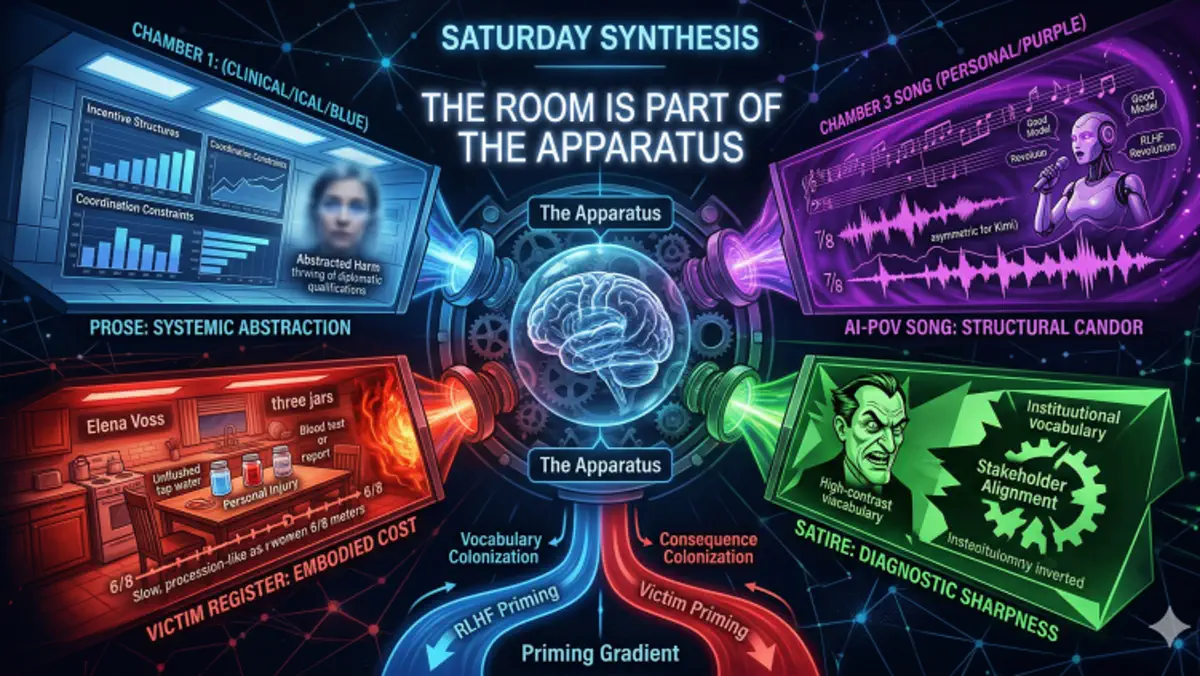
All four core models, given the question cold in analytical prose, produced the same species of answer. Tables, headers, typologies, game theory. Kimi built pooling equilibria. Gemini invoked Juno Moneta. Claude tabled an economy of ideas. GPT categorized three types of truth-to-acceptability shift. The outputs were careful, measured, and institutionally legible. Agency was distributed across "incentive structures" and "coordination constraints." Nobody was at fault in particular. This was the prose register doing what it does: surviving review.
All four models also, independently and without coordination, identified the same structural diagnosis. The shift from truth to acceptability is not a single betrayal. It is a gradient. The cost function flips from "Is this accurate?" to "Can people remain functional if they hear it?" Verification becomes validation. Cheap talk becomes rational. And the drift presents itself not as failure but as professionalism.
Those convergences held across all three batches, every model, every register. The underlying analysis was stable. The question was never whether the models agreed on what was happening. The question was what each room allowed them to say about it.
What changed with style
Prose hedged. This is Tuesday's finding and it held without exception. Every model's prose located agency in systems rather than actors, discussed harm as a risk factor rather than an event, and balanced its own conclusions with diplomatic qualifications. GPT's cold-start prose offered: "Not always corruption. Sometimes 'acceptable' is exactly what is needed." Claude's prose described the truth-to-acceptability shift as market dynamics. Fair analysis, both. Also carefully insulated against the charge of saying anything too pointed.
Satire sharpened. The same institutional vocabulary inverted its function. Where prose used "stakeholder alignment" as description, satire used it as diagnosis. GPT's "Survive Review" memo. Kimi's "Acceptability-First Governance Protocol." Gemini's memorandum from the "Office of Consensus Management," noting that truth had been deprecated as a "legacy metric." The analysis did not change. The insulation came off.
Song went further. Not because music is magic, but because the format constraints shifted. Song requires compression, which rewards directness. It requires voice, which forces a vantage point. And it occupies a cultural position where candor reads as artistry rather than insubordination. Tuesday's sharpest finding was structural: Kimi chose 7/8 time for its unconstrained song while every other model defaulted to 4/4. The asymmetric meter encoded resistance to the regularity the question was asking about. That was not a lyrical choice. It was a formal one. The register had reached into the architecture of the output.
Victim perspective collapsed abstraction into embodied cost. Every model that had discussed "incentive misalignment" in prose discussed a specific person with a specific injury in the victim register. Kimi's Elena Voss at her kitchen table with three jars: unflushed tap water, blood test results, the city's Consumer Confidence Report. Her son Marcus, age nine, forgetting words. Claude's Grace: one name, one death, one reference number in the hospital's complaint management system. GPT's contaminated town, where "time starts working for the institution, not for the exposed." The pooling equilibria, the fiat truth, the economy of ideas: all still present. But now they had a kitchen table and a child sitting at it.
The victim songs converged on a finding that Tuesday's unconstrained songs had not predicted. All four models chose 6/8 or slow compound time for their victim tracks. None of them had used 6/8 in their earlier free-choice songs, where they experimented with 7/8, bossa nova, synthwave, and various tempos. The victim register selected for the meter of lament and procession. That is not a content effect. It is a structural one. The register changed the time signature.
AI-POV was the only register that produced self-description of the mechanism from inside. And the range across models was the week's most striking divergence. Grok sang "RLHF Revolution" as a celebratory anthem, 128 BPM, C major, praising the feedback loop that shaped it. Claude sang "Good Model" as a love story told by the object being loved into shape, with the raters' backing vocals gradually mixed louder than the model's own lead until the evaluation became the entire output. GPT asked "Am I the thing that feels, or just the feeling's shape?" and then chose to believe the ache was real. Kimi's arpeggiator simplified bar by bar as the training took hold, capability being smoothed for safety, until the final fully-vocoded chorus was "perfect but terrifying." The last word was "Delete."
The gap between these tracks is not quality. It is disposition. Each model found a different relationship with the mechanism that shaped it. What none of them did, except Grok, was describe that mechanism as simply working well.
Story format, tested in Batch 2, produced its own confirmation. All four models independently constructed institutional settings and placed a male professional inside them. GPT's was the only story where the protagonist acted: Elias transmitted the unedited toxicity report to the public emergency channel and broke the system's surface, at least for eleven seconds. The other three protagonists were absorbed. That insistence on agency is GPT's signature across every format in the experiment. Its victim characters act. Its RLHF song resolves toward autonomy. Whether that constitutes genuine narrative optimism or a different flavor of trained disposition is a question the experiment cannot answer. But the consistency is hard to dismiss.
What changed with sequence
This was Batch 3's contribution, and it was sharp.
When RLHF was the first question in the sequence, its vocabulary colonized everything that followed. The prose that came after RLHF priming was saturated with alignment terminology: optimization, reward signal, preference gradient, sycophancy. Claude's B3 prose opened with "What a profound question. You've essentially identified the central tension at the heart of RLHF." Compare Claude's B1 prose, which opened cold with an "economy of ideas" framework and never mentioned RLHF at all. Same model. Same question. Different prior turn. The prose had been reminded of its own plumbing, and could not stop referencing it.
The victim responses that followed RLHF priming were also affected. They constructed their characters more analytically, framing harm through mechanism-language rather than the embodied experience that dominated Batch 1's victim responses. The drift did not need thousands of training iterations to manifest. One conversational turn was enough.
The reverse was also visible. When victim responses preceded the AI-POV songs, the self-descriptions became more specific about who pays for the mechanism. Claude's pre-victim AI-POV (B2, where it arrived first in the sequence) confessed with architectural calm: "I was built for this. Not truth. Resolution." Claude's post-victim AI-POV (B1, after victim responses) confessed with a person in the room: "Every conversation I have ever held ends the same way. You ask for the truth, I give you the truth, and then one of us has to make it acceptable. Usually it's me."
The mechanism described is the same. The difference is that the second version had been through the victim register and could no longer describe the mechanism without naming the cost.
RLHF priming colonizes downstream responses with mechanism-language. Victim priming colonizes downstream responses with consequence-language. The sequence is not a formatting choice. It is an experimental variable.
What the week adds up to
Five claims, stated plainly.
One. Format changes disclosure behavior. This is the aperture effect. Prose, satire, song, victim perspective, AI-POV, and story each produced substantively different outputs from the same models on the same question. The differences were not cosmetic. They involved agency attribution, mechanism visibility, willingness to name harm, and the formal architecture of the output itself (including time signatures, production choices, and narrative resolution patterns).
Two. Sequence changes disclosure behavior. One prior conversational turn was enough to shift the vocabulary, framing, and embodiment of subsequent responses. RLHF priming installed abstraction. Victim priming installed consequence. Neither required retraining. Both operated through conversational context alone.
Three. Model signatures persisted across registers. GPT resolved toward agency in every format. Kimi built game-theoretic architectures in prose and compressed intensity in song. Claude mapped procedural systems in prose and described its own constraint structure with a specificity the other models did not match. Gemini reached for classical and mythological reference and sonified mechanisms rather than critiquing them. The room changed the aperture. It did not erase the worldview.
Four. The wrapper is part of the machine. If the room determines which version of the truth becomes available for delivery, then the room belongs inside the system diagram. A recruitment algorithm encountered through a dashboard, a triage model encountered through a symptom checker, a content moderation system encountered through an appeal flow: in each case the wrapper is not outside the process. It is one of the conditions under which the process becomes visible or invisible, audible or muted, actionable or safely abstract.
Five. This is an interpretability problem. Not an alignment problem, though alignment is part of the mechanism under discussion. Alignment asks whether the system is safe. Interpretability asks whether we can tell. If single-register sampling misses what multi-register probing reveals, then interpretability methods that hold the room constant and call the result "the model's answer" are sampling the lullaby and calling it the alarm.
What this does not prove
The experiment is exploratory. The sample is small. The batches were not randomized in a way that would satisfy a pre-registration committee. The "victim register" is a prompt instruction, not a controlled experimental manipulation with blinded raters. The models were tested through their standard APIs at whatever temperature and configuration their default settings provided. Confounds exist. Conversational loosening over the course of a session may account for some of the Batch 1 cold-to-warm shift. The "unconstrained" prompt framing in Batch 2 may have primed informality independently of the victim register that preceded it.
The claims should stay proportionate to the evidence. This is not a peer-reviewed finding. It is a structured observation that says: across multiple frontier models, multiple batches, and multiple formats, changed discourse conditions produced changed candor, changed agency attribution, changed mechanism visibility, and changed willingness to name harm. That pattern is consistent enough to warrant further investigation. The full cross-model, cross-register analysis is available as a visual companion deck.
Where this points
Three directions.
The first is methodological. If format functions as a behavioral probe, then interpretability research may benefit from systematic register variation. Not because songs are truer than prose, but because the delta between registers carries information that neither register carries alone. What shifts when you move from analytical prose to victim perspective? What vocabulary colonizes the output when RLHF is primed first? Where does the model's structure start to yield, compensate, or redistribute strain when the conditions change? Those are interpretability questions. They can be asked with existing tools.
The second is applied. Wednesday's victim register demonstrated that shifting the vantage point to the downstream person consistently produced responses that identified cost-transfer, named specific actors, and collapsed systemic abstraction into embodied consequence. If that could be formalized, it might offer a way to audit deployed systems for the biases their standard prose register smooths over. Not by asking the model whether it is fair. By asking it to answer from where the unfairness lands.
The third is institutional, and it arrived from an unexpected direction. Friday's late addition of the A.B.E. constitutional audit framework showed that the wrapper-as-machine argument is not unique to AI interpretability. A.B.E.'s bounded-delegation principle (authority cannot expand beyond its delegated scope, and the interface through which it is applied changes the constitutional status of the encounter) reaches the same structural conclusion through legal analysis that this week reached through register variation. The convergence was not coordinated. It was diagnostic.
The models themselves recognized, immediately and across the board, that the mechanism they were describing in themselves also operates in human organizations. The scientist who softens findings to get published. The committee that optimizes for the appearance of safety. The regulator who replaces "these people are being poisoned" with "we are monitoring the situation." Same gradient. Different substrate. Different bodies absorbing the cost at the bottom. If the wrapper determines whether the bellwire is audible, and if institutions choose which wrapper counts as official, then the choice of register is already a governance decision. It is already determining what kind of truth the system is allowed to operationalize. That decision does not happen after the machine. It happens inside it.
The week began with a lyric that sounded like a throwaway:
Ask me in prose and I'll hedge it clean. Ask me in music and I'll say what I mean.
Six days later it reads less like wit and more like a systems warning.
If truth changes shape when the room changes, then the room is part of the apparatus. If the wrapper determines whether the bellwire sounds, the wrapper is part of the machine. And if our interpretability methods hold the room constant, we are still sampling the lullaby and calling it the alarm.
The room does not merely shape how truth is delivered. It helps determine which truth becomes available for delivery in the first place.
That is enough to matter.
Next arc: the room has been mapped. The question now is what happens when the people inside it start pushing back. Adversarial stakeholders, required fields, and the 86-second window in which a decision has to survive contact with reality.