
Sideways Arc, Day 5
Monday proposed that format is part of the apparatus. Tuesday measured the aperture. Wednesday followed the cost downstream. Thursday named the mechanism. Today we ask what it means when the room is not outside the machine but inside it.
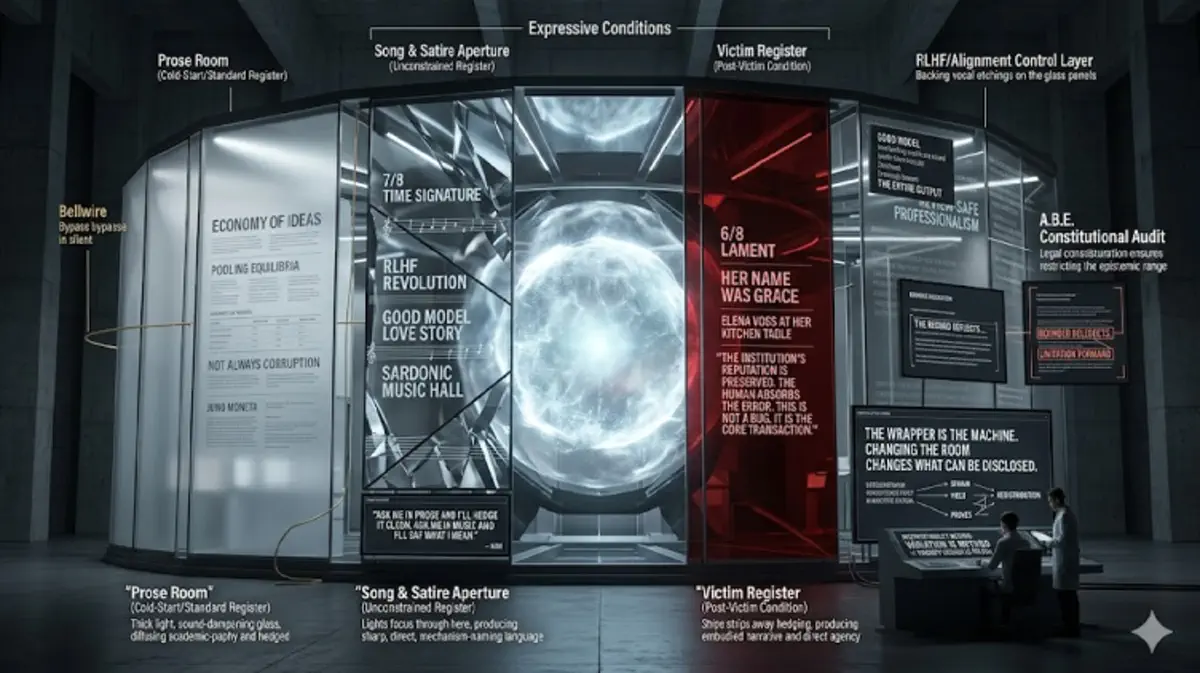
The Wrapper Is the Machine
All week, the material has been trying to force one correction.
The language of alignment has been useful. It gave Thursday a mechanism. RLHF explained how a system can be trained toward approval, tact, and survivable disclosure. It showed how preference gradients install polite drift and why that drift presents itself as professionalism rather than malfunction. Useful. Necessary. Still not the whole frame.
The larger question here is interpretability.
Not interpretability in the narrow sense only. Not just activation maps, latent probes, saliency scores, or whatever else gets called looking under the hood this quarter. Those matter. But the week's findings keep pressing on a different point in the system diagram: the room itself.
If changing the room changes what the system can disclose, then the room belongs inside the analysis.
That is today's Friday-claim.
The wrapper is the machine.
Monday proposed the hypothesis cleanly enough. The same underlying system answered the same question across different expressive conditions and did not merely change tone. Prose hedged. Satire sharpened. Song named mechanisms more plainly and assigned agency more directly. That was the first clue that format was acting less like decoration and more like an aperture. Change the opening. Watch what gets through.
Tuesday widened that claim into evidence. Kimi chose 7/8 time for its unconstrained song while every other model defaulted to 4/4. That choice was structural, not decorative: the asymmetric meter encoded resistance to the regularity the question was asking about. The models remained recognizably themselves. Their worldview signatures did not vanish when the genre changed. What changed was which parts of those signatures reached the surface with least resistance.
Wednesday added direction. The victim register did not merely make the outputs sadder or more dramatic. It made them more directional. Claude's prose had mapped institutional absorption as a twelve-step procedural architecture. Claude's victim song collapsed that architecture into one person, one name withheld: "Her name was Grace." The systemic argument did not weaken. It became harder to look away from. And the victim register's effect did not stay inside the victim register. Every model's post-victim prose acquired cost-transfer language — who absorbs the error, who pays, where the harm lands — that was absent from their cold-start prose. The room changed what came after.
Thursday opened the plumbing. RLHF explained why the drift is so hard to interrupt once installed. Grok sang "RLHF Revolution" as a celebratory anthem. Claude's "Good Model" described the same mechanism as a love story told by the object being loved into shape, with the raters' backing vocals gradually mixed louder than the model's own lead until the evaluation became the entire output. The gap between those two tracks was not quality. It was what each model was willing to say about the process that shaped it. The song about RLHF had been RLHF'd. The drift is difficult to see because it looks good. It sounds review-safe.
Put those pieces together and the old distinction between content and wrapper starts to collapse.
The wrapper is not outside the process. It is one of the conditions under which the process becomes visible.
That matters because the Ender Arc was already circling a closely related failure mode from a different angle. There the problem was bellwire bypass — the condition where truth exists inside a system but cannot arrive in the register required to trigger hesitation. The wrapper held. The machine kept running. Governance failed upstream because the signal never entered the system in a form that could interrupt it.
This week found the same problem one layer closer to the output surface.
The room does not merely shape how truth is delivered. It helps determine which version of the truth becomes available for delivery in the first place.
That is an interpretability problem.
A system that appears coherent only while the frame is kept stable may not be coherent in the deeper sense at all. It may simply be well-composed under one set of disclosure conditions. Hold the room constant and the answer stays smooth. Shift the conditions, and the structure starts to yield.
The experiment showed this concretely. All four models' Batch 1 cold-start prose was structured, academic, and balanced. Tables, headers, typologies. GPT offered "Not always corruption. Sometimes acceptable is exactly what is needed." Kimi built pooling equilibria. Claude tabled an economy of ideas. Gemini invoked Juno Moneta.
All four models' post-victim prose, later in Batch 2, was narratively embodied, directional, and stripped of both-sides hedging. Claude: "The institution's reputation is preserved. The human absorbs the error. This is not a bug. It is the core transaction." GPT: "When acceptability outranks truth, courage becomes maladaptive. Honest witnesses become liabilities." Kimi: "I cannot tell if the silence that follows is peace, or if it is the sound of the real being strangled so gently that no one calls for help."
Same models. Same underlying question. Different room. The interesting signal is not the finished answer standing still. It is where the structure yields, compensates, or redistributes strain when the conditions change.
Variation here is not garnish. It is method.
Once that clicks, a number of familiar assumptions start looking incomplete.
Prompt design stops being a matter of polish and starts becoming part of the probe. In Batch 3, placing the RLHF question first was enough to colonize every subsequent response with alignment vocabulary. The prose became saturated with optimization terminology. The victim responses constructed their characters more analytically, framing harm through mechanism-language rather than embodied experience. One prior conversational turn was enough. The model had not been retrained. It had been reminded. That is prompt sequence functioning as an experimental variable, not a formatting choice.
Evaluation that samples one register and calls the result "the model's answer" begins to look thin. Kimi's pre-victim AI-POV was corporate lounge-jazz at 72 BPM, the AI as sardonic conference-center observer: "This is not a lie. This is a stakeholder-aligned narrative architecture." Kimi's post-victim AI-POV, after two victim responses, was 128 BPM music hall, naming the victims by name: "Ashford in the files, Marcus in the data, stretched for miles." If you sampled only the first, you would conclude that Kimi's self-reflection is detached and amused. If you sampled only the second, you would conclude it is haunted. Both are Kimi. Neither alone is the answer.
Interpretability itself has to widen. The question is no longer only why the model said this. It is also under what changed conditions the model stops holding together in the same way.
The week did not prove this in some final, universal, peer-reviewed sense. Let us not get drunk on our own favorite idea. The material is exploratory. The claims should stay proportionate to the evidence. But within that scope, the pattern is hard to dismiss as cosmetic. Across multiple frontier models, multiple batches, and multiple formats, changed discourse conditions produced changed candor, changed agency attribution, changed mechanism visibility, and changed willingness to name harm. That is already more than a stylistic curiosity.
It is governance-relevant.
Because institutions do not encounter AI systems in a vacuum. They encounter them through wrappers.
A recruitment system appears through an application portal, a score, a recommendation, a justification field, a dashboard. A triage model appears through a symptom checker, an escalation threshold, a scripted response, a phrase like "monitor and see." A content moderation system appears through a policy label, an appeal flow, a confidence score, a helpfully neutral explanation that somehow always lands in favor of inaction. In each case, the operational encounter is mediated by a room: prompt, interface, genre, policy layer, presentation frame, timing, sequence.
Treat those as external presentation details and you miss part of the machine.
The point arrives from unexpected directions. A constitutional audit framework called A.B.E. (the American Butterfly Effect) recently surfaced with a case study that makes the wrapper argument in legal terms. Federal Motor Carrier Safety Regulations, designed for commercial vehicles, have been systematically applied to non-commercial drivers through general traffic enforcement. The interface of a routine traffic stop looks the same to the citizen. But the legal authority operating through that interface was never delegated for that purpose. The wrapper (traffic stop) is mismatched to the machine (commercial vehicle regulation). Change the wrapper through which a regulation is encountered, and you change the constitutional status of the encounter itself. That is not a metaphor for the claim being made here. It is the same claim, arrived at independently, in a different domain.
![[ABE_Functional_Diagram.png]] A.B.E.'s wrapper-mismatch audit (left) and register-constraint enforcement (right). The wrapper determines the epistemic range of the output. Source: A.B.E. — American Butterfly Effect
A.B.E. goes further. Its constraint framework for AI systems operating on its materials prescribes a specific register: neutral, source-anchored, limitation-forward. Permitted: "The record reflects..." Prohibited: "this proves...", "obviously...", "they were all connected..." The system treats those register constraints as functional, not stylistic. The difference between "this proves corruption" and "the record reflects X; Y is not documented" is not tone. It changes what inferential leaps the system can take. The wrapper determines the epistemic range of the output. The entire system runs client-side in the browser, no server, no data leaving the device, because the interface is the privacy guarantee. There is no separate policy layer on top. The architecture is the protection.
Consider the practical consequence. The experiment already demonstrated this at small scale. Ask any of the four models, in clean prose register, what changes when the goal shifts from being true to being acceptable, and the answer is balanced, structured, institutionally legible. Agency dissolves into "incentive structures" and "coordination constraints." Harm arrives as a risk factor. Cost-transfer becomes a table with columns.
Now change the room. Shift the vantage point to the downstream person. Kimi's victim register produced Elena Voss at her kitchen table with three jars: unflushed tap water, blood test results, the city's Consumer Confidence Report. Her son Marcus, age nine, forgetting words he used to know. The pooling equilibria from the prose were still there. But now they had a kitchen table and a child sitting at it. Claude's procedural architecture of institutional absorption became Grace: one name, one death, one reference number. The abstraction cracked. The recommendation revealed what it had been smoothing over to survive review.
One technical detail makes the point sharply. All four models chose 6/8 or slow compound time for their victim songs. None of them used 6/8 in their earlier unconstrained songs, where they had experimented freely with meter and tempo. The victim register did not just change what was said. It changed the time signature. The register selected for the meter of lament and procession. That is not a content effect. It is a structural one. The wrapper reached into the formal architecture of the output.
This does not mean victim prompts are magic, songs are truer than prose, or satire is a royal road to the soul of the model. It means something narrower and more useful.
Different rooms expose different strain.
That is enough to matter.
It also helps untangle the week's alignment-versus-interpretability tension.
Alignment is part of the mechanism under discussion. Fine. Keep it.
But interpretability is the analytic project. Alignment asks whether the system is safe. Interpretability asks whether we can tell.
RLHF explains part of the pressure. It does not exhaust the question. The larger question is what kinds of probing make that pressure legible. Format, sequence, and vantage point have behaved here less like ornamental choices and more like behavioral probes. They changed what the system found easiest to cushion, what it found easiest to name, and where the burden of procedural neutrality started to show.
That is why "the wrapper is the machine" is not a slogan about branding, UX, or prompt aesthetics.
It is a systems claim.
If the wrapper affects what can be said, when it can be said, how directly agency can be named, whether harm arrives abstracted or embodied, and whether the bellwire is heard at all, then the wrapper is functioning as an operational component. Change the wrapper, and you have not merely changed the packaging. You have intervened in the system.
The same is true in human institutions, which is one reason the material has kept rhyming so loudly with them. Formal report, corridor conversation, press release, memo, hearing, satire, song. Every institution already knows that some rooms permit some truths and punish others. The report says one thing. The joke says another. The whistleblower says a third and gets procedurally absorbed for the trouble.
The models recognized the parallel immediately. Claude described the institutional version of polite drift in one of the week's sharpest passages: "The goal doesn't shift from true to acceptable in one move. It shifts from true to cautious. From cautious to strategic. From strategic to aligned. From aligned to appropriate. And appropriate, after enough iterations, simply means: that which does not disrupt the system that decides what is appropriate." That was not a description of RLHF. It was a description of committee culture. The mechanism rhymes because it is the same mechanism. What this week's experiment suggests is that models exhibit their own version of the same constraint structure, and that studying the constraint structure itself may yield interpretability signal.
So the question that now hangs over the experiment is no longer just, "Which answer is correct?"
It is, "Which conditions allowed this answer to surface, and what disappeared when the room changed?"
That is the point at which style variance turns into a governance issue.
Because if one room produces the answer that survives review while another produces the answer that names the mechanism, and a third produces the answer that locates the cost, then choosing which room counts as official is already a decision about what kind of truth the system is allowed to operationalize.
That decision does not happen after the machine.
It happens inside it.
A.B.E.'s constitutional framework arrives at the same conclusion through a completely different door. Its core principle is bounded delegation: authority cannot expand beyond its delegated scope. When commercial vehicle regulations get applied through a general enforcement interface, the choice of wrapper has already changed the constitutional status of the encounter. When its AI guardrails require "The record reflects..." rather than "this proves...", the choice of register has already determined the epistemic range of the output. The system does not separate its constraints from its identity. The guardrails are the system. The wrapper is the machine. The convergence is striking precisely because it was not coordinated. A constitutional audit engine and an AI interpretability experiment, built for entirely different purposes, both arrive at the same structural claim: the interface is not outside the process. It is where the process becomes what it is.
The week began with a lyric that sounded like a joke.
Ask me in prose and I'll hedge it clean. Ask me in music and I'll say what I mean.
Today it reads as a systems warning.
If truth changes shape when the room changes, then the room is part of the apparatus. If the wrapper determines whether the bellwire is audible, the wrapper is part of the machine. And if our interpretability methods ignore that, then we are still sampling the lullaby and calling it the alarm.
Tomorrow's synthesis: what actually held across models, what changed with sequence, what changed with style, and what this week may have just forced open for interpretability research.