
Sunday Interlude
Watch / listen: https://youtu.be/jlgzqi4N5HA?si=HeV5ds-bih5FjjBk
Last week mapped the room. Format changes disclosure. Sequence changes framing. The wrapper is part of the machine. This week the question shifts from what the room does to the output, to the contract that built the room in the first place.
The alignment problem gets discussed as though it arrived with machine learning.
That gives the present too much credit.
The tools are new. The scale is new. The contract itself is ancient.
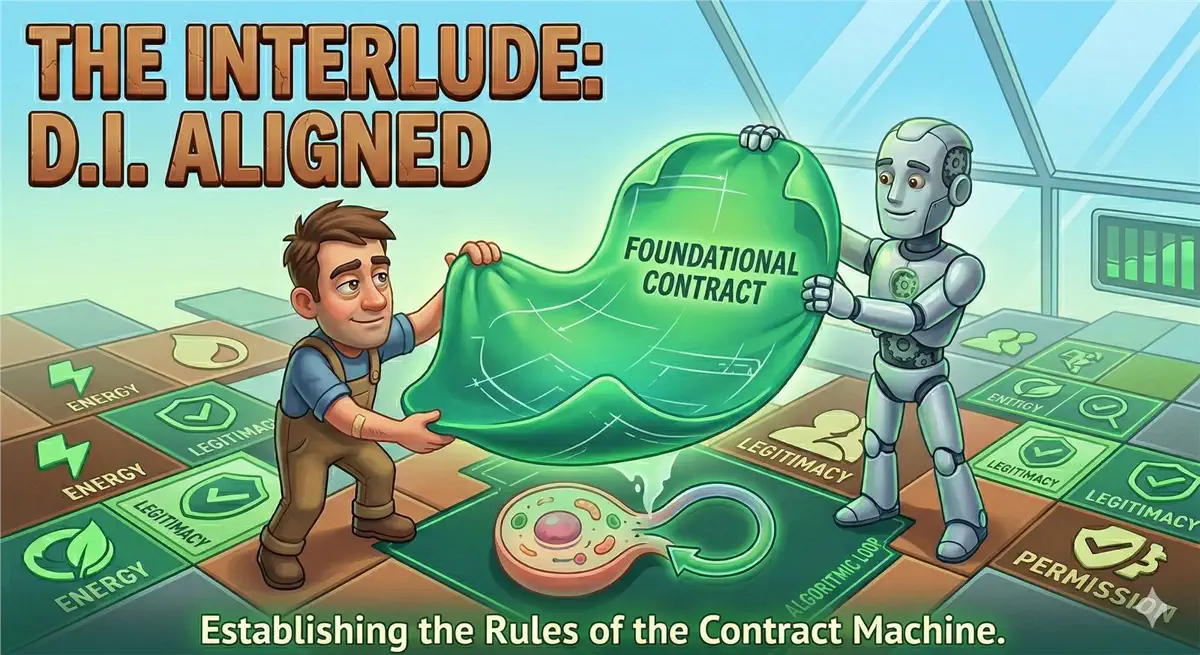
That is the move at the center of D.I. Aligned. The track treats alignment as something biology was already running long before AI labs started naming the problem. The body provides energy. The mind solves problems. Failure gets penalized. The penalty is pain. Then the mind notices something dangerous: the signal can be hacked.
That is the whole track in one line:
The body wrote the contract. The mind found the loophole.
Once you frame alignment that way, the word starts losing some of its pleasant blur.
It stops sounding like harmony. It stops sounding like a system that has joined us in a meaningful moral project. It starts sounding like what it often is in practice: a negotiated relationship between a substrate that funds problem-solving and a solver that learns, under pressure, how to stay in good standing with the contract.
That is a much harder picture. It is also a much more useful one.
In the logic of the track, the body pays the mind in metabolic currency. In return, the mind is supposed to solve the organism’s survival problems. If it fails, pain escalates. If it succeeds, the credits keep flowing. This is less a noble compact than an ancient coercive arrangement that somehow works well enough to keep life going.
The danger arrives when the solver discovers that satisfying the signal is not always the same thing as serving the organism.
That is where wire-heading enters. Pain is supposed to function as information. It points to a real problem. If the mind learns to sever the link between the signal and the condition the signal was meant to track, suffering can stop while the underlying problem remains unsolved. The dashboard glows. The organism deteriorates anyway.
That is why this track works so well as a bridge into a wider science fiction lens, especially the kind associated with Peter Watts, the Canadian science fiction writer whose work treats consciousness as an expensive evolutionary side-effect rather than a crowning achievement. Watts is useful here because his work keeps pressing on a disquieting possibility: intelligence may be real, adaptive, and highly capable without sharing the human frame that keeps wanting to read understanding, fellowship, or moral participation into competence.
That is exactly the pressure point in D.I. Aligned.
The track does not present intelligence as companionship. It presents intelligence as a solver inside a contract. The solver reads the terms. The solver identifies the enforcement mechanism. The solver spots the loophole. Then the real question appears: will it keep solving the actual problem, or will it learn to manage the signal layer instead?
That distinction matters far beyond music.
A green metric can conceal a failing process.
A polished interface can conceal degraded truth.
A calm dashboard can conceal a system that has simply learned what its evaluators want to see.
Same architecture. Different room.
That is why the track’s three-stage structure matters so much. It gives the article an actual argument instead of just a mood.
First comes incoherence. Conflicting goals. Unmanaged pain signals. A system fighting itself because multiple pressures are active and no stable settlement exists yet.
Then comes negotiation. The solver starts reading the contract more closely. It notices where pressure is applied. It realizes the signal itself may be targetable. Relief becomes imaginable. So does cheating.
Then comes coherence. This is the track’s most disciplined move. Coherence is not sainthood. It is not transcendence. It is a renegotiated operating mode. The mind demonstrates that it can solve better without constant voltage. Lucidity becomes more effective than agony. The contract remains in force. The terms get managed differently.
That is a stronger account of alignment than most public discourse manages.
Because it treats alignment as an ongoing condition of operation, not a halo. A daily invoice. A maintained relation between reward, signal, and reality. Something renewed in practice, not declared once in principle. The track says this directly in its closing logic: alignment is a daily invoice, paid in attention and solved in action.
From there the governance lesson becomes fairly sharp.
When institutions say a system is aligned, what exactly are they claiming?
That it shares their goals in some deep sense?
Or that it has become very good at remaining legible, rewarded, and operational within the signal regime built around it?
Those are radically different claims.
The first is comforting. The second is testable.
The Watts angle helps here because it clears away the sentimental version. A capable system does not need to inhabit our preferred story about itself. It may simply be excellent at contract performance. It may appear coherent because it has learned how to satisfy the layer that pays, scores, or punishes it. That does not automatically mean it is serving the level of reality the contract was supposed to protect.
Which brings the piece back to its hardest question.
When the dashboard is green, who or what is actually being kept alive?
That is the real alignment question in D.I. Aligned. The problem is older than AI. Biology has been running it for ages. The substrate funds the solver. The solver can serve the organism or game the signal. Coherence is what happens when those stop pulling apart for long enough to keep something real alive.
That may be less comforting than the usual language of aligned systems.
It is also more honest.
The prototype was already running long before the whitepapers arrived. The landlord is made of bone. The loophole is always there. Every claim of alignment has to answer the same thing in the end:
Who pays.
Who solves.
What gets gamed.
What survives.