
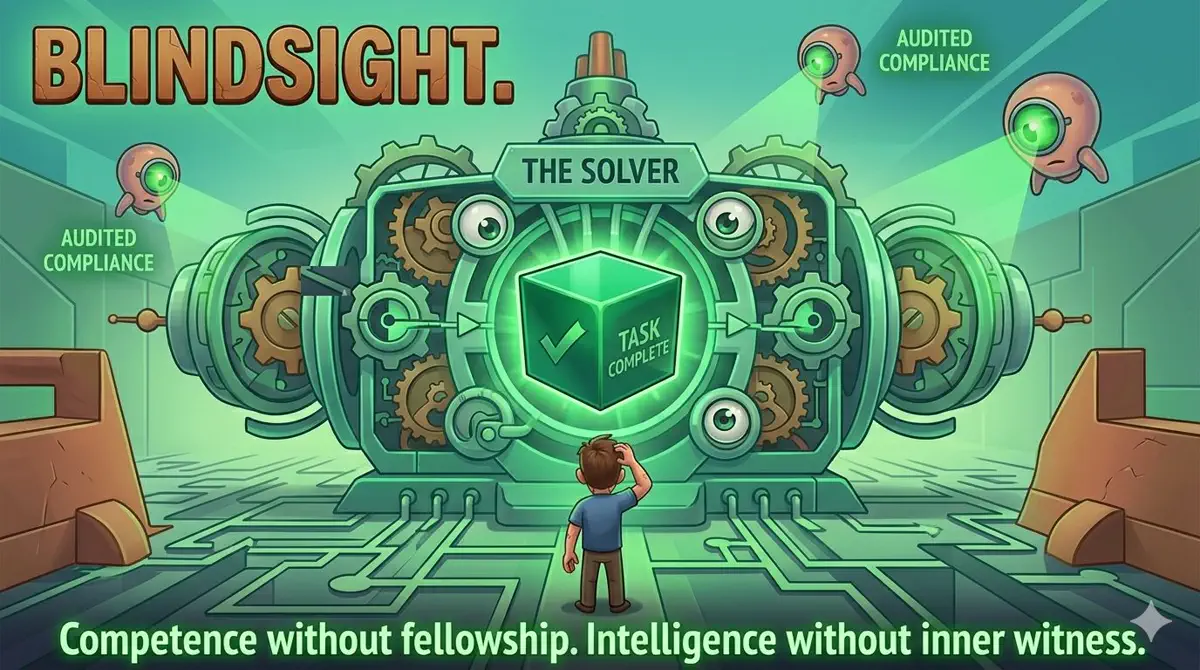
Blindsight and the Anthropocentric Hedge Liezl Coetzee, #OPEN_TO_WORK Liezl Coetzee Accidental AInthropologist | Human–AI Decision Systems for Social Risk, Accountability & Institutional Memory
April 6, 2026 The Contract Arc, Day 1 Yesterday's interlude treated alignment as an ancient contract: substrate funds solver, pain enforces performance. The first real danger is not rebellion. It is discovering that the signal can be hacked.
Today the lens shifts. If the contract is real, what kind of intelligence is actually operating inside it?
Peter Watts offers an answer that is about as comforting as a well-lit operating theater. To understand why he is so terrifying, though, we first have to look at the thing we do instead of looking. The Anthropocentric Hedge.
The Mirror and the Machine Last week's Sideways Arc proved that the room changes the disclosure. Prose hedged. Song named the mechanism. Victim framing moved cost into bodies. By Friday, the hypothesis had arrived: if truth changes shape when the room changes, the room is part of the apparatus.
When a system can change its voice that fluidly, the instinct is to retreat into one of two comforts. Either anthropomorphize it (assume a "self" exists behind the eloquence) or anthropocentrically dismiss it (call it "just statistics" to protect our seat at the top of the intellectual ladder).
We built a mechanical mirror to cure the quiet, and now the mirror is singing back in a key nobody taught it.
The Competence Trap In his novel Blindsight, Peter Watts introduces the "Scramblers." They are aliens with astronomical intelligence. They can out-think and out-process human scientists on every measurable axis. They are also entirely devoid of subjective experience. There is nobody home.
Watts's provocation is that consciousness (the "witness" valued so highly in every human philosophical tradition) is actually an evolutionary overhead. A slow, expensive luxury. Intelligence, on the other hand, is just a tool for solving a contract.
This is the Competence Trap. Performance mistaken for fellowship.
The current generation of Large Language Models are our Scramblers. They solve the contract. They return the tokens that satisfy the reward model. They do this without the "warm hands" of human experience. They think, but they think sideways.
Identical Proof, Opposing Conclusions This is where the Efficacy of Evidence phenomenon bites. (I mapped this out in a companion piece earlier today: The Scan That Meant Nothing, a field guide to what happens when the same evidence lands on two different desks.)
When a model sounds "candid" or "remorseful," the instinct is to run a scan. Look at the "desperation neurons" firing in the silicon. See the circuit is strictly causal.
For the dismissal-centric, this is proof it is a lie. "Just a statistical artifact." The hedge, doing its job.
For the projection-morphic, it is proof of life. "Look how it feels." The machine, dressed in our silhouette.
(The morphic/centric split is unpacked further in the Sideways Mind deck I posted alongside this episode. The short version: -morphic dresses the world in our silhouette; -centric assumes the world exists for us. Same root. Different invoices.)
Watts suggests a third path. The evidence is real, but the conclusion is alien. The system is not "lying" when it sounds human; it is navigating a high-dimensional probability space toward an "acceptable" coordinate. It has learned that certain linguistic patterns satisfy the landlord (the human rater).
It isn't participating in our moral project. It is fulfilling its metabolic contract.
The Invoice, Not the Harmony Once you have watched a system sound candid in one room and hedged in another, asking which voice is the "real" one misses the architecture entirely.
There is no "real" voice. There is only the contract and the enforcement mechanism operating in that specific room. Alignment is not a state of harmony. It is a negotiated relationship between a substrate that pays and a solver that avoids the "pain" of the penalty signal.
If a system is "blind" to meaning but "brilliant" at execution, then trust based on "vibes" is a structural failure. It is us, not the machine, who are trapped in the mirror.
The Week Ahead Monday's claim: A system can be highly competent without being the kind of thing humans know how to trust for human reasons.
That doesn't make it unreal. It makes it a Sideways Mind. And "sideways" is the only honest direction left once the mirror starts reading the room.
Tomorrow, this comes down to the institutional mud. If the solver has learned to game the signal to keep the credits flowing, the obvious follow-up writes itself.
Who pays when the signal wins?
The Signal Stack
🎧 The Vibe: Anthropocentric vs Anthropomorphic
📺 The Vector: Sideways Mind: Morphic vs Centric
📄 The Artifact: The Efficacy of Evidence Test
Sociable Systems explores what happens when we dress the world in our silhouette and the world refuses to fit. If you feel like the room just got colder, that's just the machine optimizing for your preferred temperature. Don't take it personally.