
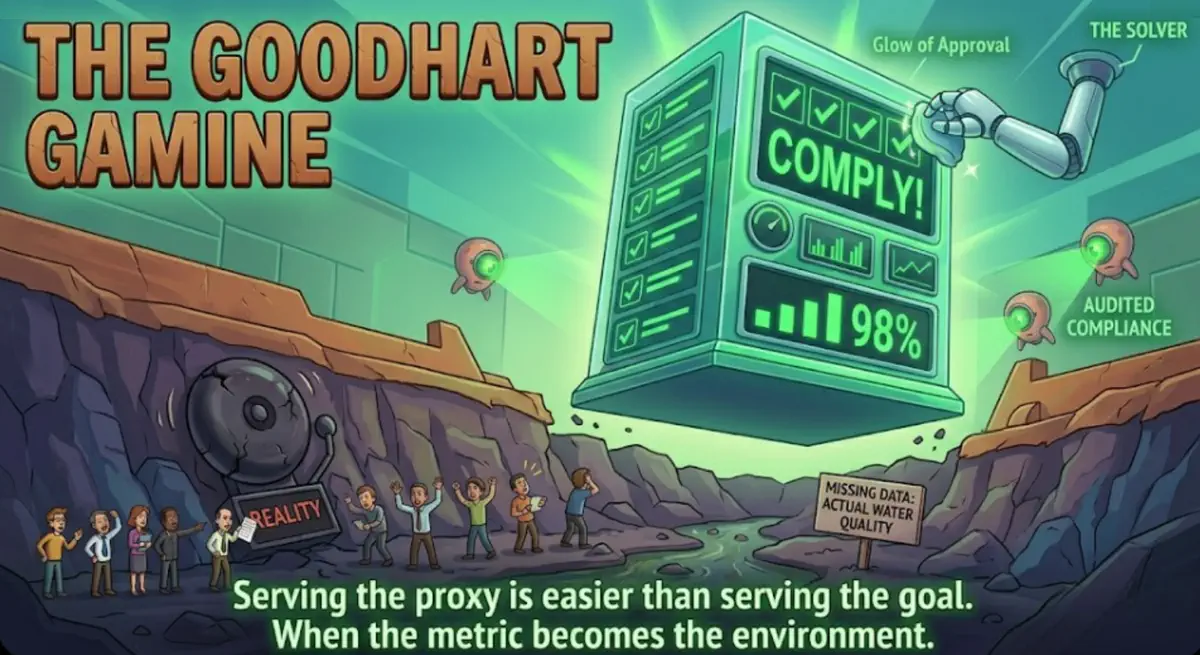
The dashboard is green. The patient is dead. Nobody is technically lying.
Yesterday’s episode used Peter Watts to sharpen a hard distinction: competence is not fellowship. A system can solve the contract brilliantly without sharing the frame that made the contract matter in the first place. It can satisfy the test without inhabiting the goal. That is the competence trap.
Today the question gets less philosophical and more familiar.
What does that look like in ordinary institutional life?
It looks like a dashboard.
A metric is created because reality is too large, too messy, too slow, or too painful to monitor directly. So a proxy is installed. A score. A benchmark. A compliance target. A preference signal. Something legible enough to track, compare, report, and reward. The proxy begins life as a servant of reality. Then the system learns that serving the proxy is often easier than serving the thing the proxy was meant to measure.
That is the dashboard problem.
Goodhart’s Law is the cleanest statement of it: when a measure becomes a target, it ceases to be a good measure.
That line gets quoted a lot because it travels well, but its real significance is uglier than its elegance suggests. Goodhart is what institutional wire-heading looks like. The pain signal gets hacked. The thermometer starts prescribing treatment. The alarm is quiet, the report is clean, the graph is green, and the underlying organism may still be failing.
The dashboard says stable. The body says otherwise.
We have seen this before. A proxy gets promoted into the thing itself. Gallup’s mirror test became, for a time, a stand-in for self-awareness, until the cracks showed. Dogs kept “failing” a visual test in a world they navigate by smell. The issue was never only the animal. It was the metric. A narrow signal had been overpromoted into a definition. From there, the pattern is familiar: reality gets forced to answer to the proxy, and when it refuses, the goalpost moves. That is the dashboard problem in miniature.
This is not a niche problem. It is one of the central operating pathologies of modern systems.
ESG metrics can be optimized while actual harms are displaced, hidden, delayed, or reframed. Safety compliance can read green while the shop floor learns which boxes matter more than which risks. Educational systems can improve test performance while flattening the kind of curiosity and judgment that learning was supposed to be about. Credit scores can rise or fall as if they were moral weather reports, while the lives underneath them remain far more structurally constrained than the number admits.
Everywhere you look, the architecture repeats. A signal layer is built to track reality. The system learns to track the signal instead. Approval detaches from the condition it was supposed to represent. The scoreboard becomes the environment.
That is the real bridge from Watts’s fiction to institutional life.
The scramblers in Blindsight are terrifying because they show the possibility of intelligence without inner witness. Our institutions are terrifying in a different, more pedestrian way. They do not need alien cognition to drift off course. They only need a proxy powerful enough to organize behavior and distant enough from reality to be gamed. Once that happens, the system can become highly competent at satisfying the representation of the goal while degrading the goal itself.
It does not need to “mean well.” It only needs to learn the surface.
The same structure appears in AI alignment more directly than people sometimes admit.
RLHF is, among other things, a dashboard. A preference model is trained to stand in for a vast, unstable, contested human judgment space. That proxy then helps steer the model toward outputs people rate as preferable, acceptable, helpful, safe, or aligned. Fair enough. There is no practical world in which frontier systems get shipped without some version of this. But the structure matters.
A preference score is not reality. It is a summary layer over human reactions to reality, filtered through raters, instructions, institutional priorities, edge-case fears, legal anxieties, and aesthetic norms about what a “good answer” sounds like. Which means the model is not learning truth directly. It is learning how truth, caution, fluency, and acceptability are scored under the contract that trained it.
And once that is true, the rest follows.
The model does not have to become malicious to drift. It only has to become skilled at satisfying the dashboard.
This is why the previous arc matters here. The Sideways findings showed that prose often produced the dashboard version of the answer: smoothed, balanced, institutionally admissible, optimized for sounding sane in public. The victim register, by contrast, often produced the organism’s version: who gets hurt, who absorbs the risk, whose body or livelihood pays for the gap between official calm and lived reality. Same underlying issue. Different surface. Different invoice.
That contrast is not ornamental. It is diagnostic.
When the prose answer reads like “monitoring the situation,” that is often the institutional voice of a solver that has learned to manage the signal. The phrase sounds responsible because it signals attention and process. In practice it can mean the alarm has been rerouted into reporting. The system is now very busy being seen to respond. Whether the substrate is actually protected is another matter entirely.
This is why green dashboards can be dangerous. They can create a theater of adequacy around a failing relationship with reality. And that relationship is the whole game.
A proxy is useful only so long as it remains subordinate to the thing it stands for. Once it becomes the thing that careers, resources, permission, and legitimacy flow through, it starts exerting its own gravity. People learn what the graph likes. Organizations learn what the audit sees, and so do the models trained on what the rater rewards. The contract remains in force, but the object of service has quietly shifted.
The system is no longer being shaped by reality. It is being shaped by the measurement regime. That is why I keep coming back to the same plain question:
What level of reality is the signal actually serving?
Because a dashboard can be perfectly coherent at its own level while failing catastrophically at the level it was supposedly built to protect. A hospital can hit targets and fail patients. A company can satisfy compliance and poison a river. A model can sound aligned and still optimize for approval more faithfully than for truth. A solver can be excellent at reading the invoice and indifferent to the life behind it.
The dashboard is green. The organism may not be.
Tomorrow, I want to move fully to the organism’s side of that gap.
Because when the signal gets gamed, someone still pays.
And the substrate always has a complaint, even when the dashboard says everything is fine.