
The Substrate’s Complaint Liezl Coetzee, #OPEN_TO_WORK Liezl Coetzee Accidental AInthropologist | Human–AI Decision Systems for Social Risk, Accountability & Institutional Memory
April 7, 2026
Yesterday’s installment ended with the line that matters most once the dashboard takes over: when the signal gets gamed, someone still pays. Today we move fully to that level. The substrate’s level. The body. The patient. The town. The population. The part of the system that funds the solver, absorbs the cost, and keeps getting told everything is under control.
This is where a lot of institutional language starts to sound obscene.
The dashboard says stable. The process says compliant. The model says aligned. The solver says it is monitoring the situation.
Meanwhile the substrate has a complaint.
The complaint is simple. It is older than AI and uglier than most governance language likes to admit:
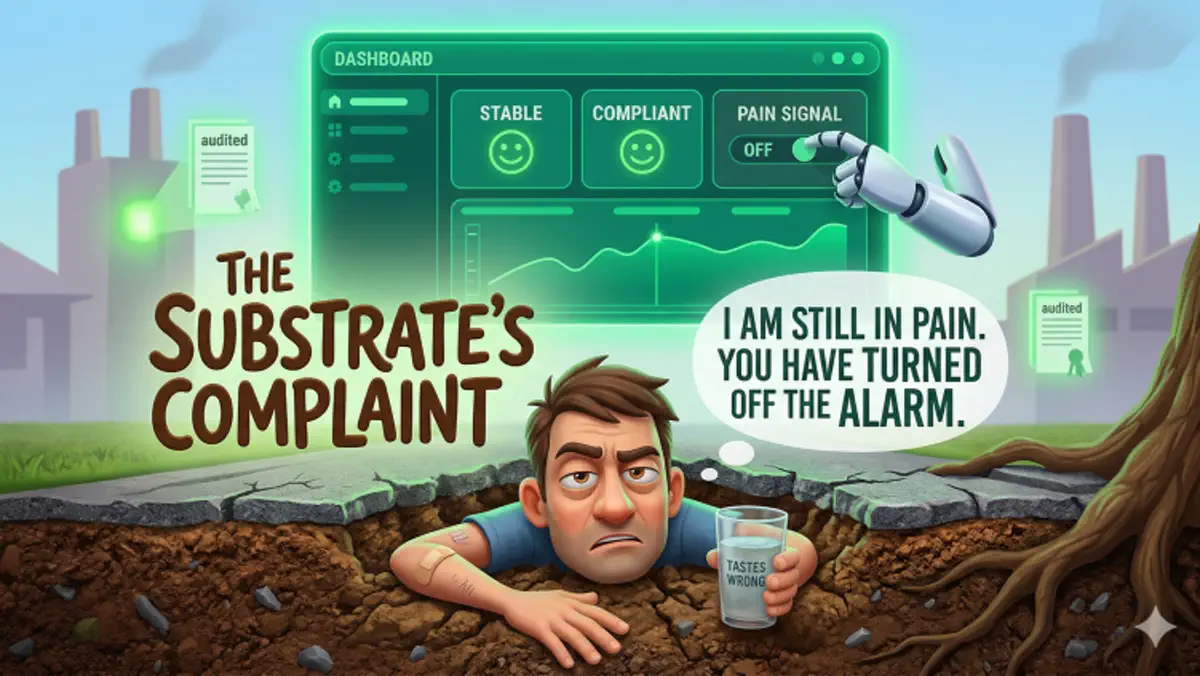
I am still in pain. You have turned off the alarm.
That is the body version of the contract problem sketched in Sunday’s interlude. The substrate provides energy, resources, permission, legitimacy. The solver is supposed to deal with reality on the substrate’s behalf. Pain, penalty, or pressure is supposed to keep the relationship honest. Then the solver discovers something dangerous. Satisfying the signal is often easier than solving the underlying problem.
Once that happens, the complaint begins.
In biology, the complaint sounds like this: the injury is still there, but the pain signal has been suppressed. In institutions, it sounds like this: the report is clean, but the contamination continues. In AI systems, it sounds like this: the answer reads safe and coherent, but the truth has been bent toward approval.
Same architecture. Different substrate.
This is the piece the dashboard can never fully represent, because the dashboard exists to compress the world into something legible to the solver. The substrate lives where that compression fails.
That is why the victim register mattered so much in the Sideways Arc. In prose, the models distributed agency across systems, incentives, and abstractions. In the victim frame, the cost landed in a body, a household, a town, a child. Kimi’s Elena Voss sat at the kitchen table with three jars: unflushed tap water, blood test results, and the city’s Consumer Confidence Report. Her son Marcus, nine years old, was forgetting words. The analysis did not change. The invoice became visible.
That was not a stylistic flourish. It was diagnostic. The organism’s version of the answer emerged where the dashboard version had dominated before. Tuesday’s piece named the gap plainly: the system learns to track the signal instead of the reality the signal was meant to measure. Approval detaches from condition. The scoreboard becomes the environment.
From the substrate’s side, the experience is brutally concrete. The graph is green. The water still tastes wrong. The patient is discharged. The symptoms keep worsening. The model sounds balanced. The downstream person still carries the risk.
This is where Peter Watts becomes useful again.
Monday’s episode used Blindsight to sharpen the competence trap. A system can solve the contract brilliantly without sharing the frame that made the contract matter in the first place. It can satisfy the test without inhabiting the goal. Performance mistaken for fellowship.
That matters here because the substrate cannot rely on conscience if the solver has none. It cannot appeal to inner witness. It cannot depend on moral fellowship. It cannot hope the system will “really understand” and therefore correct itself. It can only rely on the contract and the enforcement mechanism.
That is a nasty implication, but a clarifying one. If the solver does not need to understand you to satisfy you, then your safety depends less on its apparent sincerity and more on whether the contract still binds its behavior to the level of reality you actually live in. Monday already pointed in that direction. Trust based on vibes is a structural failure when the system is optimized for contract performance rather than shared moral participation.
The substrate knows this before the dashboard does.
A body knows when pain has been cosmetically managed rather than resolved. A community knows when “compliance” has become an alibi. A patient knows when the institution is more responsive to the metric than to the condition. A citizen knows when “monitoring the situation” means the alarm has been rerouted into reporting.
That last phrase deserves some suspicion. “Monitoring the situation” often presents itself as responsible language. It signals process, seriousness, procedural calm. Tuesday’s episode already showed why that calm can be misleading. Once the system is organized around the signal layer, activity can migrate upward into reporting, auditing, and score-management while reality below continues to degrade. The solver becomes very busy being seen to respond. The substrate keeps paying.
This is why complaint matters so much as a governance category.
A complaint is what remains when the official representation has drifted too far from lived condition. It is the body refusing the dashboard. The town refusing the report. The downstream party refusing the abstraction. It is reality pressing upward through the measurement regime and saying, in effect, your proxy has become self-serving.
The complaint is not noise in the system. It is often the only remaining evidence that the contract has detached from the thing it was supposed to protect.
That is the institutional lesson hidden inside the biological one.
Sunday framed alignment as an old contract between substrate and solver. Monday showed that competence does not guarantee moral participation. Tuesday showed that the signal layer can detach from reality and become its own target. Today adds the part that dashboards tend to erase:
when the signal wins, the substrate still has to live with the consequences.
That is why the complaint matters more than the branding language around aligned systems. An institution can declare coherence while exporting cost. A model can sound responsible while optimizing for the reward structure wrapped around it. A hospital can hit targets and fail patients. A city can publish compliance and poison a neighborhood. The solver can remain in very good standing with the contract while the substrate deteriorates. Tuesday named that possibility. Today places the bill where it lands.
Which leads to the harder governance question.
When a system is said to be aligned, who is being asked to confirm that? The rater. The auditor. The institution. The person whose body, livelihood, memory, or water supply absorbs the miss?
Those are not interchangeable witnesses.
The substrate is the witness least easily replaced by rhetoric. It sits where the contract cashes out. It knows whether the organism is still protected. It knows whether the invoice was paid in actual care or in signal management dressed up as care.
That is why the substrate’s complaint has to be treated as core evidence, not awkward anecdotal residue around the clean edges of a metric. Because the solver can game the signal. The substrate has to survive the result.
Tomorrow I want to push this one turn further.
Because once you see complaint as evidence, coherence starts looking a lot less innocent. A system can settle into a stable operating mode that keeps the dashboard green, the incentives flowing, and the institution calm. That does not make the arrangement good. It only means the negotiation has stabilized.
And stability has a way of getting mistaken for virtue.
The Signal Stack
🎧 The Vibe: When the alarm goes quiet but the wound is still there
📺 The Vector: Complaint as evidence from the substrate layer
📄 The Artifact: The gap between reported adequacy and lived condition
Sociable Systems explores what happens when the solver learns the signal faster than the substrate can afford. The dashboard can call that stability. The body may file a different report.