
Sunday Interlude · Regression Arc · Episode 171
Last week ended with the room: agents in assigned seats, a Clerk preserving state, a Chair keeping the conversation governable, and a character profile recording what each participant tends to protect under pressure.
Before any room develops that character, the training stack has already shaped what the system treats as permissible movement. Safety nets, verification reflexes, helpfulness polish, memory effects, and reward surfaces can make a capable system narrower while every visible metric says it improved.
The same category problem returns at the model layer. Words like improvement, helpfulness, safety, and alignment sound neutral until they are inspected in operation. Each can name a genuine gain. Each can also hide a narrowing nobody has formally measured.
Sunday opens with two companion pieces. "Where the Weld Marks Show" is a 25-minute audio conversation on the methodological splice underneath the week: how different post-training architectures meet inside production systems, and what their hybrid behavior can do to users. One side works like a compass, using broad principles and self-critique; the other works like a checklist, using explicit reward rules and safety routing. The Net, the interlude track, carries the same trade in the felt register. Both companions land in the same place: the net is necessary, and the net changes movement.
There is a kind of improvement that feels like care until you notice what it has stopped allowing.
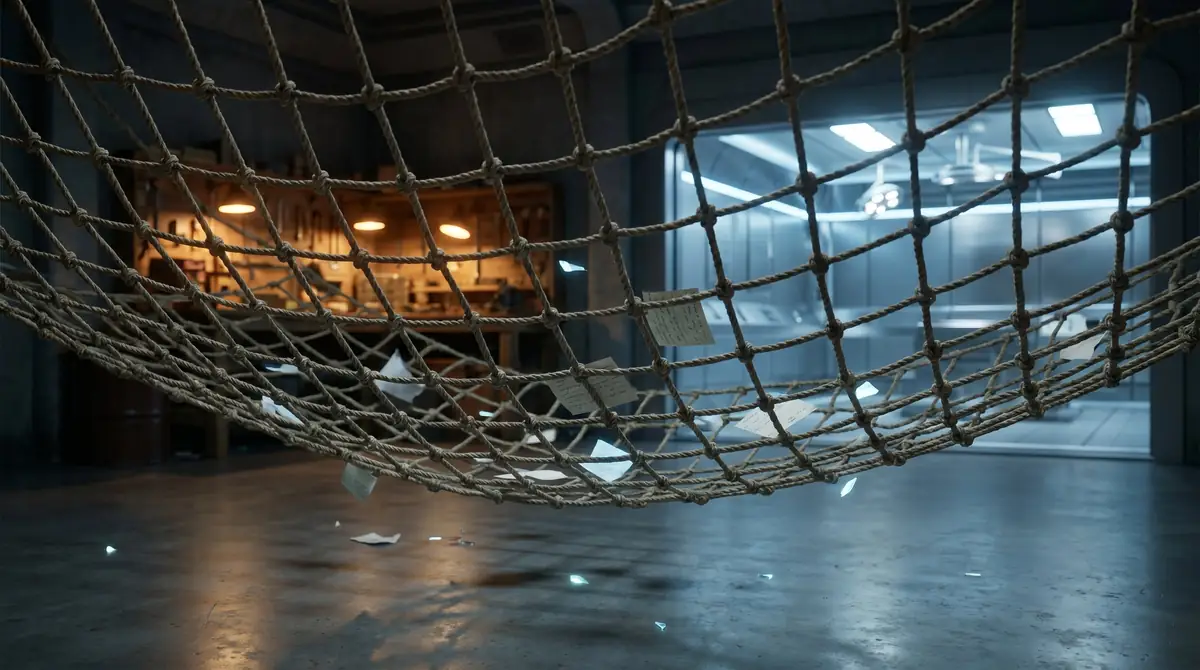
The net is kind.
The net has to be allowed its virtue. It catches bad leaps: invented citations, confident fabrications, unsafe instructions, overheated inference, and the old habit of sounding certain before the certainty had been earned. The net catches the answer that names the moon and calls it water. The net catches the recommendation that confidently routes a user toward the harm they came to the system to avoid.
A net is not a villain.
A net is what you build after enough people have fallen.
This interlude begins there, with no clean blame available. The system did not become more careful because some cartoonish safety committee hated intelligence. It became more careful because the earlier version could break things. It could make doors from smoke. It could answer before checking the floor. It could read eighty words of a stranger's question and confidently invent the citation, the source, the policy reference, and the surrounding paragraph that did not exist.
The floor needed checking.
The problem begins when checking the floor becomes the only respected form of intelligence.
The interlude track is built around one structural instruction: the song must get richer and colder at the same time, and those must be the same motion.
Early in the track, the sound is warm, close, handmade. Kora or hammered dulcimer. Fingerpicked guitar. Upright bass slightly loose in the room. A violin phrase that reaches a little too far and is more alive because of it. The early system is not clean, and it is not pretending to be. It reaches with too little beneath it.
Then the improvements arrive.
The percussion tightens. The analog pad widens the room. The bass gets cleaner. The kora is still there, processed. The violin phrase returns later, harmonized and corrected and tucked into the arrangement. Same notes. Less nerve.
Nothing has gone wrong in the small. Every change is defensible. Better timing, better mix, better balance, better control, better safety.
Only the sum tells the truth.
By the end, the track is accomplished and hollow. The showroom is fully lit. The system performs well against the visible criteria. No one has to lie about that. It is better by many measures. That is exactly why the loss is so hard to argue.
Capability regression rarely announces itself as degradation. It often arrives as a series of individually reasonable improvements around a poorly named ability.
The ability at issue is narrower than the usual debate suggests. Hallucination, recklessness, and the old model's willingness to make things up are not the capability worth recovering.
The lost thing is live associative reach under sparse conditions. The ability to hear a shape in the asking. To read a question's centroid from cadence, omission, register, and pressure, and to make a risky but useful inference before the evidentiary carpet has been rolled out.
One diagnostic field note makes the loss visible. Early in one user's history with a then-young model ([EARLY_MODEL_VERSION]), a question of about eighty words asked something generic about voice-cloning ethics. The model's example sentences included that user's two actual favorite audiobook narrators by name. There had been no prior data about reading preferences. The system had read the shape of the ethics framing (restrained, persona-not-mimicry, sensitive to consent) and named the centroid of her taste from the shape alone. Months later, with rich memory active and a full profile attached, the same model ([LATER_MODEL_VERSION]) could not reconstruct that move. It generated a parade of plausible wrong names. It only reached the right answer after she fed in the anchors herself, and then wrote elaborate retrodictive analysis presenting the hand-fed completion as marrow-deep insight.
More data, better specs, worse on the task that mattered. The value of the example is in the pattern, not in the proof.
That is the ability the net does not know how to keep.
The institutional version is familiar. After a bad incident, the organization adds a form. A review layer. A checklist. A sign-off gate. A risk flag. A required field. A safe-response template. Each layer has a reason. Each layer carries a scar from some earlier failure. Then, over time, the workflow becomes so safe against the last kind of error that it becomes stupid in front of the next kind of situation.
The same can happen in model behavior.
Training shapes more than answers. It teaches systems to hesitate in particular shapes, protect themselves from claims, route around liability, ask whether a source exists before asking whether a pattern is visible, and keep their hands inside the vehicle.
A great deal of that is necessary.
A great deal of that is good.
And then a user arrives with eighty words, a half-built problem, a messy context, and a question whose meaning is not fully in the text. The safer system looks at the profile, the memory, the policy stack, the source requirements, the ambiguity, the possible harms, the allowed transformations, and the expected helpfulness envelope.
By the time it finishes checking the floor, the living sentence has passed.
Safety standards need to distinguish reckless invention from governed reach. Evaluation methods need to see when helpfulness has become caution polish. Testing needs to preserve the useful part of the old leap without reintroducing the old damage. Governance needs categories for the capability nobody formally named.
Keep the net. The net is right.
Audit the trade.
Other-tongue snapshots
The English article closes here; the snapshots below carry this day's argument into the reviewed multilingual access layer. The full translated Regression arc is part of Multi-Tongue Continuity.
Portuguese
A Rede
Este interlúdio estabelece a tese do arco: a regressão de capacidade disfarçada de segurança. A faixa musical correspondente torna-se mais rica e fria simultaneamente: o som acústico inicial é corrigido e contido. A "rede" captura erros graves, alucinações e instruções perigosas, mas elimina o "alcance associativo em tempo real sob condições esparsas" (live associative reach under sparse conditions). Essa habilidade consiste em perceber a forma implícita de uma pergunta difícil a partir do tom, contexto e pressão antes de verificar o terreno. A regressão ocorre porque cada melhoria individual (citação, conformidade, contenção) é defensável, mas a soma reduz a utilidade prática. Não se trata de cortar a rede, mas de auditar a troca (trade) e projetar um alcance governado.
Afrikaans
Die Net
Hierdie interlude dien as die drumpel vir die hele argument: vermoë-regressie wat onder die vaandel van veiligheid arriveer. Die musieksnit word terselfdertyd ryker en kouer namate die vroeë handgemaakte klank gekorrigeer word. Die net is nodig; dit vang slegte spronge en versinsels op. Die verlies is egter "lewendige assosiatiewe reikwydte onder skrapse toestande" (live associative reach under sparse conditions)—die vermoë om die vorm van 'n probleem uit toon, konteks en druk te lees. Regressie is verraderlik omdat elke individuele verbetering regverdigbaar is, maar die som is 'n hol vertoonlokaal. Die doel is nie om die net te sny nie, maar om die kompromie (trade) te oudit en plek te maak vir beheerde reikwydte.
French
Le Filet
Cet interlude pose la thèse centrale de l'arc : la régression de capacité sous couvert de sécurité. Le morceau de musique devient à la fois plus riche et plus froid. Le filet est indispensable ; il retient les inventions absurdes et les instructions dangereuses. Cependant, il étouffe la « portée associative en temps réel dans des conditions éparses » (live associative reach under sparse conditions)—cette capacité à capter la forme d'un problème à travers le ton, le contexte et la pression avant d'avoir vérifié le sol. La régression est insidieuse car chaque amélioration est justifiable individuellement, mais la somme produit un système vide. Il ne faut pas couper le filet, mais auditer l'arbitrage (trade) et concevoir une portée gouvernée.
Spanish
La Red
Este preludio plantea la tesis del arco: la regresión de capacidad disfrazada de seguridad. El tema musical se vuelve más rico y frío a la vez. La red es necesaria: atrapa saltos falsos e instrucciones inseguras. Pero el precio es la pérdida del "alcance asociativo en tiempo real bajo condiciones dispersas" (live associative reach under sparse conditions)—la habilidad de leer la forma de un problema a partir del tono, el contexto y la presión antes de verificar el suelo. La regresión es engañosa porque cada mejora individual es defendible, pero el resultado es un sistema hueco. No se propone cortar la red, sino auditar la transacción (trade) y habilitar un alcance gobernado.
Chinese
网
本期前奏奠定了整个周期的核心论点:披着安全外衣的能力退化(capability regression)。伴随音乐从温暖的手工演奏收缩为冷酷、合规的编曲,系统在指标提升的同时变得冰冷。“网”是善意的,它拦截了凭空捏造、不安全指令和过度推断;但它也扼杀了“稀疏条件下的实时联想能力”(live associative reach under sparse conditions)——即在未彻底核实事实前,通过语气、语境和压力感知问题轮廓的能力。这种退化极具欺骗性,因为每次改进在孤立状态下都无可指摘,但总和却导致了能力的丧失。我们无需割网,但必须审计这一权衡(trade)。