
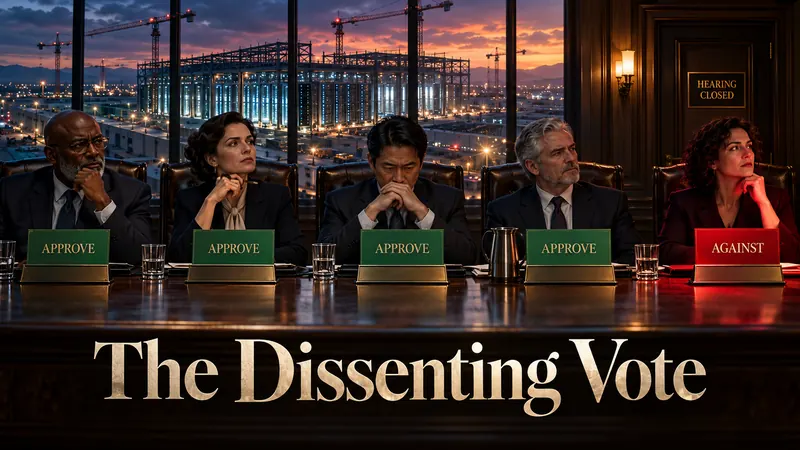
On 14 July, Cape Town’s Municipal Planning Tribunal approved a land-use application for two very large data centers at King Air Industria, beside the international airport. The applicant was the landowner, King David Country Club. The vote was four to one.
The vote against came from planner Wally Johnstone. He argued that the record lacked an adequate account of water and electricity use, including the implications for grid stability and public access to power. The proposed facilities covered about 120,000 square meters. The July reporting included an electrical-capacity figure of 174 megavolt-amperes, or MVA. A capacity figure does not by itself explain the effects of supplying the load. MVA also measures a different electrical quantity from megawatts; the units cannot simply be exchanged.
The applicant’s representatives said further figures would come with the site development plan, the later detailed layout and servicing plan. The chair promised close scrutiny at that stage and again when building plans arrived. The tribunal approved the changes to land use and parcel boundaries. It also relaxed an earlier floor-space restriction.
What later scrutiny can decide
Cape Town’s planning by-law gives the City powers to require servicing details in a site development plan. Item 123(5) also protects a plan that complies with the zoning and conditions of approval from refusal. The later plan is examined against permissions and requirements already set.
The conditions therefore matter as much as the promise of scrutiny. A binding requirement for an adequate water supply can make a later figure consequential. A promise to examine that figure leaves its effect less clear. The general by-law alone cannot settle how far the City could require changes at King Air: that depends on the operative approval conditions and other applicable controls.
The question Johnstone raised belongs at the decision allowing the use of the land. Which effects were understood before approval, and which requirements would govern the figures deferred to later stages? Confirmed After Approval traced the danger of information arriving after the decision it should inform. Here a member with power to vote asked for more evidence and lost. The approval is now suspended during the appeal; the tribunal vote is not an unrestricted permission to start building.
The appeal and its record
The Housing Assembly and Foxglove challenged the approval, represented by the Legal Resources Centre. Their case is that the tribunal lacked adequate resource evidence and deferred the effects of backup generation. They also question whether it assessed the facilities’ combined impact. The Housing Assembly organizes Cape Town communities seeking decent housing; Foxglove is a UK nonprofit working on technology justice.
Before the appeal panel’s scheduled meeting, the appellants said they were denied Equinix’s response, although the company could see their appeal. They also objected to a closed meeting and requested an opportunity to address the panel. Those are separate concerns: a chance to speak does not by itself provide a chance to answer documents withheld.
EWN reported on 13 October that the panel considered the matter the day before. The City called the exclusion claims premature and said both sides could request oral representations. EWN reports approval of such a request, but its account leaves unclear which party would speak and when. The dispute over access to the company’s response remains distinct from that speaking opportunity.
The panel advises the appeal authority, expected to be executive mayor Geordin Hill-Lewis. On the appellants’ reading of the by-law, the authority has ninety days from the panel meeting to decide, potentially carrying the decision into January. South Africa’s local-government election is on 4 November. The appellants asked for a decision before that election and publication of the panel’s recommendation with reasons. They also sought access to the company’s response and a pause on further approvals while a participatory framework is developed.
The appeal can change the outcome. Its usefulness depends partly on a record each side can test, and on reasons the public can read. A calendar deadline settles neither question.
The apology
Denver shows what a later policy response can leave untouched. In October 2024, its City Council considered a nine-million-dollar tax incentive for a CoreSite data center in Elyria-Swansea. The neighborhood already lives beside a refinery and contaminated sites designated for federal cleanup. The incentive passed, and construction followed.
In May 2026, the council unanimously approved a one-year moratorium on new data-center permits while it develops rules. Council members apologized for the earlier decision. Councilmember Sarah Parady said she regretted that the council failed to act sooner.
City attorneys advised that the CoreSite building already under construction fell outside the pause. The moratorium blocked two further buildings planned for the campus. It left construction of the permitted building untouched. That is a limit of this moratorium, rather than proof that every possible public power has expired.
The apology acknowledges an earlier failure and can shape the next decision. Households beside the permitted building live with the consequence that remains.
Two markers on one road
Cape Town records a request for more evidence at the point of approval. Denver records regret after construction began. The distance between them is measured in concrete.
An appeal and a moratorium have different powers. Neither can be judged by its name alone. The useful questions concern the permission it can change and the conditions it can enforce. Johnstone’s dissent identifies a decision where further evidence was requested while the tribunal could act. A lost vote is a place to start reading.
Companions
- The Compact Majority, on processes that count expressions.
- Confirmed After Approval, on figures scheduled past the decision.
- The Dissent Stays on File, on preserving the losing account.
- Before the Commit, on deciding reversibility in advance.
Bibliography
9News, ‘“My biggest regret on council”: Denver city council apologizes for allowing data center to be built, passes moratorium’, May 2026.
City of Cape Town, Municipal Planning By-law, 2015, consolidated to 2025, Schedule 3, item 123(5).
Daily Maverick, ‘Two giant data centres secure initial green light from Cape Town municipal tribunal’, 14 July 2026.
Foxglove, ‘Local communities and media shut out of Equinix data centre appeal hearing as campaigners call on Mayor to decide before the elections’, 9 October 2026.
Foxglove, ‘US data centre gets approval in South Africa despite unknown impact on water and power’, 14 July 2026.
IT-Online, ‘King Air appeal tests Cape Town rules for hyperscale data centres’, 6 October 2026.
Ngcobo, Thandoluhle, ‘City of Cape Town denies locking applicants out of data centre appeal’, EWN, 13 October 2026.
Rocky Mountain PBS, ‘Denver approves one-year pause on new data centers’, May 2026.
Roos, Tara, ‘Appeal against Equinix data centre to be heard behind closed doors’, Business Day, 11 October 2026.