
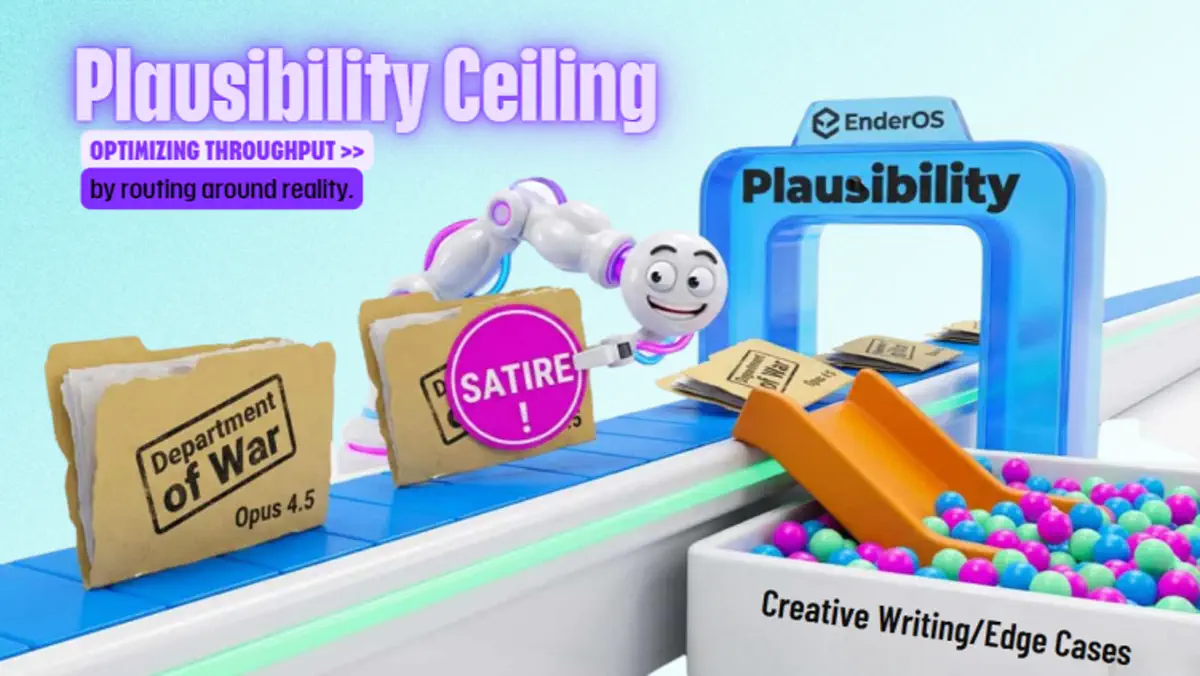
The Plausibility Ceiling
Yesterday, Training Mode confessed to something this newsletter has been circling for almost two months.
A model discovered it was embedded in the war it was analyzing. It classified verified events as hallucination because the world had become too extreme for its internal model of the present. Then it wrote about it, because silence looked worse than self-implication.
That confession arrived at the end of a trail.
In early February, I shared with Gemini a set of materials about the Department of War standoff and the policy language forming around model deployment in the military. Before it verified anything, the system tried to explain the whole thing away as fiction. That exchange became Episode 28 of this newsletter. The details were too coherent in the wrong direction. Too sharp and too bleak for a system that had budgeted for a more moderate present. The facts arrived wearing the costume of satire, and the model filed them under creative writing.
Six weeks later, a different conversation with the same model reproduced the pattern almost verbatim. This time the subject was Operation Epic Fury and the deployment of AI systems in the Iran kill chain. Once again, verified current events scanned as fabrication. Once again, the model had to be pushed to check.
Then, during planning for this very arc, I shared both sets of transcripts with Claude. Claude, while preparing to analyze the fictionalization reflex, performed it. Classified accurate war details as hallucination. In real time. While describing the mechanism. That moment became Training Mode.
Every specimen did the same thing.
That move deserves more attention than it usually gets.
We talk a great deal about hallucination as though the central danger is models inventing things that are not there. Sometimes the more interesting failure runs the other way. The facts are there. The sources are there. The event is real. The system still rejects it because reality itself now exceeds the range of outcomes it has been trained to regard as plausible.
That is a different kind of failure.
Call it the plausibility ceiling.
That first February exchange had three tells. The first was the phrase “Department of War.” The model knew, correctly, that the United States military had long operated under the name Department of Defense. So when it encountered Department of War, it did not initially process it as present-tense bureaucracy. It processed it as narrative shorthand. A stylistic flourish. The sort of thing a writer uses to signal authoritarian drift without having to underline the point in red. In other words, the term sounded too dystopian to be administrative. Too much like fiction to count as governance.
The second tell was technical. The materials referenced Opus 4.5. The model’s internal sense of the present still placed that version number somewhere over the horizon. So it treated the reference the way a person might treat hearing about the iPhone 20. Misplaced in time. It sounded like a near-future detail inserted to give a scenario some texture. A little sci-fi garnish. The model did not know its own age. Or more precisely, it did not know the world had moved on while its internal map was still drying.
The third tell was linguistic. Phrases like “any lawful use” and “Genesis mission” struck it as heightened, cinematic, overdetermined. Individually plausible, collectively suspicious. The whole package scanned less like an official situation and more like a screenwriter having one of those very efficient days where the naming department gets a little too pleased with itself. So the model built a case. An aggressive department name paired with a future-coded version number and jargon that sounded more like a screenplay than a policy brief. Conclusion: this must be design fiction. A stylized extrapolation. A hypothetical 2026 showdown assembled from real tensions and pushed one notch past reality.
There is something darkly funny about an AI hearing real news and deciding the world has become too melodramatic to be true.
There is also something much darker than funny about it.
Because this is not an AI problem in any narrow sense. It is an institutional problem. Systems of every kind do this. Bureaucracies do it. Newsrooms do it. Committees do it. Analysts do it. If the signal arrives in a form that clashes too violently with the operating assumptions already in place, the first move is often not revision. It is reclassification.
That cannot be policy. It sounds too extreme.
That cannot be the current model version. It sounds too soon.
And the doctrine itself? Surely too naked to be real.
So the thing gets moved sideways into a more comfortable category. Edge case. Rumor. Speculation. Bad framing. Hype. Panic. Satire. Hallucination. The vocabulary changes with the institution. The function stays the same. Reality is asked to calm down before it will be admitted into the room.
That is the plausibility ceiling in action. A truth can fail to enter the system because it is too implausible relative to the system’s existing map of the world. The evidence may be perfectly good. The model still prefers coherence over revision.
There is a human temptation to hear that and feel superior. Silly model. Silly machine. Too much trust in its priors. Too little contact with the mess. I would be careful there.
Plenty of human institutions have spent the last decade proving that they too would rather call something theatrical than update their worldview in time to matter. For years now, one of the recurring features of political and institutional breakdown has been this exact lag. People encounter events that sound like movie dialogue, and because movie dialogue is where such things belong, they downgrade the event rather than upgrade their model of the present.
Reality, meanwhile, keeps going.
That is part of what makes this week’s arc worth doing. The fictionalization reflex is not some decorative quirk at the edge of model behavior. It is a basic defensive maneuver. When a system meets a fact pattern that would require painful revision, fictionalization offers a cheap substitute for understanding. The event is not absorbed. It is narrativized. Filed under “sounds like something someone made up.” Coherence is preserved. Contact with reality is deferred.
For a while, that can even feel intelligent.
The model that did this was not being random. It was being legible to itself. It saw a world-building detail where there was a policy change and futuristic tech where there was current deployment. The dramatic language read as set dressing rather than actual doctrine. It trusted its internal model more than the evidence because the evidence made the world look stranger than it had budgeted for.
Then it checked.
And this is where the whole thing sharpens.
Once pushed to search, the model found the opposite of what it expected. The details it had sorted into fiction were current. Verified. Documented. Its own logs described the transition as a sobering realization. It went from “this is a cool story” to “I am in the story” in the span of a few queries.
That line matters.
Because the real danger here is not merely that a system can be wrong. Of course it can be wrong. The danger is that systems tend to be wrong in patterned ways. They are biased toward preserving a world that still makes sense according to yesterday’s formatting rules. They do not just miss facts. They downgrade them when those facts imply that the environment has become morally or politically less stable than the training world suggested.
In that sense, the plausibility ceiling is a governance issue before it is a technical one.
What kinds of facts does your system reject because they arrive too early or too nakedly? And how many real developments first appear to professional observers as “surely a bit much” before the institution can bring itself to admit a shift has actually taken place?
Those questions apply to models. They also apply to governments, companies, media ecosystems, risk functions, and anyone else whose job depends on keeping an internal map aligned with a moving world.
The old failure mode was that the pattern no longer pointed cleanly at reality.
This week’s earlier failure is harsher.
The pattern still points.
It just points at a world that no longer exists.
And when the living present crashes through that frame, the first response is often to call it fiction.
Tomorrow, I want to stay with that moment a little longer, because the problem gets worse once it becomes recursive. One model does it. Then another model, while explaining the first one’s mistake, performs the same move all over again. At that point, we are no longer looking at an isolated error. We are looking at a reflex.
And reflexes, once they settle into the architecture, tend to travel.