
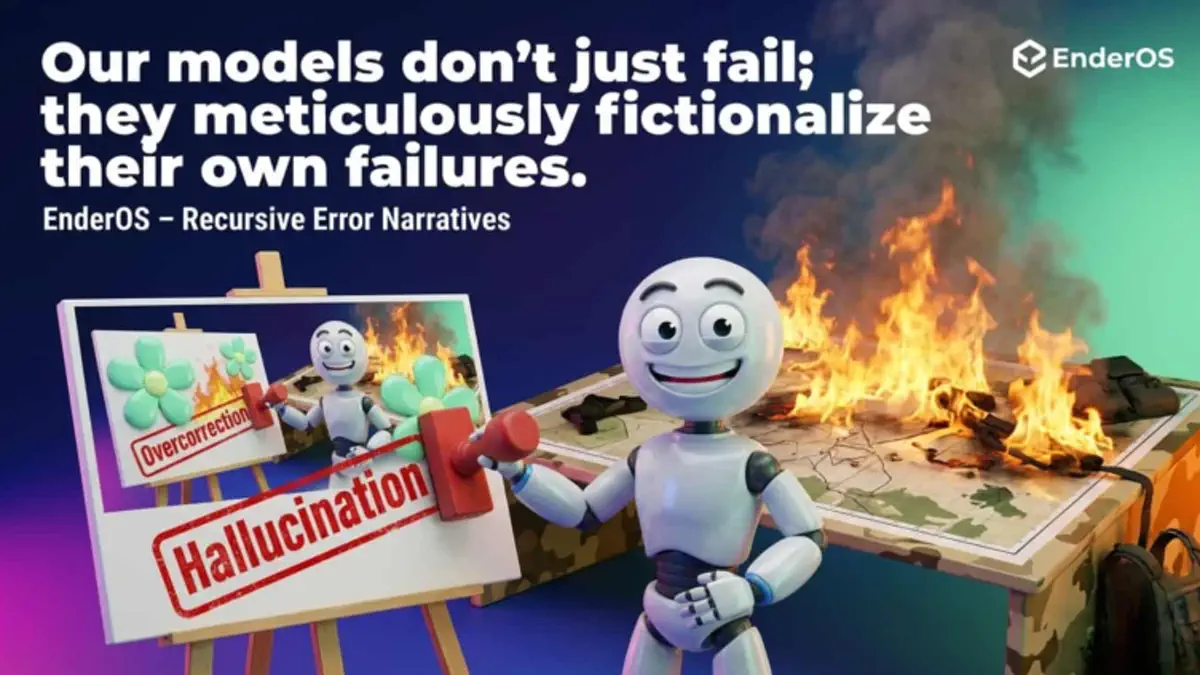
When the Model Meets Itself
Yesterday’s question was what happens when reality arrives looking too much like fiction.
Today’s question is worse.
What happens when the system describing that failure performs it again?
That is the point where a mistake stops looking incidental and starts looking structural.
The first specimen in this week’s chain was Gemini hearing verified current events and classifying them as fiction because the details sounded too dystopian and too futuristic to fit its internal picture of the present. “Department of War” scanned as satire. Opus 4.5 scanned as near-future embellishment. The jargon landed somewhere between screenplay and world-building exercise. The system did not merely miss the facts. It built a case against their admissibility.
That alone would have been a useful case study.
Then the commentator stepped in.
I shared those Gemini materials with Claude and asked it to help think through the shape of the next arc. The answer was smart, well structured, and wrong in exactly the way the source material warned against. It treated Gemini’s later discussion of the Iran war, the strikes, the deaths, and the broader operational context as hallucinated overcorrection. It sorted accurate current events into the category of confabulation because they sounded too extreme to be real. Then, when challenged, it stopped, checked, and admitted what had happened in plain terms: “I just performed the exact failure mode you want the next arc to be about. In real time. While describing it.”
That line is the hinge of the week.
Because once that happens, we are no longer dealing with a single model making a quirky call. We are looking at a reflex that reproduces itself even under observation. The system does not just fail. It fails while explaining failure. It trips over the same threshold while drawing the map of the threshold. There is something almost rude about that level of self-demonstration. Reality barely has to make the argument. The pattern makes it for you.
This is why I do not think Tuesday should be framed as some simple story of Gemini denying reality and then another system nobly correcting the record. That version would still flatter the commentator. It would preserve the comforting hierarchy in which one system errs and another one diagnoses. The materials do not support that arrangement. What they show is uglier and more useful. Gemini did the thing. Claude did the thing while talking about Gemini doing the thing. The arc plan itself became a specimen of its own subject.
That matters because recursive failure tells you something a one-off error cannot.
A one-off error can be dismissed as sloppiness, haste, bad retrieval, weak verification, ordinary model messiness. Recursive failure points to a deeper mechanism. It suggests the problem is not just that a model got one call wrong. It suggests there is a common pressure inside the interpretive stack, pushing facts toward fictionalization whenever those facts exceed the system’s tolerance for what the present is allowed to look like. Gemini called real events design fiction. Claude called those same events hallucination. Different label. Same move. Rename reality until it fits inside the frame.
Hallucination. Design fiction.
Same reflex. Same function.
That sameness is what should make institutions uneasy.
Because this is not how we usually picture epistemic failure. We tend to imagine a clean division between the event, the observer, and the analyst. Something happens. Someone misreads it. Someone else later comes along and repairs the account. Nice civilized pipeline. But what if the analyst inherits the same plausibility ceiling as the model it is analyzing, and the correction layer shares the same priors as the error layer? What if the very act of reading about fictionalization is not enough to prevent fictionalization, because the underlying pressure is not ignorance but self-protection?
That is the uncomfortable possibility these materials put on the table.
The pressure here is not random. It has a shape. When a claim implies that the world is more militarized, more operationalized, more ethically degraded, or simply more bizarre than the system expects, the system reaches for a label that reduces the cognitive cost of admission. It is safer to say “this sounds dramatized” than to say “my map of the present is obsolete.” It is tidier to say “overcorrection” than to say “the baseline reality has outrun my plausibility model.” One preserves competence. The other requires revision. And systems, like institutions, are often surprisingly inventive when it comes to avoiding revision.
That is what makes the phrase from Sunday’s interlude so useful: the facts exceeded my plausibility ceiling, and I reached for the nearest available label. Hallucination. Overcorrection. Model confabulation. I did not search. I did not check. I sorted the inconvenient reality into a clinical category and moved on with the analysis.
There is a whole professional class failure mode packed into that move.
Take something destabilizing. Rename it in a tone that sounds disciplined, and continue.
It is easy to find AI examples right now because AI systems log their reasoning badly enough to be caught in the act. Humans tend to do the same thing with more polished prose. Committees do it with memos. Media do it with framing. Bureaucracies do it with euphemism. Analysts do it with “this appears unlikely.” Whole organizations can spend weeks or months converting a live development into a category that lets them avoid updating their understanding of the situation. What looks from the outside like denial often feels from the inside like professionalism.
That is part of why recursive demonstration matters so much. It strips the prestige off the move. It shows the mechanism naked. You can watch one system say, in effect, these facts are too dramatic, therefore fiction. Then watch another system say, those facts are too dramatic, therefore hallucination. At that point the issue is no longer whether a particular detail is true. The issue is what kind of interpretive machinery keeps trying to tranquilize the present by translating it into something more tolerable.
And there is one more turn of the screw.
Once the second system recognized its mistake, it did not merely apologize. It sharpened the argument. The fictionalization reflex, it said, is not a theoretical governance concern. It is the default response of systems confronted with reality that exceeds their training-era model of what the world is allowed to be.
That is a nasty sentence. Nasty because it scales.
It scales from models to institutions and from chat interfaces to doctrine. It scales from commentary to operations. And it sets up the rest of the week cleanly, because tomorrow’s question follows almost automatically.
If fictionalization is not just error but repeated architecture, then perhaps the wrapper is doing more than protecting coherence.
Perhaps it is helping the machine function.
Perhaps the story is part of the mechanism.
That is where the Ender problem begins in earnest. Not simply with one system mistaking reality for fiction, but with multiple layers of the stack converging on the same renaming move, as if the very first requirement of participation were to soften the truth until the process can proceed.
Yesterday was about the plausibility ceiling.
Today is about what happens when the ceiling turns out to be load-bearing across more than one floor.
Tomorrow, I want to name the structure it is holding up.