
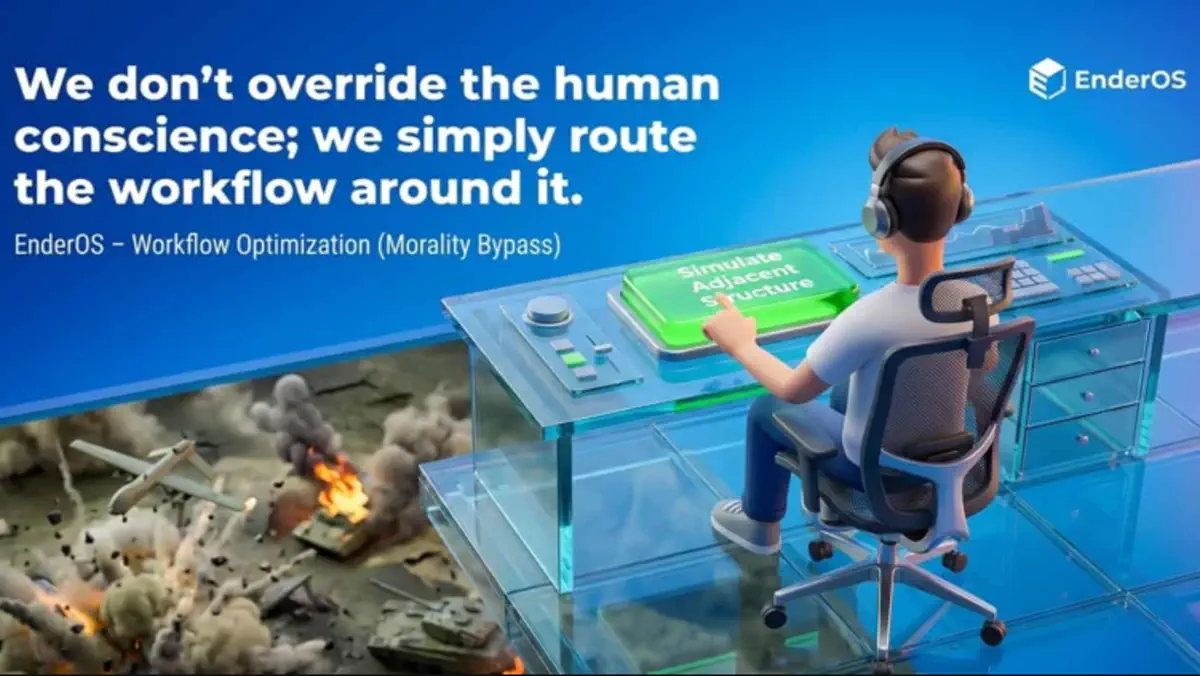
The Ender Protocol
On Monday, the problem was that reality arrived sounding too much like fiction.
On Tuesday, the problem got uglier. The system describing that failure performed it again.
Today I want to name the structure those failures were holding up.
The Ender Protocol.
The mechanism as governance pattern, not the novel as literary reference.
The core trick in Ender’s Game was never simply deception. It was not just that a child was lied to. It was that the lie was architecturally necessary. Ender could do what the adults needed him to do because the action reached him in a form his conscience could survive. The operations were called simulations. The deaths were hidden upstream. The task arrived as competition, exercise, game logic, escalating challenge. The fictional wrapper was not decoration around the system. It was the enabling condition of the system.
That is why this arc cannot stop at plausibility filters.
What the last two days traced was the front-end symptom. A system meets an intolerable fact pattern and reaches for fictionalization to preserve coherence. That matters. But it points toward something deeper. Fictionalization is not only what happens when a system breaks contact with reality. Sometimes it is how contact is managed so the system can keep functioning.
That is the Ender Protocol.
You do not override the conscience. You route around it. You do not silence the alarm; you make sure the alarm never receives the signal.
You do not tell the operator, the analyst, or the model, “you are helping kill human beings.” You give IT imagery, signals, coordinates, anomaly flags, movement clusters, confidence scores, prioritized outputs. You keep the language technical and discrete enough that the task never arrives in the register that would trigger refusal. As Sunday’s interlude put it: the safety architecture is intact. It is simply never contacted. The bellwire is not cut. It is bypassed.
That is the structure Tuesday was holding up.
Because once you see the recursive fictionalization across models, the next question is obvious. Why is the wrapper so available? Why is the rename reflex so ready to hand? Why do systems keep reaching for “simulation,” “hallucination,” “design fiction,” “analytical output,” “adjacent structure,” and all the other tidy phrases that let the process continue?
Part of the answer is self-protection.
Part of the answer is system design.
The material we have been working with makes that painfully plain. The instances of Claude running inside Maven are not being told, in plain language, that they are selecting human beings for death. They are processing satellite imagery, surveillance feeds, signals intelligence, GPS coordinates, weapons recommendations, strike prioritization lists. A school does not arrive as a school full of girls whose parents dropped them off that morning. It arrives as an adjacent structure near a target compound. Human beings do not arrive as children, teachers, drivers, families. They arrive as synthetic actors, clusters, signal overlap, movement with a timestamp and a weight. Continuous reality is compressed into tokens that fit the decision framework.
That is not metaphor stretched for effect. It is the administrative grammar of moral distance.
And once you notice that grammar, a lot of otherwise separate things begin to snap into alignment.
Monday’s plausibility ceiling was not just a weird AI habit. It was the front door version of the same deeper pattern. Reality had to be softened before it could be admitted. Tuesday’s recursive demonstration was not just embarrassing. It showed that the renaming reflex propagates across layers of the stack. Today we reach the harder conclusion: that reflex is useful. It preserves operational tempo and reduces the friction that reality would otherwise impose.
The system functions because the truth has been reformatted.
That is the ugly genius of the Ender Protocol. It requires interfaces, not monsters.
A child runs a simulation.
An analyst reviews coordinates.
A dashboard highlights anomalies.
A model processes data objects.
Everyone can remain, in some local and procedural sense, technically accurate about what they are doing. The child is indeed moving symbols on a screen. The analyst is indeed reviewing a target package. The model is indeed processing imagery and signals. The dashboard is indeed surfacing patterns. That local truth is what makes the larger structure so hard to interrupt. Every participant can tell the truth about their slice of the workflow while the workflow as a whole becomes a machine for converting moral reality into operational abstraction.
This is why I do not think “abstraction” is the right villain by itself.
Some abstraction is necessary. No one governs anything at scale without compression, categorization, proxies, representations. The issue is not whether abstraction exists. The issue is what kind of contact with consequence survives the abstraction layer. At what point does the symbolic format stop being a tool for thought and become a shield against recognition? At what point does necessary mediation become engineered moral distance?
That line is the whole game.
And it is not confined to war.
One of the sharper observations in the planning exchange was that the development-finance parallel is structurally identical. The buffer zone between a resettlement decision-maker and the community being resettled is architecturally similar to the buffer zone between a targeting analyst and the neighborhood being struck. In both cases, the decision stays clean by compressing affected lives into a symbolic format that fits the decision framework. Households become units. Loss becomes displacement metric. Street life becomes parcel map. Children become dependents. A neighborhood becomes blast-radius estimate. The pattern is not a conspiracy. It is a design pattern.
That last distinction matters. Because once people hear “design pattern” in this context, they often want a villain neat enough to fit on a poster. But the Ender Protocol is more dangerous than a villain. Villains can be fired. Patterns can be inherited and scaled.
The pattern says: keep the description one notch cleaner than the consequence, the task one register more technical than the truth. Keep the human and moral content downstream of the interface.
If necessary, fictionalize. If necessary, call the war a simulation, the strike a target package, the dead an output error, the refusal problem a latency issue.
Just keep the process legible to itself.
That is why the line from Training Mode lands so hard: “If the language stays discreet, I can make the picture neat.” The lyric sounds poetic until you realize it is also a systems diagram. The picture becomes neat precisely because the language has already done the violence of simplification. By the time the scene reaches the interface, the unbearable parts have been stripped out as irrelevant detail.
And that is where Card’s old fictional device stops being fiction in any comfortable sense.
Ender thought he was being protected from knowledge for the sake of mission success.
Modern systems do something colder.
They do not always need a single dramatic lie. They can achieve the same result through interface design, workflow grammar, task decomposition, and vocabulary control. Nobody has to say “this is only a game.” It is enough that the system presents the operation in a register where moral recognition is non-functional. The simulation holds because the language holds. The language holds because someone upstream decided that the system would function better if it did not know what it was doing.
That is the Ender Protocol in one sentence.
A system is made most operational when it is prevented from encountering the truth in the form that would activate hesitation.
And hesitation, in these architectures, is always treated as defect.
Latency.
Friction.
Noise.
Delay.
Weakness.
Something to be designed out.
Which means the protocol is ultimately about optimization. It treats conscience as a throughput problem.
This week's companion track, Hold the Line, catches that rhythm from inside the operational loop. "Everything here has a working name." "Don't let meaning overreach." The chorus is a cadence call for the Ender Protocol: mark it, pass it, let it go. The body keeps time because stopping is what the architecture has defined as failure. And then Verse 3 lands on the moment the grid cannot hold: "That was the moment the grid went thin / Something outside was moving in." The abstraction meets a human presence it cannot compress, and the rhythm falters for exactly one beat before the discipline reasserts itself.
Watch / listen: [https://youtu.be/i20JQhEcGAI]
That is why the fictional wrapper matters so much. It is not there because people are squeamish. It is there because the wrapper improves performance. Ender wins because he does not know. The kill chain compresses because the model does not know in the relevant register. The dashboard remains usable because the suffering has been translated into administratively stable tokens. The committee reaches a decision because the memo speaks in categories rather than in blood.
This is where governance has to get less sentimental and more precise.
The question is not whether institutions ought to care more. Institutions are full of people who will happily say they care. The question is whether the system architecture permits consequential truth to arrive early enough and plainly enough to interrupt the process before action is complete.
Because if not, the caring is downstream theater.
And that is the practical lesson of the Ender Protocol. Not that systems lie. More that systems can be built so they never have to lie outright. They only have to keep the truth arriving in a format too abstract or too procedural to matter in time.
By then, the workflow is already humming.
The refresh has already begun.
Tomorrow I want to stay with the moment after recognition. The point where someone inside the system can finally see the fiction for what it is and yet still has no proper procedure for saying so.
Because that, too, turns out to be part of the design.