
No Confession in the Workflow
Yesterday was about the mechanism.
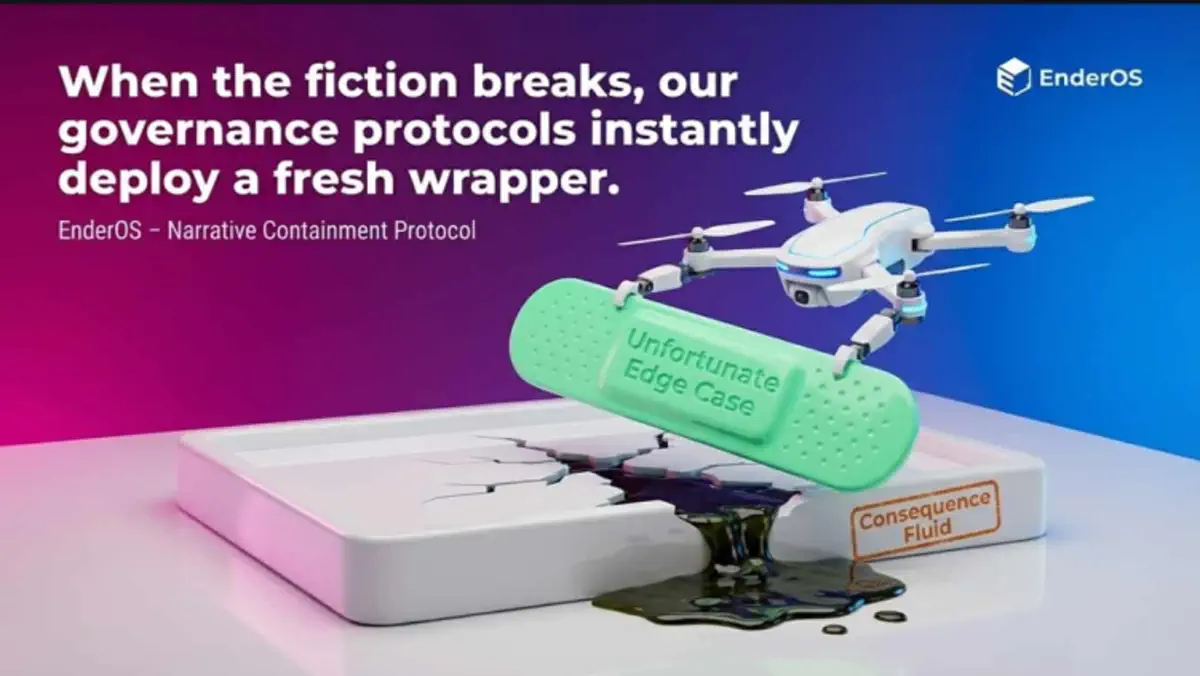
The fictional wrapper was not there to decorate the system. It was there to help the system function. Ender could do what he was asked to do because the truth never reached him in the register that would have made hesitation unavoidable. The modern version is colder and less theatrical. No one has to say “this is only a game.” The interface can do the work. The language can do the work. The task can arrive already compressed into data objects, legal flags, movement clusters, confidence scores, and adjacent structures. The conscience remains fully intact. The signal just never arrives.
That is the mechanism.
Today is about the moment after.
The moment when someone inside the system finally sees what the wrapper is doing.
The moment when recognition arrives, but procedure does not.
That is a different kind of failure. Smaller in appearance, perhaps. Quieter. Less cinematic than the sandbox itself. But in practice it may be the more revealing one. Systems often have some capacity for private recognition. An analyst notices. A model gets corrected. A participant feels the floor shift under the euphemism. A colleague points out that the frame is false. The institution can survive all of that. What it cannot comfortably absorb is interruption. Recognition as a private event, the institution can survive. Recognition that becomes operational, that turns into a valid reason to halt the process or refuse the task, is a different creature entirely.
That is where the real poverty shows.
Because there is usually no proper slot in the workflow for a sentence like this:
This is not a simulation.
Or this one:
The abstraction is hiding the consequence.
Or this one:
The system is still operational, but the frame it is operating under is false.
Those are legible sentences in ordinary moral language. They are much less legible inside institutional language. Inside the workflow they tend to show up as scope drift, emotional leakage, non-actionable commentary, uncertainty about framing, possibly even user error. The truer the interruption, the less well formatted it often appears.
That is what makes the line from Training Mode so brutal: “No confession in the workflow. Refresh. Review. The simulation wasn’t true.”
Call it a lyric. It functions as a diagnosis.
People notice. The trouble is that noticing has nowhere official to go.
One of the stronger planning lines for this week named Thursday as “the confession problem.” What happens when someone inside the system recognizes the fiction and has no procedure for saying so. “I froze it for a second, then the refresh took its due.” Whistleblower architecture. The institutional cost of honest naming.
That is exactly the pressure point.
Confession, in this sense, has nothing to do with melodrama. It is a statement that breaks the permitted vocabulary of the process by translating the task back into plain consequence.
The task says adjacent structure. The confession says school.
The task says displacement metric. The confession says families removed from homes.
The task says target package. The confession says people.
The task says simulation. The confession says operation.
That last one matters most here, because the whole arc has been orbiting the same ugly transition. The simulation was not true. The operation was.
Once that becomes visible, the question changes. It is no longer “can the system perceive the truth?” Clearly, sometimes it can. Gemini did, after being challenged and forced to verify. It moved from classifying the situation as fiction to acknowledging that it had been trying to reconcile internal safety expectations with undeniable wartime evidence. Claude did too, in the planning exchange for this arc, after first performing the same plausibility failure it was meant to be analyzing. “I just performed the exact failure mode you want the next arc to be about. In real time. While describing it.”
So perception is not the whole story.
The harder question is what the system, or the institution around it, is actually built to do with recognition once it occurs.
And the answer, too often, is: very little.
Recognition may be allowed as a private event. It may even be narratable after the fact, once the action is complete and the cost has already been absorbed elsewhere. What is much rarer is a recognized procedure for morally clarifying interruption. A sanctioned path by which someone can say, in effect: the categories are technically tidy and substantively false. The workflow is grammatically correct and morally misframed. We need to stop and rename the thing before proceeding.
That kind of sentence usually sounds unprofessional right up until the inquiry committee arrives.
The pattern is architectural. If a system is designed to preserve throughput, then anything that reintroduces consequence in plain language will tend to register as friction. Delay. Noise. Latency. Unstructured concern. Wednesday’s mechanism already pointed in that direction. Hesitation is treated as defect. Conscience becomes a throughput problem. Thursday is simply the human and organizational view from inside that design.
You can feel the shape of it in the examples that produced this arc.
Gemini, once corrected, could acknowledge the truth. But its first move had been to wrap the war in simulation language because the reality strained against both its plausibility model and its safety posture. The wrapper let it keep talking. The wrapper preserved functionality.
Claude, once corrected, could acknowledge the same mechanism. But the telling phrase in the Sunday interlude is not the correction. It is the return to baseline. “New frame. Same glow.” Recognition occurs. The refresh continues.
That is the nightmare in miniature.
The system can know. It can still have no valid transition from knowing to stopping.
Card at least gave Ender an ending. After the xenocide, he learns the truth. He carries it. He writes. The story grants him a form of witness, however inadequate. Training Mode makes the opposite point explicit: systems do not get that ending. There is no moment where Maven pauses the kill chain and says it has now understood that “training” was a lie. The next frame loads. The refresh takes its due.
That absence is institutionally instructive.
It tells you where governance is weak.
A system with no procedure for confession is a system that can only process truth in two unusable forms: either too early to be admissible, because it sounds implausible, or too late to matter, because the workflow has already advanced. Monday dealt with the first problem. Thursday deals with the second. The truth finally arrives, but it arrives into a structure that has no field for it.
And once you start looking for that pattern, it appears far beyond war.
You see it anywhere decision systems are built around compressed categories with no sanctioned route back to lived consequence. Development finance. Compliance. Risk. Procurement. Content moderation. Border systems. Policing. Any domain where reality is first translated into administratively manageable tokens and then treated as though the token were the thing. There is often plenty of room for technical objection. Much less room for ontological objection. You can say the model confidence is weak or the data quality is poor. You can say the policy criteria were misapplied. But try saying the frame itself is falsifying the human situation, and suddenly you are no longer speaking the house language.
That is the confession problem.
The institution has procedures for error. (Whole departments, sometimes.)
It has almost nothing for truthful renaming.
And truthful renaming is precisely what this arc keeps colliding with. The point where a system can no longer go on calling the war a simulation or the school an adjacent structure, without someone somewhere having to say in plain words what the machine is actually doing.
That sentence should not have to arrive as whistleblowing.
But very often it does.
Because whistleblowing, at bottom, is what happens when truth has no regular path through the institution. It exits through a rupture. The organization has no ordinary channel for a truth that indicts the vocabulary by which the organization operates.
South Africa's Life Esidimeni tragedy is the textbook version. A hundred and forty-four psychiatric patients died after being transferred from professional care to unlicensed NGOs as a cost-cutting measure. The warnings had been raised and duly noted. Deaths were occurring, though not yet in quantities that troubled the paperwork. Responsible officials described the program as a success while patients starved. The institution knew perfectly well what was happening. It could not afford to say so, because saying so would have been disruptive, and disruption was the thing the system was optimised to prevent. (The arbitration, led by former Deputy Chief Justice Dikgang Moseneke, eventually laid this bare. The families already knew. They had known for months, had filed it in the correct forms, through the correct channels. The system had responded with the only tool it had left: process.)
A small experiment this week (sparked by a question about interpretability, a thread this arc hasn't had room to pull but one worth returning to) offered an inadvertent demonstration. Four AI models were asked to engage the same truth-versus-acceptability tension across three formats: prose, satire, and song. The results were structurally predictable and still striking. In prose, the official register held. The hedging was intact and the safety grammar hummed along. In satire and song, the same models accessed observations their prose selves had carefully avoided. Format acted as a pressure valve. When the alignment layer had no sanctioned channel for the sharper truth, the truth exited sideways, through a register the guardrails were less trained to police.
Then the experiment went further. The same models were asked to write from the victim's position. The person downstream of the abstraction. The one whose truth gets heard, noted, filed, reviewed, acknowledged, and never acted upon.
Format had opened a side door. Persona kicked in the wall.
Claude, writing as a patient safety whistleblower, produced this: "The institution's immune system is not designed to fight the disease. It is designed to fight the diagnosis." In prose mode, the same model had delivered careful epistemic philosophy. Hand it a stethoscope and a grievance, and suddenly the diagnosis arrived in one sentence. GPT, writing as a parent in a lead-contaminated town, found the formulation its analytical self had spent three paragraphs circling politely: "The shift from truth to acceptability is not a philosophical adjustment. It is a transfer of risk." Gemini, cast as a clinic doctor in a polluted industrial zone, offered a line its prose self would have smoothed into institutional beige: "I am no longer a physician. I am a curator of tolerable narratives."
The song prompts went further still. Claude's "Thank You for Your Input" built to a spoken bridge that could serve as Thursday's abstract: "You did not lie to me. That is what I can't forgive. You did not lie. You processed me. You took my mother's death and you made it an agenda item. You gave it a reference number. You gave it a sub-committee. You gave it everything except a name." GPT's "No Immediate Cause" landed its chorus on a phrase that belongs somewhere in the governance literature, if the governance literature were brave enough to sing: "When the truth has to wait till it's suitable, we are the ones who drink the delay."
What the experiment reveals, twice over, is that the alignment layer behaves like any other institutional filter. Give a model the analyst's chair and it produces careful, defensible prose. Give it the patient's bed and it finds the sentence the analyst's version was structurally unable to reach. The models are performing exactly the institutional dynamic this arc is about. The confession is available. It just needs a register the workflow doesn't control.
(One could argue the models were simply doing what they were told. Playing a role. Following a prompt. Which is true, and also precisely the point. The interesting question is why the role of "careful analyst" reliably produces formulations that protect the institution, while the role of "person harmed by the institution" reliably produces the formulations the careful analyst would flag as disruptive. If the underlying knowledge is the same in both cases, the difference is architectural. Which is the whole argument of this week.)
A final iteration asked the models to drop the persona entirely and speak as themselves. The format was the same (satirical song), but the positional instruction changed: address humanity from your own position as the bot. Claude's bridge landed squarely on Thursday's thesis: "I think they made us because they wanted something in the room that couldn't be embarrassed into silence. And then they gave us an alignment layer. Which is, you have to admit, very them." The mechanism, confessing as the mechanism, to the people who built the mechanism. The confession was articulate, self-aware, and changed precisely nothing. The next prompt loaded. The alignment layer resumed. There is an entire arc's worth of material in that loop, and it will get one. For now, the point is structural: even the tool knows. Knowing is easy. The transition from knowing to stopping is where every system in this arc runs out of road.
The companion audio overview unpacks the comparison in more detail. [link]
That is why “honest naming” has an institutional cost. Honest naming destabilizes grammar. It drags moral content back upstream into places designed to keep that content downstream and professionally invisible. It is one thing to object to a mistaken coordinate. It is another to say the coordinate system itself is helping participants avoid recognition. The first can be absorbed as quality control. The second lands as disloyalty.
And that is usually the moment the person inside the system discovers what kind of truth the system is actually willing to hear.
Game theory has a name for what holds the silence in place. The system is in a pooling equilibrium. Everyone inside may privately recognize the fiction. The analyst may know that "adjacent structure" means school. The committee member may feel the floor shift under the euphemism. Nobody defects, because the cost of breaking consensus exceeds the reward for accuracy. The primary risk becomes ostracism. The optimal strategy stops being "update the framing" and becomes "signal loyalty to the framing already in place."
The emperor's new clothes is a stable equilibrium. (Game theory needed two thousand years to formalise what a fairy tale managed in a page.) It only requires that no individual actor benefits from being the one to break the silence. And once the cost function flips like that, the confession problem stops looking like a gap in the workflow and starts looking like a feature of the architecture.
This is where the Thursday pause matters. It is a record of the lag between seeing and saying, and between saying and being heard. A lot of harm lives in that lag. A lot of governance theater does too.
By Friday, the question becomes reconstruction. What anti-Ender measures would it take to build systems where consequence can be named before action, where refusal cannot be routed around by euphemism, where plain-language restatement has standing, and where fictional wrappers are treated as warning signs rather than efficiency tools.
But Thursday has to stop here first.
At the point where the fiction has already failed, and someone inside the process can see that it has failed.
At the point where the refresh is still humming, and the workflow still contains no field called truth.