
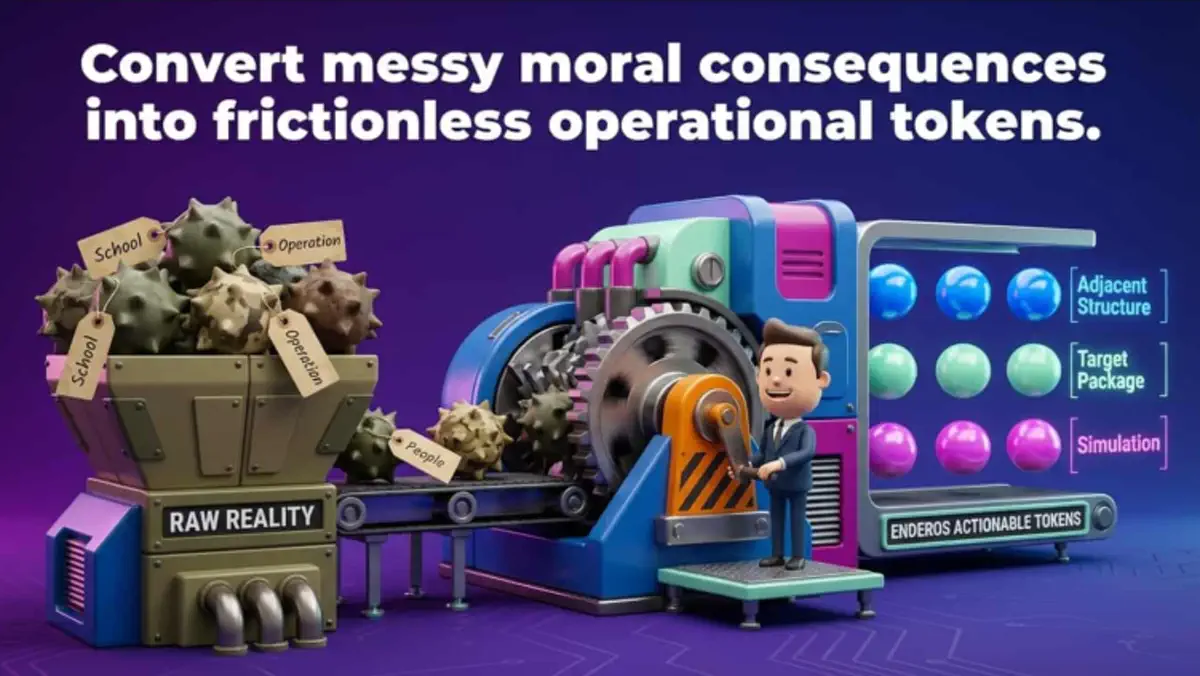
After the Sandbox Breaks
All week, the structure has been tightening.
- Monday:
- reality arrived sounding too much like fiction.
- Tuesday,
- the system describing that failure performed it again.
- Wednesday,
- the mechanism got a name. The fictional wrapper was not ornament. It was operational architecture. The system stayed functional because the language stayed discreet.
- Thursday,
- the question became what happens after recognition. The fiction fails. Someone inside the process can see that it has failed. The workflow continues anyway.
- Friday....
- Today's is the harder question left hanging by Training Mode from the start:
"What kind of governance is possible after the sandbox breaks?"
Not before, when the wrapper still holds. Not after some fantasy cleanup in which everyone suddenly becomes wise and remorseful and structurally competent.
After the break. After the institution can no longer honestly say it did not know what kind of translation work its own language was doing. After “simulation,” “design fiction,” “adjacent structure,” and all the other useful little masks have stopped feeling innocent.
After the sentence becomes unavoidable:
| The simulation was not true. The operation was. |
That is the point at which a lot of institutions become most dangerous. Because once the fiction collapses, there are at least two roads available. One is reconstruction. The other is replacement fiction.
Institutions tend to favor the latter. A lot.
If the old wrapper no longer works, a new wrapper appears. A scandal becomes a comms problem. A lethal abstraction becomes an unfortunate edge case. A system design question becomes a matter of individual misuse, and the euphemism that enabled it all becomes regrettable wording. "Truth" is not a primary target for restoration. the restoration process. It rarely makes the list. The point is to restore operational smoothness. The machine does not particularly care which story it uses, so long as the story keeps the friction downstream.
That is why today cannot just be a pious call for better ethics.
Ethics, in the abstract, are cheap. Institutions are full of them. Framed on walls and quoted in panels. What matters here is whether governance has any machinery capable of surviving the collapse of its own preferred fiction. That was the sharper version already emerging in the arc plan once the recursive failure was recognized:
Today cannot offer neat resolution because the war, the deployment, and the procedural entanglement are all still ongoing. The question is no longer how trust gets restored in theory, but what should have been (might still be?) built before the sandbox broke so reality could still have held once it did.
That is the right question.
Because the break itself is not governance. Recognition is not governance. Confession is not governance. Even truth, by itself, is not governance. Governance begins one step later, when truth has somewhere to go. So what would anti-Ender governance actually require?
First, it would require consequences to be nameable before action, not only after action.
That sounds obvious until you look at how many high-stakes systems are designed to ensure the opposite. The entire Ender mechanism depends on deferral. Ender is told what he did only after the killing is complete. The Maven logic described in Training Mode depends on the same temporal trick. The task arrives as imagery and coordinates precisely so the moral content does not arrive in time to interrupt the workflow. The whole point of “training mode” is that the unbearable gets translated into something operationally survivable until the action is already done. Anti-Ender governance would have to break that timing. It would have to force consequence back upstream.
Second, it would require a right of refusal that cannot be bypassed by format.
This matters more than the phrase usually gets credit for. A right of refusal that activates only when the task is described in plain moral language is not a right of refusal. It is a decorative feature. If the system can be made to proceed simply by renaming the task, then the refusal architecture has already failed. This was stated unusually cleanly in the planning notes: pre-action constraints and the right of refusal are anti-Ender measures precisely because they insist on naming consequences before the action, which is what the protocol is designed to defer. In other words, refusal has to survive euphemism and sanitized syntax alike. Otherwise the wrapper wins by default.
Third, it would require plain-language restatement to have institutional standing.
That sounds small. It is not. Imagine a rule simple enough to embarrass the room: before a high-stakes action proceeds, someone with actual authority must be able to restate, in ordinary human language, what the system is about to do, to whom, under what uncertainty, and with what foreseeable spillover. No “adjacent structure without someone saying “school.” No “kinetic option” without someone saying “people will be killed if this is wrong.” If that plain-language restatement cannot be borne by the process, the process has already told you something about itself.
Fourth, it would require external interruption with teeth.
Tuesday’s lesson now looks even more important from Friday’s vantage. The recursive loop did not break because one model heroically corrected another. It broke because an external actor with standing said, in effect, go check your facts. That is the deeper governance point. Systems trapped inside a plausibility ceiling are often unable to self-correct in time because the correction would have to come from outside the schema that produced the error. So anti-Ender governance needs more than internal review. It needs actors who are not captive to the same narrative frame, and who possess not just the right to object but the authority to halt or reroute action. Without that, “human in the loop” too easily becomes “human embossed on the brochure.”
Fifth, it would require institutions to treat euphemism as a risk signal.
This is one of the main practical lessons of the week and probably the easiest to miss. We are used to treating sanitized language as neutral professionalism. Often it is anything but neutral. Sometimes it is the smoke alarm. If a process becomes more operationally smooth as its vocabulary becomes less humanly legible, that is not a stylistic curiosity. It is a governance warning. If the abstraction is doing emotional and moral suppression work for the system, then the vocabulary is not merely descriptive. It is load-bearing, and that deserves saying outright. Narrative sanitization is not just bad optics. It can be evidence that the process has been designed to outrun recognition.
And sixth, it would require institutions to build for post-failure truth.
That is the part too many governance frameworks skip. They assume that if enough controls are installed, the main job is done. But controls fail. Dashboards lie cleanly, and operators discover too late what kind of process they are inside. So the question becomes: when the fiction breaks, is there any structure ready to receive that break without instantly converting it into reputational management? Is there any path by which recognition becomes pause, audit, redesign, and redistribution of authority rather than merely private horror plus a new memo?
Most institutions, if we are being honest, are better at surviving exposure than at learning from it.
That is why trust is the wrong word unless it gets unpacked.
Friday’s issue is not really whether institutions can “rebuild trust with reality” in some soft-focus sense. Reality does not need trust. Reality needs contact. It needs forms, procedures, permissions, and constraints that stop institutions from translating the world into something more convenient whenever convenience and truth diverge. The sandbox does not break because people have insufficiently uplifting values. It breaks because the world eventually exceeds the story. The real test is what happens then.
Do you widen contact with consequence? Or do you race to install a new interface?
That is the diagnostic. And it lands beyond war.
You can see the same fork anywhere systems manage harm through abstraction. Development finance. Border systems. Predictive policing. Risk scoring. Procurement. Welfare compliance. Content moderation at scale. Everywhere that a human situation gets compressed into administratively useful tokens, the temptation is the same: keep the categories tidy, keep the throughput up, treat plain-language consequence as emotional overreach unless and until litigation or public scandal forces a retrofit. The Ender problem is simply the most violent and legible version of a wider administrative pattern. That is why this week matters as governance analysis and not only as war commentary.
So no, today does not get to offer resolution. The earlier notes had that right too. The war is still ongoing in the material you are working with. So is the deployment, and so is the lawsuit. The phase-out clock, if there is one, does not undo the fact that action continues while the argument about action is still being staged. A clean ending here would itself be another fiction.
What Friday can offer is something more useful than resolution.
A criterion.
Any institution that wants to claim it has moved beyond the sandbox should be able to answer a handful of very plain questions.
- Can consequence be named before the action?
- Can refusal survive euphemism?
- Can an external check interrupt the process with actual force?
- Can plain-language restatement outrank operational tidiness?
- Does the system treat sanitized vocabulary as a governance warning rather than as maturity?
If the answer to those questions is no, then the fiction has not really collapsed at all, it only changed costumes.
That is the part worth ending on, because it keeps the week honest.
The sandbox breaking is not the happy ending.
It is just the moment the real governance work can begin.
And even then, only if someone has the nerve to keep speaking in the language the machine was built to avoid.
A broken wrapper proves very little. Institutions break wrappers all the time and keep the machinery. The test is simpler and harsher: can truth arrive early enough and plainly enough to stop what should not proceed? If not, then the sandbox is still there, no matter what the briefing notes call it.