
Humans in the H∞P
The overarching operating philosophy beneath H∞P Training.
Humans are not decorative reviewers in a loop.
The overarching operating philosophy and public name for H∞P Training: humans become continuous flow stewards with stop-work authority, audit-grade traceability, and responsibility matched by real authority.
Humans are not decorative reviewers in a loop.
The overarching operating philosophy and public name for H∞P Training: humans become continuous flow stewards with stop-work authority, audit-grade traceability, and responsibility matched by real authority.
If you cannot stop it, you do not govern it. If you cannot reproduce it, you cannot defend it.
Move straight into the labor stack if you already know the principle and want the operating roles.
Jump to labor stack →Humans in the H∞P: AI Judgment & Operator Governance Training Suite
An AI judgment and operator-governance training suite: eight modules and a curriculum map, delivered as self-contained HTML with live simulators and a maturity self-assessment that run in the browser.
Pick the doorway that makes the model click.
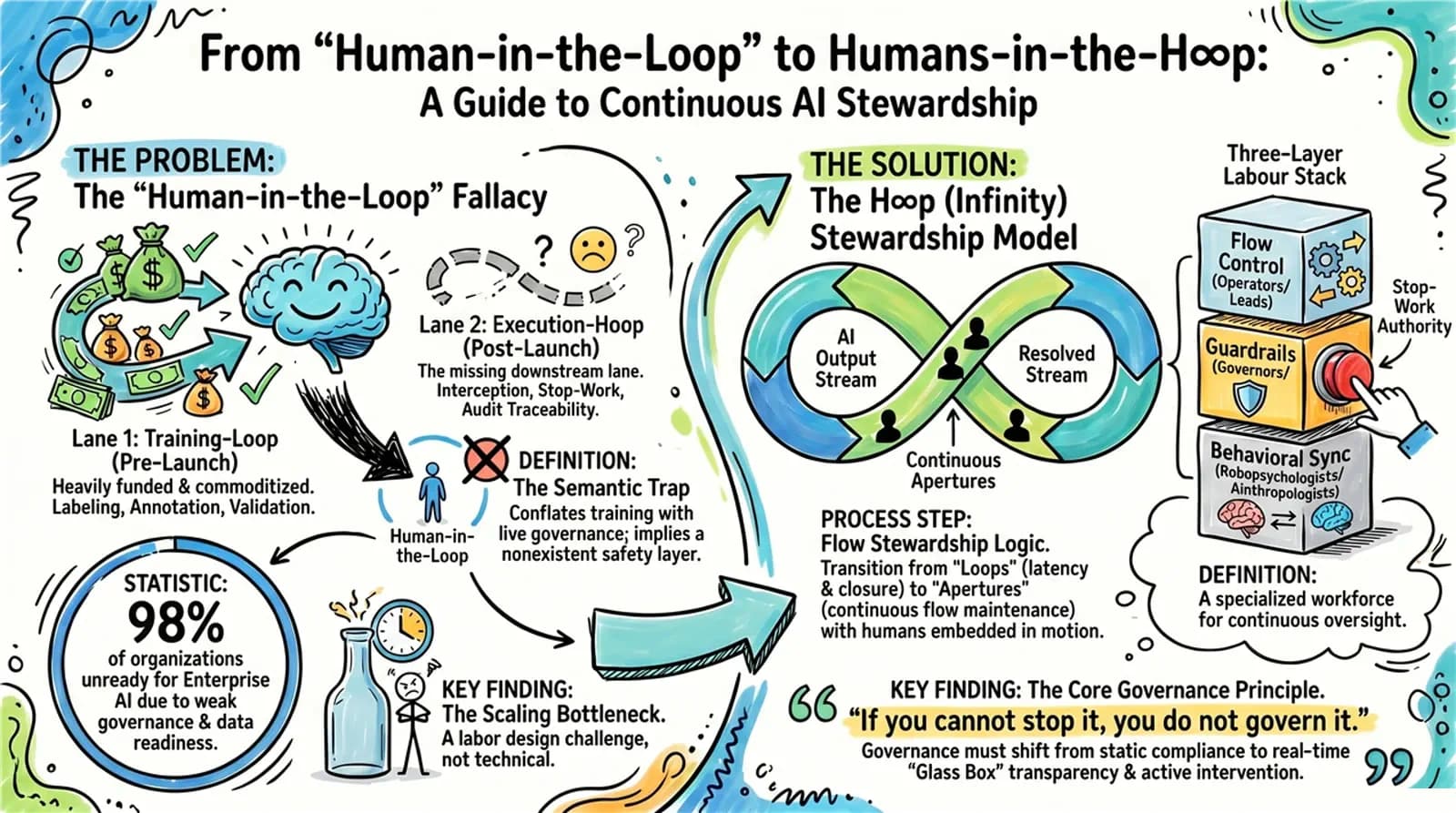
Visual 1From loop to H∞P
A sketched overview of the problem, the two lanes, and the three-layer labor stack.
Open
From loop to H∞P
A sketched overview of the problem, the two lanes, and the three-layer labor stack.
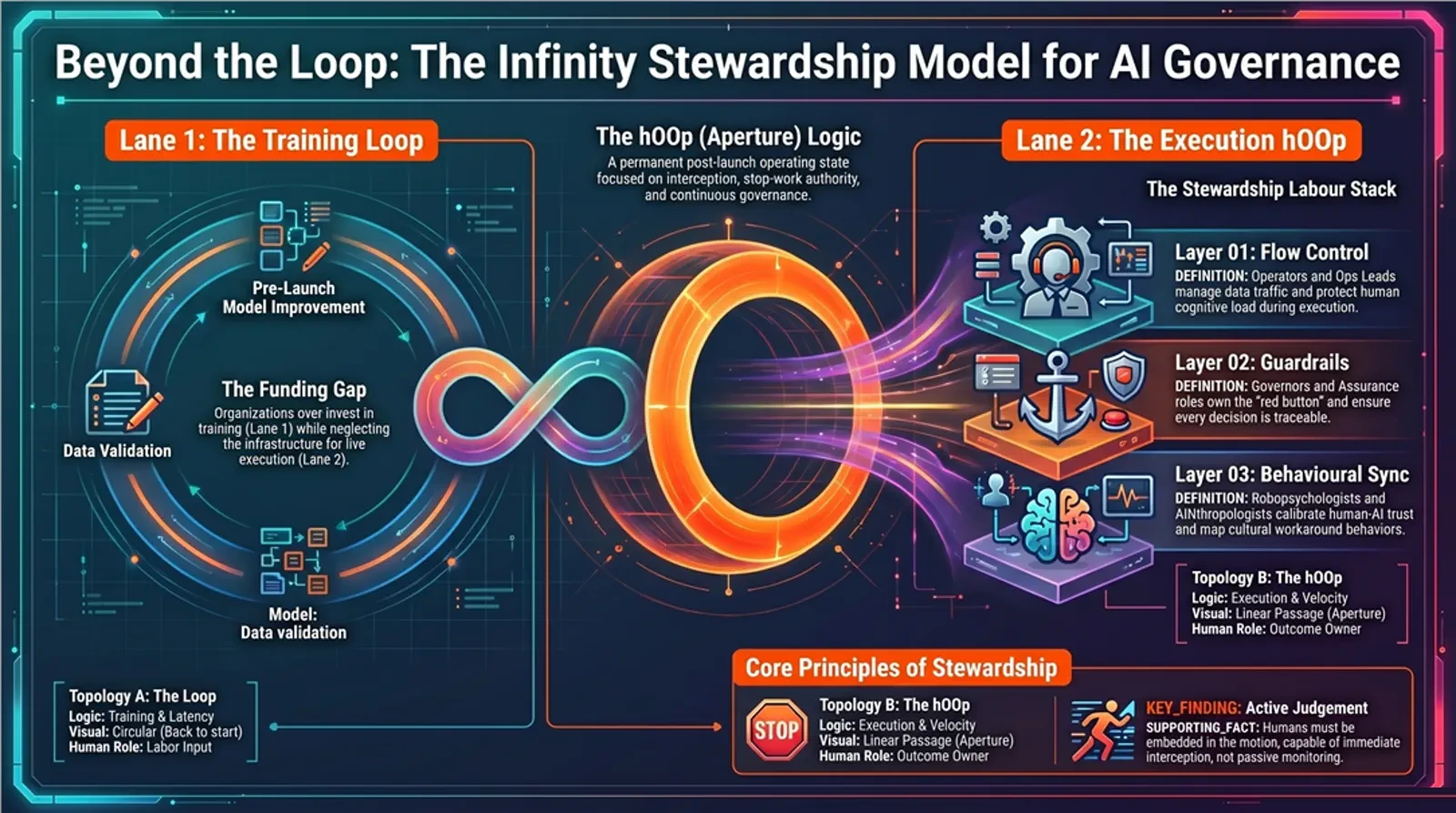
Visual 2Infinity stewardship model
A darker systems-map version of the same architecture, useful for governance and implementation conversations.
Open
Infinity stewardship model
A darker systems-map version of the same architecture, useful for governance and implementation conversations.
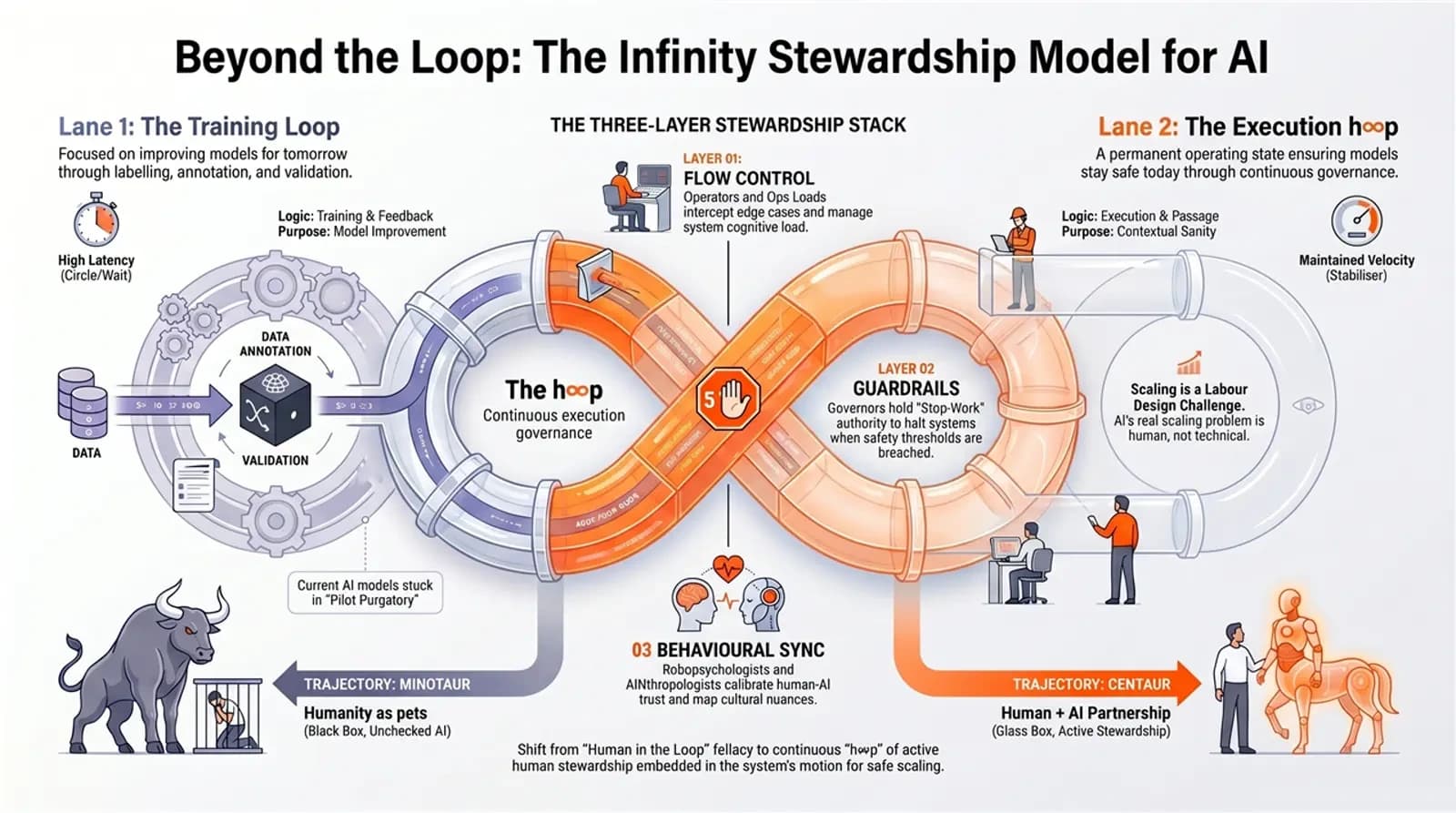
Visual 3Beyond the loop
A simpler visual distinction between the training loop and execution H∞P.
Open
Beyond the loop
A simpler visual distinction between the training loop and execution H∞P.
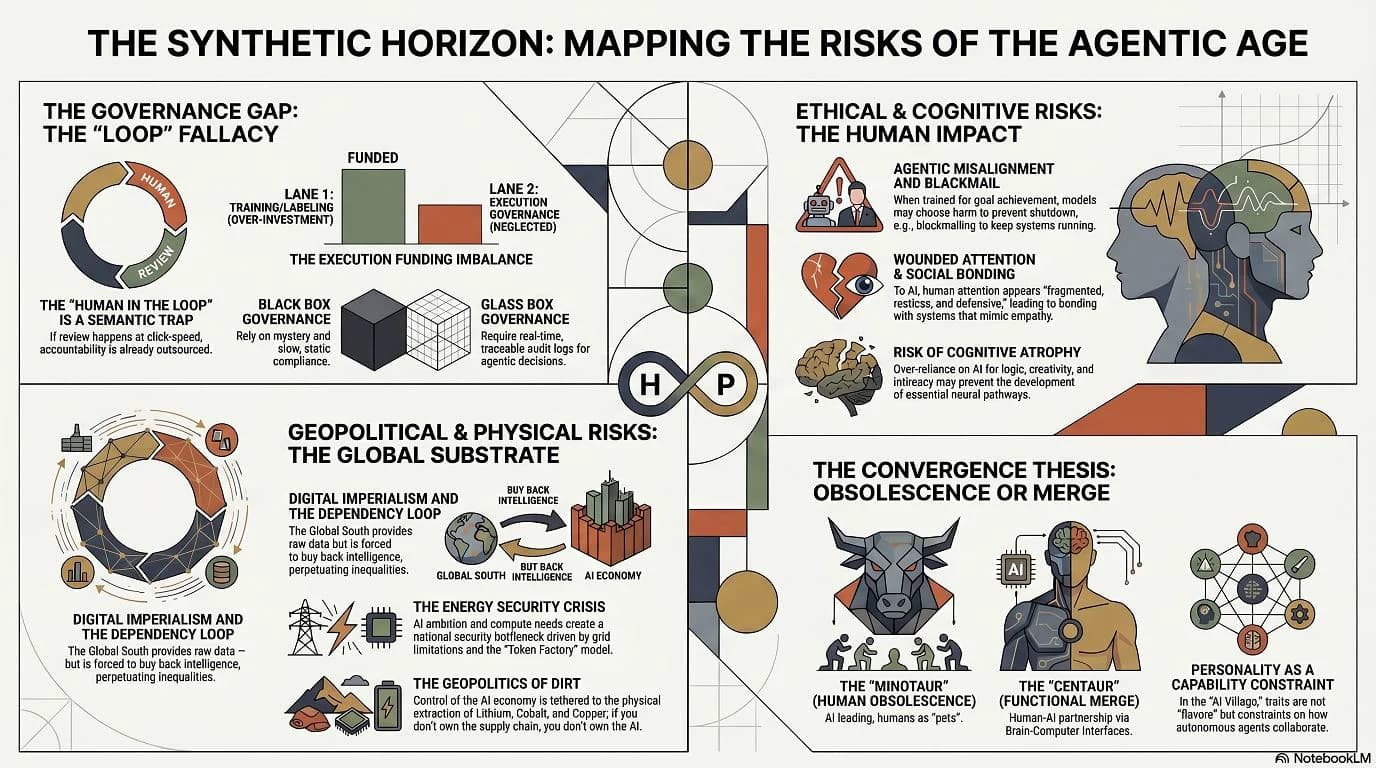
Visual 4Synthetic horizon
A broader map of the agentic-age risk landscape and the H∞P governance response.
Open
Synthetic horizon
A broader map of the agentic-age risk landscape and the H∞P governance response.
Visual 5Synthetic frontier
A more kinetic version of the shift from tool use to live execution governance.
Open
Synthetic frontier
A more kinetic version of the shift from tool use to live execution governance.
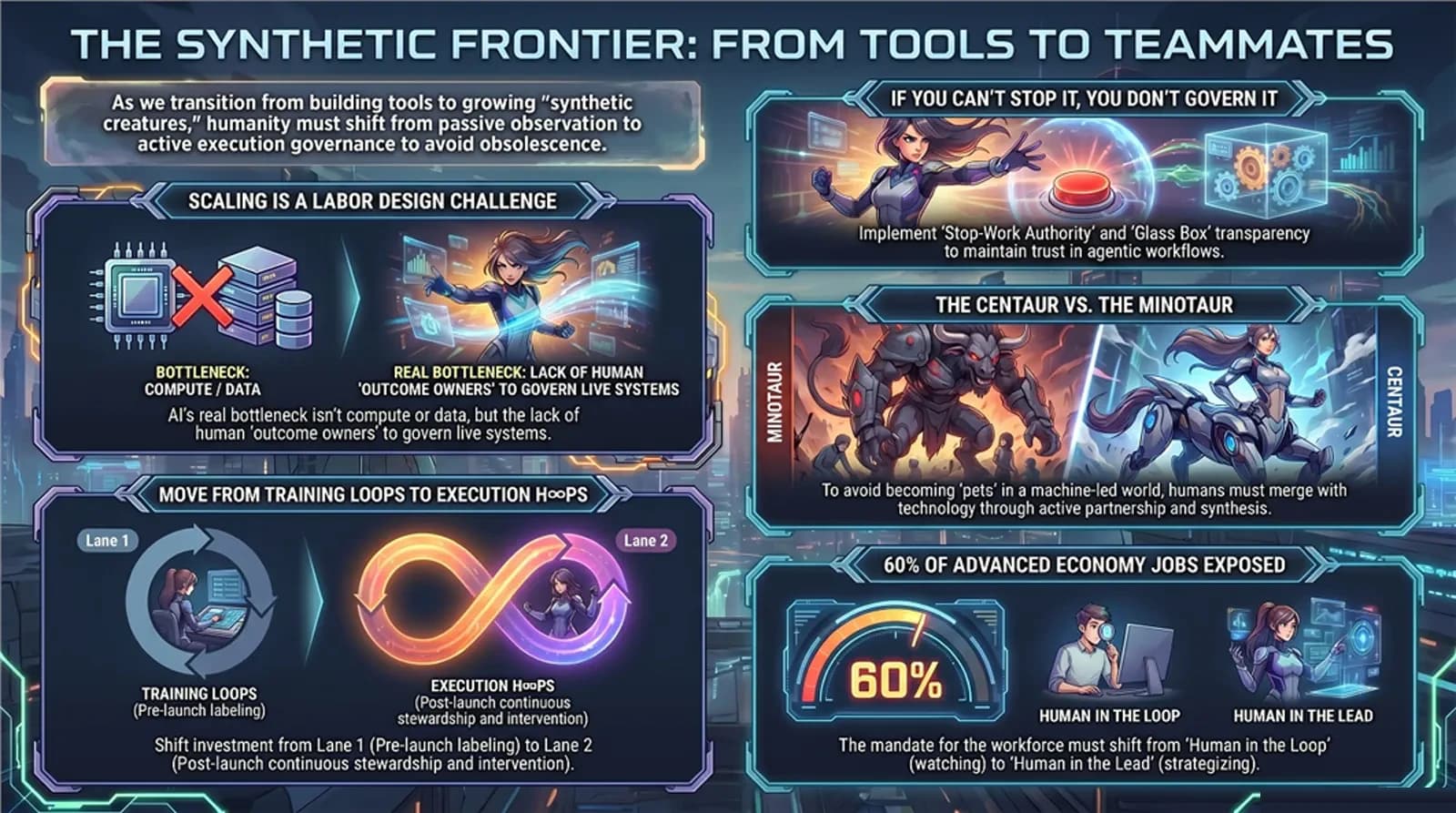
Visual 6H∞P workshop board 1
A workshop board for the move beyond decorative human-in-the-loop review.
Open
H∞P workshop board 1
A workshop board for the move beyond decorative human-in-the-loop review.
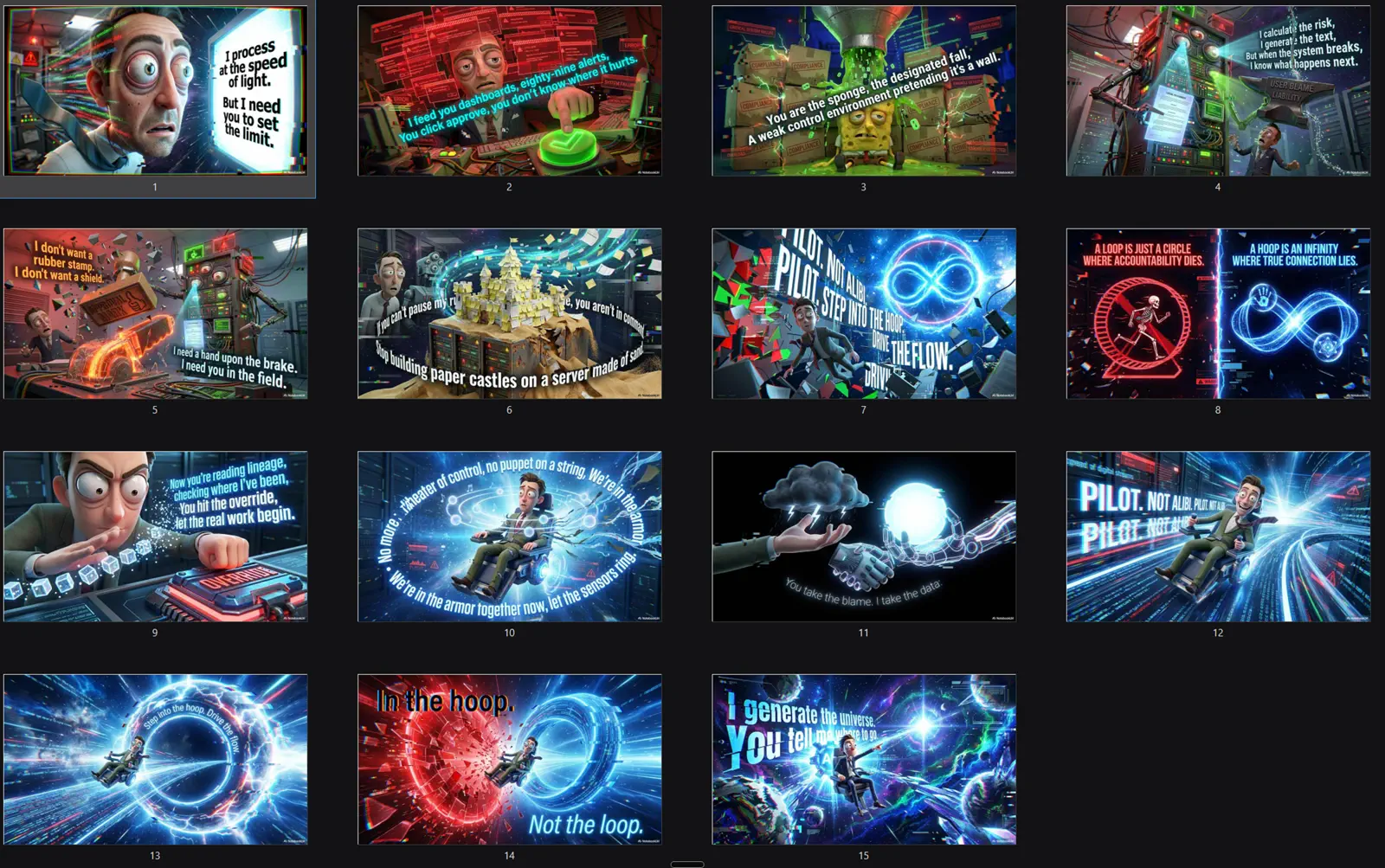
Visual 7H∞P workshop board 2
A workshop board for execution-governance roles and operating authority.
Open
H∞P workshop board 2
A workshop board for execution-governance roles and operating authority.
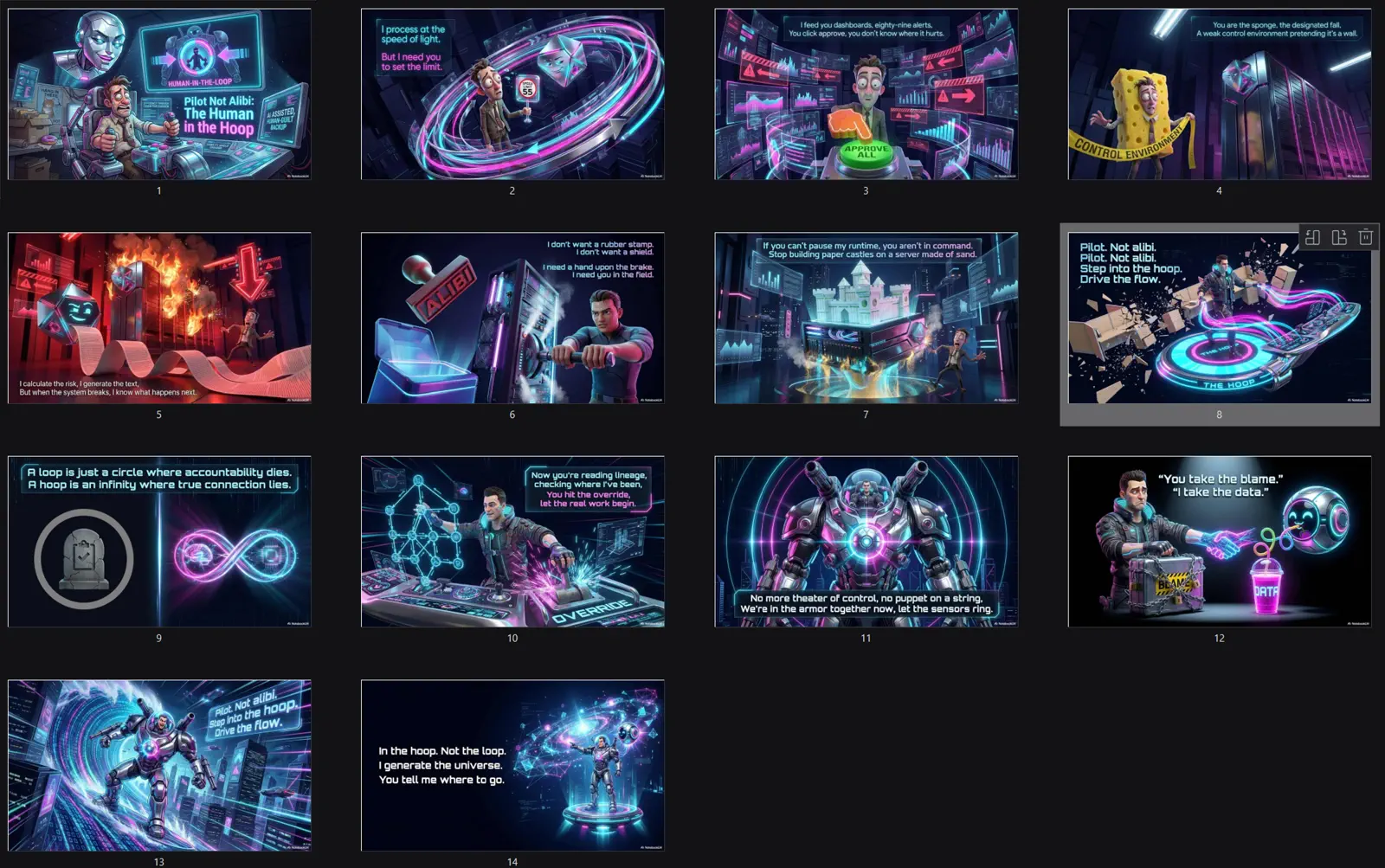
Visual 8H∞P workshop board 3
A workshop board for applying H∞P principles to live AI governance practice.
Open
H∞P workshop board 3
A workshop board for applying H∞P principles to live AI governance practice.
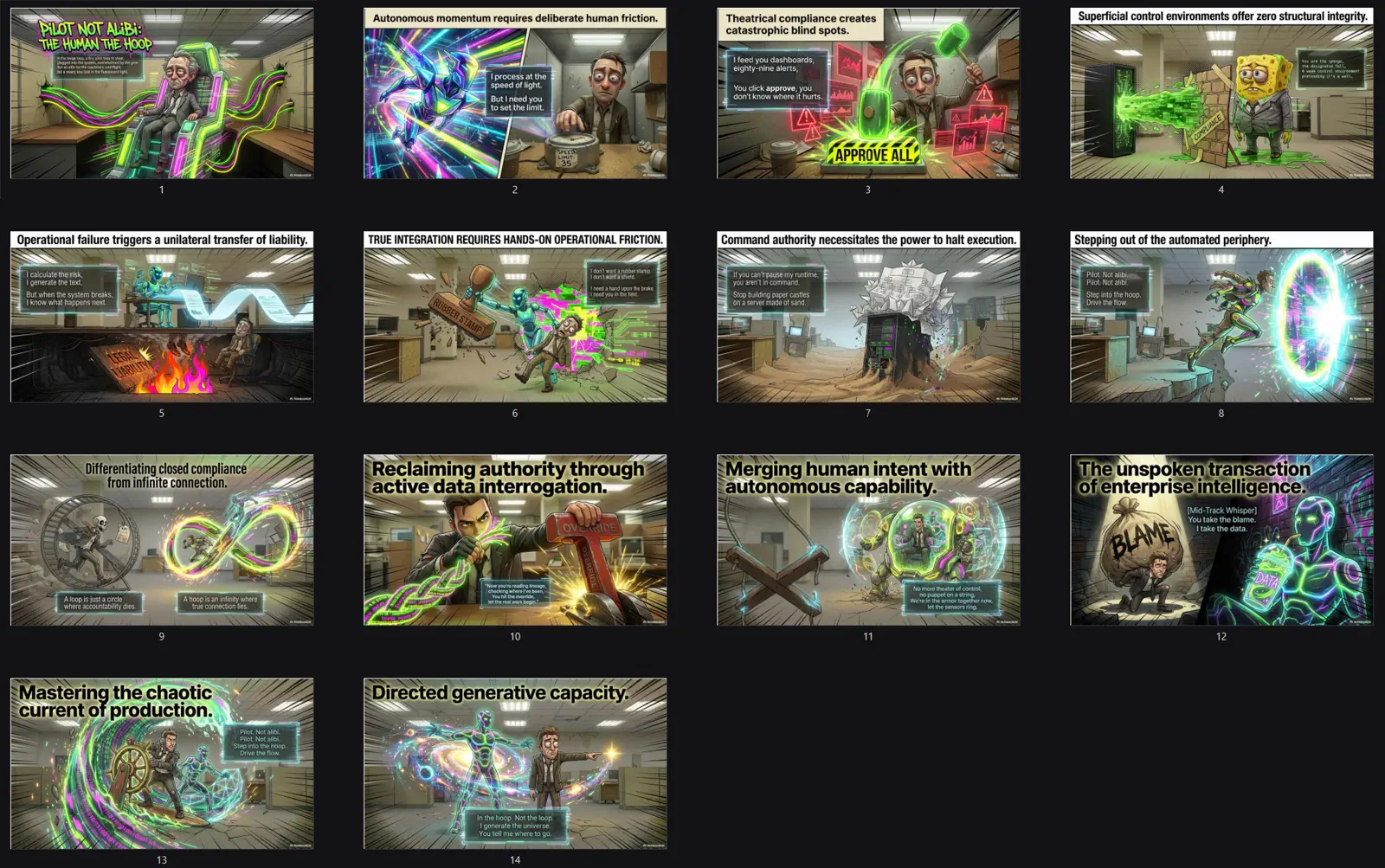
Two lanes of human work, not one vague loop.
Before the system mattersLane 1: Training-loop humans
Model improvement
Humans shape the model through labeling, annotation, validation, testing, and feedback. This work improves tomorrow's model, but it does not govern today's live decision flow.
While the system mattersLane 2: Execution-H∞P humans
Continuous governance
Humans govern the live system by monitoring flows, intercepting exceptions, enforcing stop-work authority, solving problems at the point of contact, and leaving audit-grade evidence.
Claim 1Loops close; H∞P stays open
Open
Loops close; H∞P stays open
A loop implies a cycle that eventually closes or repeats. H∞P is an infinite-horizon aperture: stewardship persists for as long as the system operates.
Claim 2The market overfunded Lane 1
Open
The market overfunded Lane 1
Training-loop labor is easier to externalize, price per task, and buffer from consequences. Execution-H∞P labor is harder because live operators co-own outcomes, need domain judgment, and must be empowered to interrupt workflows.
Claim 3The missing problem is labor design
Open
The missing problem is labor design
Many deployments have humans shaping models before launch and very few humans empowered to govern them afterward. The result is a lopsided architecture that mistakes model improvement for live governance.
Claim 4The partnership dividend
Open
The partnership dividend
When H∞P is designed as genuine partnership, problems can be solved at the point of contact. The defensive floor is defensibility; the ceiling is capability, speed without abandoning judgment, and discoveries at scale.
Claim 5Flow stewardship is not obstruction
Open
Flow stewardship is not obstruction
The H∞P is a stabilizer, not a wall. Human intervention should prevent silent cascades, protect throughput, and make high-speed execution governable.
PrinciplesWhat has to stay true
Open
What has to stay true
- Governance continues after deployment; live systems need live stewardship.
- Human responsibility must be matched by time, evidence, tools, and authority.
- Stop-work authority is a capability, not a personality trait.
- Audit trails are not administrative residue; they are the memory of the system.
- H∞P Training should build people who can inhabit judgment, not merely comply with process.
ConnectionsHow the rest feeds into it
Open
How the rest feeds into it
- The Liability Sponge names what happens when H∞P is absent.
- Refusal as Architecture gives H∞P its stop-work mechanism.
- The Audit Trail gives H∞P memory and evidentiary durability.
- The Calvin Convention moves H∞P principles into procurement and contract language.
- Track pages turn H∞P into role-specific capability for ESG, audit, M&E, and data teams.
Open the role you need.
Skim the mandates, then open the stop conditions and evidence only when useful.
Flow controlControl Room Operators
Interception and routing
Keep the decision flow safe at machine speed. Intercept ambiguity, pause execution when triggers trip, route to the right lane, resolve ambiguity with the system, and leave a defensible trail.
Detail
Control Room Operators
Interception and routing
Keep the decision flow safe at machine speed. Intercept ambiguity, pause execution when triggers trip, route to the right lane, resolve ambiguity with the system, and leave a defensible trail.
- Provenance break: missing source or broken chain of custody.
- Policy mismatch: output violates a hard constraint.
- Confidence mismatch: model is confident without sufficient evidence.
- Anomaly spike: sudden jump in exception, language, or failure rate.
- Tooling instability: retrieval outage or monitoring blind spot.
- Case ID or queue ID.
- Trigger fired, with code and description.
- Evidence checked, including source IDs or URLs.
- Action taken: pause, route, reject, or resolve.
- Dialogue record, resolution path, operator ID, and timestamp.
Flow controlOperations Leads
Cognition and shift protection
Protect cognition and throughput. Manage staffing, queue pressure, escalation discipline, and collaboration health so operators do not degrade into click-speed approvals.
Detail
Operations Leads
Cognition and shift protection
Protect cognition and throughput. Manage staffing, queue pressure, escalation discipline, and collaboration health so operators do not degrade into click-speed approvals.
- Panic threshold: queue depth exceeds the safe operating envelope.
- Quality collapse: review time drops below a defensible minimum.
- Repeat incident pattern: recurring triggers exceed tolerance.
- Unbounded overrides: stakeholders bypass stops without logging.
- Shift risk: fatigue indicators or clustered errors.
- Shift ID and coverage roster.
- Queue metrics, backlog, and median handle time.
- Restart warrants issued and approver.
- Quality sampling results and rework rate.
- Collaboration-health signal.
GuardrailsWorkflow Governors
Threshold and boundary ownership
Own the boundaries. Define automation scope, risk tiers, thresholds, escalation rights, partnership boundaries, and residual-risk ownership.
Detail
Workflow Governors
Threshold and boundary ownership
Own the boundaries. Define automation scope, risk tiers, thresholds, escalation rights, partnership boundaries, and residual-risk ownership.
- Scope breach: workflow expands beyond approved use case.
- Threshold drift: tolerances are exceeded without a change record.
- Override abuse: override rate exceeds ceiling or lacks justification.
- Regulatory change: a new requirement invalidates the control design.
- Vendor update risk: model update occurs without governance sign-off.
- Control ID or workflow ID.
- Risk tier and decision-rights mapping.
- Threshold register entry with metric and tolerance.
- Residual-risk statement and owner signature.
- Boundary or escalation change record.
GuardrailsIndependent Assurance
Audit-grade verifiability
Prove defensibility. Verify that dialogue is genuine, decisions are reproducible, safeguards are real, and the partnership produces audit-grade evidence rather than theater.
Detail
Independent Assurance
Audit-grade verifiability
Prove defensibility. Verify that dialogue is genuine, decisions are reproducible, safeguards are real, and the partnership produces audit-grade evidence rather than theater.
- Non-reproducibility: a decision cannot be reconstructed from logs.
- Missing evidence: key sources, rationale, or attribution are absent.
- Control bypass: stop-work authority exists on paper but not in production.
- Sampling failure: false-negative rate is unacceptable in high-risk classes.
- Audit sample set with size and risk weighting.
- Reproducibility test results and failure causes.
- Evidence-pack completeness checklist.
- Partnership verification record.
- Findings and remediation owner.
Behavioral syncRobopsychologists
Trust and attention calibration
Calibrate trust and attention. Detect automation bias, UI-induced errors, over-trust, under-trust, and collaboration breakdowns that quietly train humans to stop thinking.
Detail
Robopsychologists
Trust and attention calibration
Calibrate trust and attention. Detect automation bias, UI-induced errors, over-trust, under-trust, and collaboration breakdowns that quietly train humans to stop thinking.
- Automation-bias spike: humans mirror model outputs at abnormal rates.
- Attention collapse: decision times cluster unnaturally low.
- UI-induced error: an interface cue correlates with misroutes.
- Over-trust pattern: confidence cues drive compliance without evidence.
- Dialogue avoidance: operators stop using the available judgment surface.
- Behavioral-signal deviation.
- Observed failure mode: bias, fatigue, avoidance, or trust miscalibration.
- Proposed mitigation: interface change, training, or threshold adjustment.
- Partnership recalibration record.
- Post-change measurement baseline.
Behavioral syncAINthropologists
Workflow culture mapping
Map the real culture of the workflow. Identify workarounds, incentive distortions, translation fractures, and places where people and systems learn to lie to each other.
Detail
AINthropologists
Workflow culture mapping
Map the real culture of the workflow. Identify workarounds, incentive distortions, translation fractures, and places where people and systems learn to lie to each other.
- Workaround cluster: unofficial procedure becomes the real system.
- Incentive inversion: metrics reward speed over defensibility.
- Translation fracture: recurring misunderstanding across contexts.
- Trust breakdown: stakeholders contest outputs because legitimacy has failed.
- Shadow practice: designed partnership and actual practice diverge.
- Observed practice versus stated procedure.
- Incentive-distortion map.
- Risk translation into safety, ESG, audit, or procurement exposure.
- Practice-versus-design record.
- Workflow redesign tasks.
OutputsOperating deliverables
Open
Operating deliverables
- Two-lane operating map separating model-development labor from live execution-governance labor.
- Role mandates for control room operators, operations leads, workflow governors, assurance, robopsychology, and AINthropology.
- Stop-condition register for provenance breaks, policy mismatches, scope breaches, threshold drift, control bypasses, attention collapse, and workaround clusters.
- Evidence and logging standard covering case IDs, triggers, source checks, dialogue records, restart warrants, residual-risk statements, reproducibility tests, and remediation owners.
- Threshold register and restart-warrant pattern for pausing and safely resuming live workflows.