
Arc Consolidation | Episodes 291–297
When the Answer Counts ended on a customer holding evidence of an answer the institution never acted on, and a question about force from outside: who can compel the institution to act, on whose evidence, by when? The Price of the Promise turned the same question around. A customer struggles to make a cancellation take effect. An executive can make a forecast take effect across a supply chain before the forecast comes true. The asymmetry lies in whose words acquire force, and how early.
Bleeding Heart Yard
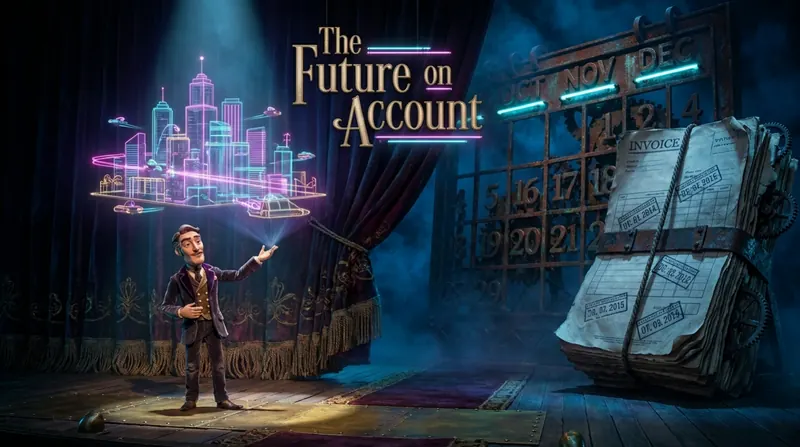
The Future on Account borrowed its residents from Little Dorrit. Mr Merdle is the man of the age, his undertakings regarded as national benefits, and the confidence spreads through London until it reaches Bleeding Heart Yard, a place without one unappropriated halfpenny, where Mr Plornish assures his neighbors that Merdle will put them all to rights. Merdle turns out to be a forger. The books examined across these seven episodes are, as far as anyone outside can tell, the books, so the comparison concerns the Yard. People with no shares in a great promise are rarely outside it. They live downstream of it, and they are usually the last to see the terms.
The opening scene paired two instructions arriving at one company on one morning. The customer’s cancellation produced a ticket number. The executive’s forecast produced a construction schedule and, somewhere in Ohio or Indiana, a fenced field with a sign on it. The working anchor came from that pairing: a promise becomes power when someone else must budget around it.
AI companies approaching the stock market offer an expensive version of the relationship. Anthropic and OpenAI each announced confidential draft registration statements in June, and a confidential draft is a long way from a share a pension fund can buy. The headline figure from Anthropic’s prospectus, at least $518 billion of infrastructure spending over roughly a decade, turned out to be a sum of agreements with different exits. Read as dated obligations with doors of different widths, it becomes informative.
The episode also introduced the ledger, with columns chosen for their dullness: the commitment, who made it, who is exposed if it fails, and who can call it in. Each episode added one entry. A disclosure sat beside the first: the practice behind this newsletter drafts in company with AI models, including models made by two of the firms under examination, and readers are invited to audit the arithmetic.
Labels on the numbers
The Number With the Missing Label started with twenty billion dollars that left the building between bulletins. OpenAI’s annualized revenue circulated at around $70 billion and then at around $50 billion, and Reuters traced the gap mainly to a comparison with Anthropic, whose figures treat partner-channel sales differently. A bookshop and a publisher can both say they sold a novel; only one of them should put the cover price on its income statement. The correction fixed a league table. It offered no evidence that customers left.
The losses carried the same lesson. Reuters put Anthropic’s 2025 net loss near $42 billion, about $34 billion of it a noncash charge on financing instruments, with an operating loss a little over $8 billion. Ed Zitron’s reporting on OpenAI’s audited statements had the same shape. Convertible instruments carried at estimated value rise when investors grow more optimistic, and the increase is booked as a loss, so the better the market feels about the company, the worse its income statement looks. Anyone presenting either headline as money burned has confused a valuation event with a fire.
None of that made the operating losses small, and a strong reported quarter at Anthropic, with adjusted profitability, cut the other way until its adjustment schedule appears. The legal point traveled further than the arithmetic. Antifraud rules reach securities offers before any prospectus is public; what a public registration statement adds is a document every reader can inspect and, once effective, a defined remedy for material misstatements. Until then, every figure in circulation is somebody’s word, carried by somebody else.
The supplier in the cap table
Your Investor, Your Supplier went back to 2000, when the telecom equipment makers lent their customers the money to buy their equipment. Lucent alone had made $7 billion of loan commitments. The routers were real, and by June 2001 an estimated 2.6 percent of the newly laid fiber capacity was in use. The lesson usually drawn, that circular deals are fraudulent, is easy to disprove and lets everyone off. The better lesson concerns correlation: when a supplier also lends to its customer and owns part of it, one disappointment at the customer arrives on its books several times at once.
Microsoft’s filing showed the supplier’s side cleanly, with OpenAI revenue and receivables in one place and investment funding a few pages away under a different heading (the correct presentation, and an excellent way to stop anyone adding them up). Nvidia went further. To CoreWeave it is shareholder, principal supplier and buyer of last resort. Since August it has also guaranteed an OpenAI affiliate’s lease and power payments at an Ohio campus, capped at $105 billion. Among the conditions that end the guarantee is OpenAI obtaining a satisfactory credit rating. The support falls away when the customer can stand alone, and the exclusive hardware stays.
Anthropic’s version ran through the shop counter. Amazon and Google hold equity, sell it compute, build competing models, and carried 47 percent of its 2025 sales through their marketplaces, while Anthropic owes them roughly $110 billion and $111 billion respectively regardless of usage. The prospectus itself says their incentives “may not be fully aligned.” Lucent believed in its customers too, and much of the fiber it financed still lies in the ground, lit for someone else.
A bill with a date on it
The Bill Has a Date named the instrument underneath: take-or-pay, one of the more honest arrangements in commercial life because it says out loud who carries the risk of being wrong about demand. The trouble begins when someone is very wrong at scale.
The gas pipelines of the 1970s promised producers to take, or pay for, most of their gas for a decade or more. Demand fell, exposure reached about $10.7 billion by 1986, and the pipelines declined to perform. FERC’s Order 500 let them recover part of the cost from customers if they absorbed an equal share, and by 1989 more than $44 billion of claims had settled at 14.6 cents on the dollar. Once the private contracts failed, a public regulator decided how much of the settlement reached people at the end of the pipe who had signed nothing.
The live version is Oracle, which borrowed to build ahead of demand for a reported $300 billion OpenAI contract, close to half its $664 billion backlog. A downgrade left its rating one notch above junk, and the cost of insuring its debt closed at a record in early October. The premium moved. The payments promised underneath it stayed put. A profitable unit of service can coexist with a company short of cash, because the price of each answer covers its cost while the reserved capacity behind it needs paying for anyway.
One firm line held around inference. Financial pressure identifies an incentive to investigate. It cannot supply anyone’s motive, and only the record of a particular decision can.
Two locks and a door
Public Money, Private Rules followed the invitation to own and the authority to govern onto different pages of the same document. Snap sold shares with no votes in 2017; the index providers were briefly scandalized and, six years later, reversed their exclusion, which matters more than the scandal did because index membership decides what passive funds buy on savers’ behalf.
Anthropic’s reported design has two locks with keys in different hands. A Founder LLC would direct a share class holding 50.1 percent of the vote on specified matters, while the Long-Term Benefit Trust would elect four of seven directors. The trust now has three members, and one former trustee left in August to become the company’s Chief Global Affairs Officer, so the door between overseer and executive has already swung once. The trust agreement remains unpublished, in a company asking the public to buy shares on the strength of the mechanism. OpenAI’s nonprofit keeps the power to appoint and remove the directors of its public benefit corporation, with safety powers secured through the Delaware attorney general’s review, and one precedent for using its sharpest power: November 2023, undone by an agreement within five days.
Both laboratories justify insulated control by the mission while leaving the mission’s beneficiaries without a defined way to call it in. Insulation works in both directions. A board protected from a shareholder majority is also protected from everyone else, unless someone builds a door.
The household on the tariff
No Shares, Still a Bill found the second public on its electricity bill. Across the PJM grid, the market monitor attributed 63 percent of a capacity price jump to data centers, about $9.3 billion recovered through higher rates. That settles the general question. The specific one, who pays when a particular campus disappoints, depends on an agreement.
Monrovia, Indiana supplied the best-documented answer. AES Indiana’s approved arrangement for a Google data center carries an 80 percent minimum demand obligation over at least fifteen years, with an exit fee: take-or-pay, with the grid as the pipeline. The press release led with $770 million in savings for other customers; the order shows that figure assumes the forecast comes true, while the minimum secures about $300 million. The order also placed $73.8 million of network upgrades in the rate base and found it reasonable for existing customers to carry a share. The coalition that asked otherwise lost on allocation, and won a rehearing of a separate rate case. The public order names the contracting party only as “a subsidiary of Alphabet, Inc.” The address exists. Part of it is a trade secret.
Louisiana showed what happens after approval, when Meta moved an 80 percent stake in a guaranteed campus to a Blue Owl-backed entity and the regulator declined to investigate. The households protected by the guarantee had no seat when its structure changed.
The blank column
Who Can Call the Promise In? set the six entries side by side, and they sorted themselves. Where the exposed party signed something, the last column has a name. Where the exposed party is the public, the column goes thin, or blank. The public’s routes exist, as Monrovia shows, but they run through intervenors and regulators and attach to particular approvals instead of to the promise itself.
A seventh row was left open for a proposal. OpenAI’s April policy paper suggests a Public Wealth Fund paying returns to citizens. Alaska has paid an oil dividend since 1982, and its record shows what a dividend can and cannot call in. In 2016 the governor vetoed roughly half of it, the state supreme court upheld the veto, and lawmakers later abandoned the statutory formula. Recipients held a payment and no enforceable claim to its size, and the dividend never gave a family near a pipeline standing to contest the pipeline. A public fund needs an account of its mandate before it needs a name: who appoints and removes its managers, what its holdings let it influence, what happens when the treasury is short, and what remedy a person holds when the answer disappoints.
The routes that worked shared one feature. They were written before the commitment hardened: the take-or-pay clause before the pipeline was laid, the Monrovia minimum before the substations were built. Late routes can open. They cost more and reach less.
The track
The companion track is Put It on Tomorrow, nocturnal new wave with a dub bassline, sung by the woman down the road who has read the small print. She enjoys the sales pitch enough to dance to it: someone draws a window in the wall and sells the view beyond. The chorus keeps the slate. When the instruments stop, she asks the question the ledger asks, of someone who can answer it: who put my name on this?
What the ledger leaves
Two tests came forward from earlier arcs. The Account Must Have an Address asked for a principal who answers, a preserved basis, authority to reconsider and a route to contest. When the Answer Counts asked for a named owner, a defined effect, a deadline and evidence of completion. Both were written for automated systems, and both carried over to capital markets without strain. The supply agreement passes them, which is why a supplier can sue. The tariff allocation half passes, explained in public on terms partly sealed. The mission statement fails the address test outright.
None of this is hostile to building useful AI. The technology’s value and its financing are separate accounts, and either can be healthy while the other is not. The case for a public account rests on the people who carry part of the cost without having signed for any of it, and the practical demand is modest: the terms before approval, time to challenge how costs are shared, an authority able to impose conditions, and evidence later that the conditions held.
When Merdle’s complaint was finally diagnosed, Dickens sent the ruin into “innumerable homes” that had never seen the books. The modern Yard is better organized and better informed. It is waiting for a seat at the table, and for the invoice to carry an address.
The Price of the Promise ran 18–24 October 2026. The question it hands forward is what happens when the people downstream stop waiting to be asked.