
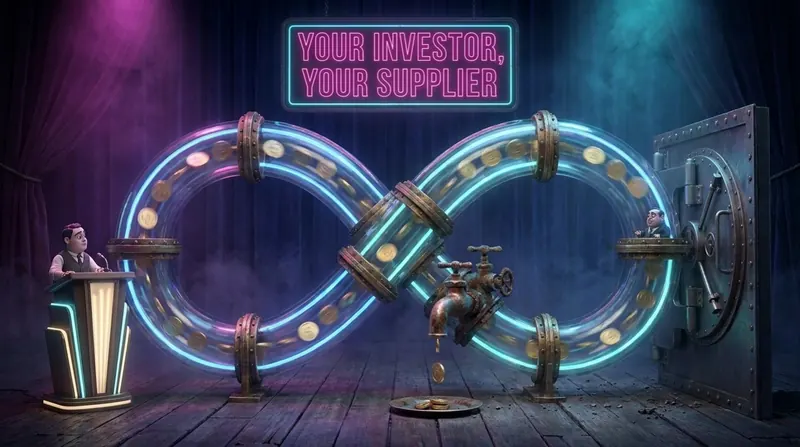
The investor puts money into the company. The company buys services from the investor. Each side records a real transaction, and both depend on the buyer finding enough paying customers to keep the arrangement going.
None of this is new, which is the most useful thing about it. In 2000 the great telecom equipment makers lent their customers the money to buy their equipment. Vendor financing peaked that year at somewhere between $25 billion and $30 billion in loans, with Lucent and Nortel prominent among the lenders. Lucent alone, an SEC filing later showed, had made $7 billion of loan commitments to customers, many of them start-ups with more ambition than revenue, and had already handed over $1.6 billion. The sales were real. The routers rolled off the line. And by June 2001 Merrill Lynch was estimating that only 2.6 percent of the fiber capacity laid in the previous four years was in use.
The lesson people usually draw from that period is that circular deals are fraudulent, which is easy to disprove and lets everyone off. The better lesson concerns correlation. When a supplier also lends to its customer and owns part of it, a single disappointment at the customer arrives on its books several times at once.
The view from the vendor
Microsoft’s accounts show the relationship from the supplier’s side with unusual clarity. Its 2026 Form 10-K, for the year ended June 30, reports $24.1 billion of revenue from commercial arrangements with OpenAI, revenue-sharing payments included. It records $6 billion receivable from OpenAI. It also shows $11.9 billion funded against a $13 billion investment commitment. The customer’s payments sit in one column and the financing supplied to the customer sits in another, a few pages apart, under different headings, which is the correct way to present them and an excellent way to stop anyone adding them up.
They should not be added up, either. An investment buys a stake in a business, while revenue records services sold and a receivable is simply money still owed. Summed into a single figure for “demand,” they would count the same hopes more than once (the accountant’s version of a hall of mirrors). The better question runs the other way: how much of the customer’s spending is paid for by its own customers, and how much depends on the next round of financing, some of which may come from the supplier?
Shovels, mine, ore, rent
Nvidia has taken the arrangement further than anyone. With CoreWeave, a cloud provider that rents out Nvidia chips, it has long been both shareholder and principal supplier, and since September 2025 it has also been the buyer of last resort: CoreWeave disclosed an agreement under which Nvidia buys whatever capacity its other customers do not take, with an initial value of $6.3 billion, through April 2032. Nvidia’s own explanation pointed to long lead times and multiyear customer commitments, which is fair. It also means the company sells the shovels, owns a share of the mine, has promised to buy the ore nobody else wants and, as of this summer, guarantees the rent.
Nvidia’s quarterly filing for the period ended July 26, 2026 discloses an August arrangement guaranteeing an OpenAI affiliate’s lease and power payments at SB Energy’s Ohio campus, capped at $105 billion. The guarantees switch on in phases as facilities enter service, and they cover defined payments after specified defaults. The campus will host Nvidia infrastructure exclusively, with limited exceptions.
The most revealing clause is the exit. Among the conditions that end the guarantee is OpenAI obtaining a satisfactory credit rating. Nvidia stands behind its customer until a rating agency says the customer can stand on its own, at which point the support falls away and the exclusive hardware stays. As instruments go, it is elegant. It also shows the guarantor’s interest plainly: the guarantee is a passing pledge, and the market for chips is the permanent part.
None of this is cash already handed over. The $105 billion is a ceiling, its tranches activate with construction, and a reader assessing today’s exposure needs those conditions alongside the cap, with the first phase expected in fiscal 2029. A reader assessing concentration needs something else, which is the list of things that would go wrong together. The CoreWeave backstop and the OpenAI lease guarantee are separate arrangements with separate customers, so they do not compose into a single domino. They do sit in one portfolio: if demand across Nvidia’s customer base disappoints, sales fall while its stakes in cloud providers lose value, the guarantee could be called after a covered default, and the residual capacity Nvidia promised to buy may become capacity it has to buy.
The partner at the till
Anthropic’s version of the arrangement runs through the shop counter, and its own filing describes the loop. Amazon has committed up to $25 billion to Anthropic (CNBC, April 2026), $5 billion of it paid alongside an agreement under which Anthropic will spend more than $100 billion on AWS over ten years, and Google followed with a commitment of up to $40 billion. Reuters’s September 29 review of the confidential prospectus prices the other side of those relationships: about $110 billion payable to Amazon between May 2026 and April 2036, and $111.1 billion to Google between April 2026 and July 2033, in each case regardless of usage. The document spells out the shortfall clause: “If our actual spend falls short, we must pay Google the difference.” The Amazon agreement carries similar terms. Both firms supply its compute and build competing models. Their marketplaces also carried 47 percent of its 2025 sales.
Two more suppliers shorten the circuit. AMD agreed to buy up to $5 billion of Anthropic stock while committing to supply capacity worth more than $20 billion, and Broadcom holds largely non-cancelable lease obligations from Anthropic of about $161.2 billion, alongside a convertible facility reported at up to $42 billion (a supplier collecting rent while holding an option on the tenant’s equity).
The prospectus puts the pattern in the company’s own words. Its three cloud giants, the risk factors say, act at once as investors, suppliers, distributors and competitors, with incentives that “may not be fully aligned” with Anthropic’s interests. Map one disappointment in demand onto Anthropic’s arrangement and the correlated positions appear: the two cloud giants would see compute sales and stake values fall together, while holding minimum payments whose size they helped shape. Those are exposures and powers held by the same two firms. Proving that each position loses money in the same quarter is a matter for the next set of filings.
There are mitigations. Anthropic is shifting toward dedicated data centers and directly leased chips, which moves part of its fate outside three other companies’ pricing decisions, and the xAI capacity, up to $84.5 billion through 2029, is largely cancelable on ninety days’ notice, a wider door than either hyperscaler minimum offers. OpenAI’s own financing, though, blurs the neat division of labor. Its February funding round named Nvidia as a $30 billion participant, so the guarantor of the Ohio lease is also a shareholder. Both laboratories, then, have investors standing on the other side of the counter. The money runs in different directions: Anthropic owes its largest minimum payments to the same firms that hold its equity, while Nvidia’s disclosed exposure to OpenAI runs through equity and credit support, and the guarantee itself sets no minimum payment from OpenAI to Nvidia.
Ledger, entry three. Commitment: stand behind the customer’s payments. Made by: the supplier, as guarantor and buyer of last resort. Exposed if it fails: the supplier’s shareholders, and the lenders who priced the facility on the strength of the guarantee. Who can call it in: the guarantee’s beneficiaries, on the triggers written into the instrument, and only until the customer earns its rating.
Lucent believed in its customers, too, and much of the fiber it financed still lies in the ground, lit for someone else.
Bibliography
Broadcom, financing arrangement with Anthropic, as reported by Dealroom from the confidential prospectus, October 2026.
CNBC, ‘Amazon to invest up to $25 billion in Anthropic, part of AI infrastructure deal’, 20 April 2026.
Microsoft, ‘Form 10-K for the year ended June 30, 2026’.
Newsweek, ‘The Stupid Loan Bubble’, 27 October 2002.
Nvidia, ‘Form 10-Q for the quarter ended July 26, 2026’, Note 10 and ‘Management’s Discussion and Analysis’.
OpenAI, ‘Scaling AI for everyone’, 27 February 2026.
Reuters, ‘CoreWeave, Nvidia sign $6.3 billion order for cloud computing capacity’, September 2025.
Tampa Bay Times, ‘Overbuilding snares fiber-optic industry’, 23 June 2001.
Wang, Echo, and Krystal Hu, ‘Exclusive: Anthropic IPO prospectus lays bare deep dependence on Big Tech partners’, Reuters, 29 September 2026.
Wang, Echo, and Sabrina Valle, ‘Anthropic’s $518 billion AI buildout hinges largely on deals that cannot be canceled, filing shows’, Reuters, 29 September 2026.
Woolley, Scott, ‘Carly Fiorina’s troubling telecom past’, Fortune, 15 October 2010.