
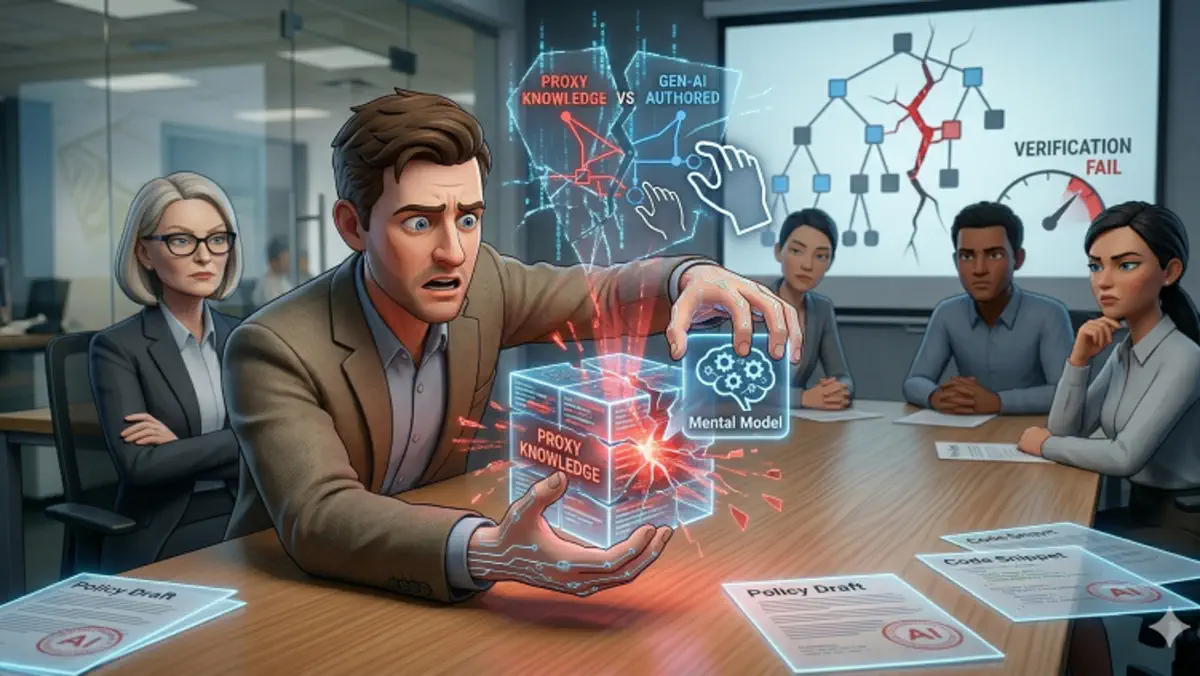
The Detection Arc, Day 2
Yesterday’s question was whether the rhythm made sense. Today’s question is sharper: can the person attached to the artifact actually move inside it?
That is where the seam opens.
Episode 102 stayed at the level of observation. The pacing was off. The burden seemed to have shifted somewhere strange. Work arrived with the right surface and the wrong metabolism. That was enough to justify inquiry. It was not enough to tell you what kind of inquiry the situation required.
Today the focus moves from artifact to agency. The issue is no longer whether the thing is present. The issue is whether the person carrying it can navigate its logic in real time.
That is the purpose of the live-edit test.
The name sounds harsher than the thing needs to be. In ordinary practice, the live-edit test is simply a professional question. Can the person who submitted the work explain it, adapt it, and remain oriented once the thing has to change in motion?
That question reaches well beyond AI use. It matters for consultants using ghostwritten decks, managers fronting work produced entirely by analysts, researchers presenting numbers they never really interrogated, and junior staff learning to pass polished surfaces up the chain before comprehension has caught up. Generative AI simply makes the seam more common, cheaper, and easier to hide behind.
The reason the live-edit matters is simple. Production can now be proxied. Navigation still has to be carried.
A system can produce a table, a slide, a memo, a paragraph, a concept note, a code snippet, or a policy draft at extraordinary speed. A human can then adopt that product, clean it, submit it, and even half-believe it. Once the room changes, though, the difference between possession and proximity becomes visible. Someone asks for a specific modification, a rationale, a tradeoff, a re-sort, a recalculation, a changed assumption, or a real-time adaptation to new conditions. The artifact now has to answer back.
That is where the seam often stops being theoretical.
A person who understands the work may still need a moment. They may be tired, nervous, junior, or imperfectly articulate. They can still re-enter the structure. They know where the logic lives. They know which assumptions matter. They know what can be changed safely and what will ripple through the rest. They may not remember every cell reference or every sentence exactly. Memory is not the point. The point is that they possess a workable mental model.
A person who does not understand the work has a different problem. They do not know where the logic lives because, in an important sense, it never settled in them. So they start searching the artifact the way an outsider would. They scan. They stall. They reverse-engineer. They offer broad paraphrases when specific reasoning is required. They try to preserve surface continuity while privately attempting to reconstruct the path by which the thing came into being.
That effort has a cost. I think of it as the defense tax.
The defense tax is the cognitive burden of trying to protect ownership of work you cannot comfortably inhabit. It shows up as delay, vagueness, strangely expensive small changes, and a kind of over-managed composure. The person is no longer working with the artifact. They are defending a claim to it.
That distinction becomes easier to see once you stop looking only at polish. Someone navigating a structure moves with it. Someone defending a structure keeps checking whether they still appear attached to it.
This is one reason the live-edit test has to be designed carefully. Any room that starts from accusation pollutes the signal. Nervous people become less articulate under interrogation. Junior staff lose fluency when the atmosphere turns prosecutorial. Institutions that want truthful signals have to create conditions in which truthful demonstration is actually possible.
So the architecture matters.
The strongest version of the test feels collaborative. The language is practical, specific, and forward-moving. Can you show me how you approached this section? If we changed this assumption, where would you update it? Walk me through the logic here. Let’s make one small tweak together and see what happens.
Those questions do real work. They do not ask whether the person achieved some fantasy of solitary authorship. They ask whether the person can think with the thing in front of them. That is much more useful. It leaves room for legitimate support, partial AI assistance, collaborative drafting, inherited templates, and the ordinary mess of contemporary work, while still insisting on a professional floor: if your name is on it, you must be able to carry its logic.
That is the actual issue.
Modern work is already collective, scaffolded, templated, tool-assisted, and unevenly distributed. Solitary authorship was never the whole truth. The real question is whether the person signing off can understand, defend, adapt, and own what has been submitted under their authority.
This is where the five-minute rule is helpful, as long as it is treated as a heuristic rather than courtroom doctrine. If someone cannot locate the logic of the work within a few minutes of live exploration, something important is being revealed. The issue is not poor memory. The issue is weak possession. A person with a mental model may need a moment to orient themselves, especially under pressure. A person without one starts searching for the model inside the artifact because it was never consolidated in them to begin with.
That distinction matters because it keeps the conversation tied to comprehension rather than performance style. Some people are verbally agile. Some freeze in meetings. Some can narrate beautifully while understanding very little. Some understand a great deal and need a minute before the words arrive. Five minutes is not a magic number. It is just long enough for the room to start seeing whether the person is reconnecting with an existing model or trying to build one from fragments while everyone watches.
Once that gap appears, the next question becomes institutional rather than theatrical. What kind of gap are we actually looking at?
Several possibilities sit inside the same live-edit failure:
- A training gap. The person assembled the work from borrowed parts they only half understood.
- A workflow gap. A tool produced a plausible answer without leaving the worker with a usable model.
- An incentive gap. The organization rewarded polished delivery more strongly than actual comprehension.
- A substitution gap. The work was passed off as owned knowledge when it was really rented fluency.
The live-edit test does not resolve those questions by itself. It does something earlier and more important. It shows you whether the logic is present in the room.
That is already a great deal.
Once the logic is absent, you are no longer discussing a successful deliverable with minor imperfections. You are discussing a professional surface that cannot currently support its own weight.
Organizations often make a second mistake here. They treat the failed live-edit as a scandal and rush immediately toward blame. That impulse is understandable. It is also frequently premature.
A live-edit failure is a verification signal. It tells you that production and comprehension have come apart. It does not yet tell you why they came apart, or how the proportions of tool use, poor training, bad incentives, weak supervision, role mismatch, or concealment are distributed.
That next layer matters because the response should differ.
A comprehension lag may call for coaching, checkpointing, and a narrower scope of responsibility while the person learns to inhabit the work they are producing.
An undisclosed substitution problem may call for discipline.
An organizational setup that quietly rewards polished surface more than responsible grasp is a room problem before it is an individual one.
This is why the live-edit test should not exist only as a crisis instrument. It belongs in ordinary workflow before suspicion arises.
That is where checkpoint design becomes useful.
Instead of waiting until something feels wrong and staging a tense reveal, a team can normalize small moments of live modification as part of how work moves. A Monday deliverable gets a ten-minute collaborative tweak. A dashboard review includes one real-time change request. A policy draft gets walked through live with one assumption reversed. A presentation includes one slide the presenter has to reframe on the spot for a different audience.
These are not paranoia rituals. They are good process.
They improve process even when no deception is involved because live-edit moments are not only detection devices. They are comprehension builders. They force contact between person and product. They reveal weak spots while there is still time to learn. They make strong practice visible. They let teams compare methods. They reduce the chances that a polished artifact arrives with no living understanding attached to it.
They also shift the value system of the workplace. The premium moves away from immaculate surface and toward demonstrated grasp.
That is healthy. It is also more realistic for an AI-shaped environment.
Tool-assisted production is becoming normal. Smoothness is cheaper now. Plausibility is cheaper. Competent first-pass prose is cheaper. The scarce thing is accountable comprehension.
The scarce thing is the person who can still explain the moving parts, adapt the structure under pressure, identify which assumptions were smuggled in, tell the difference between a persuasive sentence and a true one, and answer when the polished thing is asked to answer back.
That is where the burden of comprehension becomes a governance issue.
If institutions continue rewarding production while neglecting navigation, they will steadily accumulate surfaces that no one can responsibly operate. Some of those surfaces will be harmless. Some will be embarrassing. Some will carry budget decisions, legal claims, environmental reporting, public messaging, or operational risk.
The problem scales quickly.
The human side still needs care. A person can fail a live-edit for reasons other than dishonesty. They may be new. They may be under-supported. They may be presenting team work they were never properly invited into. They may have used AI as scaffolding and then leaned on it too much because the room rewarded speed over learning. They may panic in the moment. They may simply not yet know enough.
That matters because institutions are often tempted to treat every live-edit gap as a moral verdict.
The more useful question is narrower and colder. Can this person currently carry the logic of what they are signing their name to?
If not, what kind of gap are we looking at?
That framing creates better room for legitimate AI use as well. An employee should be able to say: I used AI to get the first structure, then I reworked it, checked it, and here is why it now says what it says. Or: I used a tool to build the first version of this dashboard, but I still need help understanding how these formulas interact.
Those are usable statements. They create governance surface. They let the institution respond with the right mix of acceptance, guardrails, training, and accountability.
The real danger begins when the room makes those statements impossible.
Then the live-edit becomes the place where everything has to be discovered backward. The artifact is already submitted. The confidence has already been performed. The claim to authorship has already hardened. A tiny modification request now has to carry the whole burden of truth.
That is too much to ask of one awkward meeting.
Better workflow would have brought that truth forward earlier.
So yes, the live-edit test verifies something important. It tells you whether the person can navigate the artifact they have produced or adopted.
Its deeper lesson is architectural.
Institutions should stop inferring comprehension from polish. They should make comprehension visible in the ordinary movement of work. More small live modifications. More walk-throughs. More explain-your-logic moments. More routine opportunities for people to show not just what they have, but how they can move with it.
Once production and navigation split apart, the problem is no longer just a suspicious artifact. It is a governance environment that has rewarded finished surface without ensuring anyone can still steer the thing.
Tomorrow that question sharpens into judgment.
When a live-edit fails, what exactly has failed?
Training?
Workflow?
Disclosure?
Or the relationship to work itself?
That is where the HR dilemma begins.