
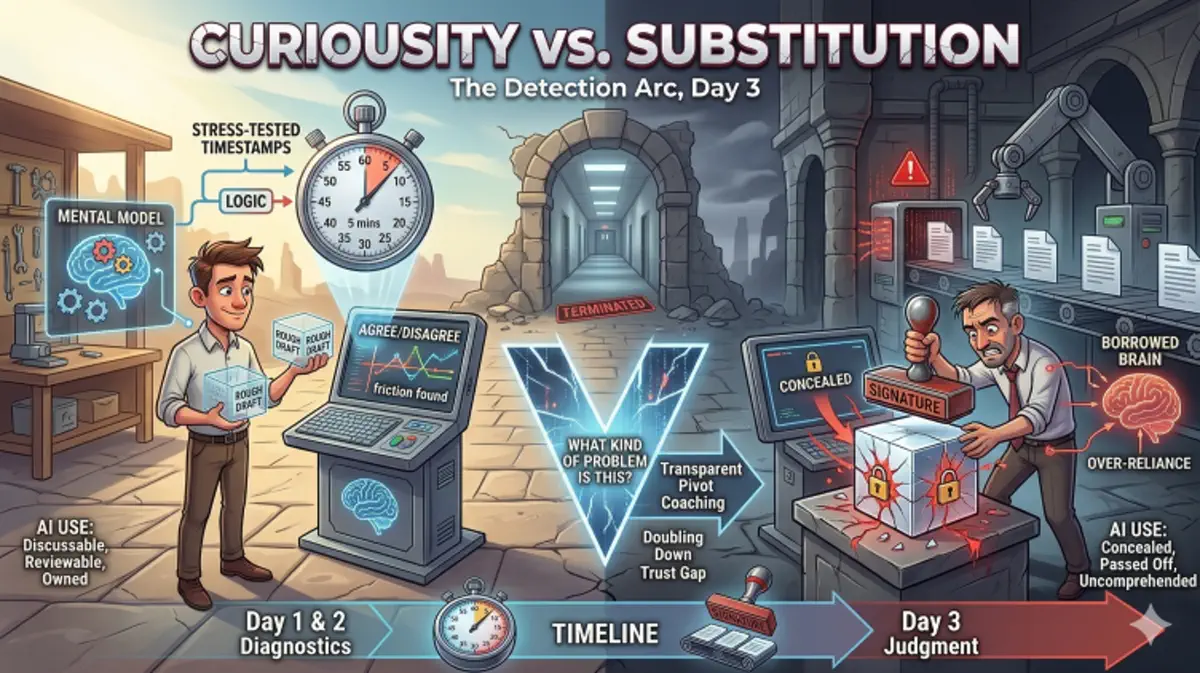
The Detection Arc, Day 3
"More a personality issue than an AI issue."
A colleague said that after letting someone go. She said it offhandedly, the way people do when they have landed on something true but have not yet measured how far it reaches.
That sentence may be the sharpest thing anyone in this series has said. It points the diagnostic away from the instrument and toward the person holding it. Away from what the tool can do and toward what the worker chose to stop doing.
The first two days were diagnostic. Day 1 asked whether the rhythm of work still matched the reality it claimed to represent. Day 2 asked whether the person could navigate the artifact once it had to move. Both questions located the seam. Neither answered the next question waiting underneath them.
Today the register changes.
The issue is no longer detection. It is judgment.
When a live-edit fails, what exactly has failed?
The Sunday interlude gave us a clean exit. The employee was let go. The song was written. The door closed. But the sentence the colleague left behind — more a personality issue than an AI issue — marks a distinction most workplaces have not yet learned to see. It marks the difference between using a tool and outsourcing your presence to it. Between reaching for a system to extend your thinking and reaching for it to replace your thinking while preserving the appearance of having done it alone.
That distinction is where the HR dilemma lives.
It helps to make the pattern visible, even if real people are always messier than any clean framing allows. What matters here are not two fixed personality types, but two different relationships to tool use.
One relationship is curiosity-driven. The person uses generative systems the way a researcher uses a difficult colleague: as something to think against. They bring rough drafts into the room. They say things like, I used GPT to stress-test this hypothesis, and here is where I disagree with it. Or: The model gave me a confident paragraph built on a source that does not exist. I kept the structure and rebuilt the evidence. They show the seams voluntarily because the seams are where the learning happened. The tool did not replace the thinking. It gave the thinking somewhere to push.
That relationship to AI is open, discussable, and oriented toward comprehension. The person may still fail a live-edit on a bad day. Everyone can. But the failure looks temporary rather than structural. The mental model exists. It may need a moment to surface.
The other relationship is substitution-driven. The person uses the same tools to a fundamentally different end. The goal is a finished surface that will pass inspection. A deck arrives at midnight, formatted beautifully, every section internally consistent. In the morning review, someone asks about the assumption behind the third paragraph. The worker pauses. Restates the question. Describes what the paragraph says. The room waits for the logic underneath it. The logic does not arrive.
The system generated the surface. The worker supplied the signature.
That relationship to AI is concealed, surface-oriented, and performance-driven. When the live-edit comes, the gap is structural. There is no mental model waiting to reconnect. There is only the artifact and the increasingly expensive effort to appear as though the reasoning lives in the person rather than outside them.
Most real people drift between these poles depending on the task, the pressure, the deadline, their confidence, the signals their institution sends, and the degree to which disclosure feels safe. That is precisely why the distinction matters. It is a way of judging direction, not labeling souls.
Once that distinction is visible, the institutional question sharpens. What is the organization actually trying to govern?
Most workplace AI policies, to the extent they exist at all, are written around the tool. AI use must be disclosed. AI-generated content must be identified. Employees must not submit AI outputs as their own work. The language is instrument-facing. It treats the model as the variable.
The deeper governance problem lives elsewhere.
Two employees can use the same model, on the same task, in the same afternoon, and create completely different professional realities. One uses it to explore, discloses the use, reworks the output, and can walk the room through every choice that followed. The other uses it to vanish, says nothing, submits the result, and cannot explain the logic when the room asks.
The model is identical. The relationship is not.
That is why policy has to govern the relationship to the tool, the level of disclosure around its use, and the degree of comprehension still present when the output lands. A policy that governs only the instrument will flatten valuable differences. It will either trap accountable use and concealment in the same net, or miss both because the actual use left no formal trace. What it will not do is distinguish between the use that strengthened the work and the use that hollowed it out.
So the policy line has to move.
A useful starting point might sound something like this:
AI use is permitted where it remains discussable, reviewable, and owned. AI use becomes substitution when it is concealed, passed off, or relied on without enough comprehension to carry the result.
That clause does several things at once. It normalizes the presence of the tool. It places the burden on the quality of the relationship rather than on the instrument itself. It makes disclosure an operational standard rather than a moral confession. And it gives the institution a more workable vocabulary. The question in the room stops being did you use AI? — which is rapidly becoming as meaningless as did you use spell-check? — and starts being: can you carry this?
That is a conversation a workplace can actually have.
If this distinction matters — and I think it is becoming one of the more important professional distinctions of the next decade — then it needs to be assessable before a governance incident forces the issue. That means at hiring. At onboarding. At ordinary checkpoints where an organization forms its sense of how a person works.
The curiosity interview is one way of doing that.
The premise is simple. Instead of asking whether a candidate uses AI — which now has roughly the diagnostic value of asking whether someone uses email — you ask how they use it. You ask about friction. You ask about error. You ask about where the system misled them and how they noticed.
Show me something you made where the tool led you astray. How did you know?
Tell me about a time an AI output looked right and turned out to be wrong. What did you do next?
Walk me through a project where you used generative tools. Where did the tool help? Where did you override it? Where are you still unsure?
These are craft questions. They test for the thing that matters: whether the person has a critical, inhabited relationship with the tool, or whether the tool is functioning as a black box that produces surfaces they accept without interrogation.
A curiosity-driven user will have stories about friction. They will know where the model tends to hallucinate. They will have opinions about its limitations that come from direct contact, not secondhand caution. They will usually have at least one vivid memory of something that sounded authoritative and was fabricated from whole cloth.
A substitution-driven user will often struggle here. Not always from dishonesty. Sometimes the relationship simply never generated friction because the tool produced and the person accepted. The loop closed before learning could enter it. Ask them where the model was wrong, and you may get silence — not because they are hiding something, but because they never checked.
This leads to the hardest human design question in the piece.
Assume you have an employee who has been using AI without disclosure. The live-edit has revealed the gap. The conversation has happened. The substitution is visible. What now?
Many institutions will reach first for the policy, locate the clause, and move straight toward consequence. That impulse is understandable. It is also often premature.
The first question is not what the policy says. The first question is what the person is doing now that the gap is visible.
Are they pivoting? Are they disclosing? Are they sitting forward in the chair, asking what accountable use actually looks like? Or are they doubling down, minimizing, defending the surface, performing the posture of someone for whom the real issue remains invisible?
That pivot matters enormously. It is the difference between someone who drifted into a bad workflow and someone who built a professional identity around one.
An amnesty protocol can be designed around it. First-time undisclosed use, where the person responds to discovery with transparency and a genuine willingness to change the workflow, can be treated as a developmental moment. The institution provides coaching, checkpointing, clearer expectations, and a supported path back to accountable practice. The message is straightforward: the concealment was the problem, the tool use was not, and we are going to help you build a better relationship with both.
Repeated concealment after that conversation deserves a different response. At that point the issue is no longer a workflow gap or a training gap. It is a trust gap. The person has been offered a bridge from substitution toward accountable use and has declined to cross it. The institution is now justified in treating the pattern as a professional conduct issue, because that is what it has become.
The forgiveness gradient matters because it preserves institutional discernment. A zero-tolerance policy for all undisclosed AI use will produce a workforce that conceals better. A no-consequence culture will produce a workforce that comprehends less. Neither arrangement deserves to be called governance.
The useful middle is more demanding. It says: we take this seriously, we will help you get it right, and we will hold you accountable if you choose not to.
None of this works if the culture upstream rewards the wrong things.
That is the turn the interlude was already pointing toward. Substitution thrives in cultures that reward individual genius over collaborative sensemaking, polished deliverables over inhabitable method, speed over comprehension. A culture that celebrates the gleaming midnight deck without ever asking how did you build this has already issued an unwritten invitation to substitute.
Tuesday showed what happens when rhythm detaches from the task. Wednesday showed what happens when production detaches from navigation. Today adds the wider implication: those are downstream expressions of a culture that keeps rewarding appearance over inhabitation.
In those cultures, substitution is not mysterious. It is rational. The tool makes it easy. The room makes it rewarding. Disclosure mechanisms either do not exist or feel dangerous. The person who says, here is where the tool helped and here is where I had to push back, risks looking less competent than the person who says nothing and submits a gleaming artifact.
Organizations get the AI use they deserve.
That is not a comfortable sentence. It is not entirely meant to be. If your best people are hiding their process, the problem is not only the people. It is the room they are performing in. If your worst outcomes trace back to undisclosed substitution, the question is not only who substituted. It is who made substitution the easier path.
The institutional task is to make curiosity legible, discussable, and professionally rewarded. Reward the person who says here is my rough draft, here is where the tool helped, here is where I had to override it. Normalize disclosure as professional practice. Build Wednesday's checkpoints into ordinary workflow so comprehension is demonstrated routinely, before anyone is under suspicion.
Build the room so accountable use is easier than concealment.
There is one more uncomfortable dimension to keep in view.
Sometimes the person who fails the live-edit is not the only one who stopped being present for the work. Managers may never have read closely enough to notice the seam. Teams may have rewarded polish without asking how it was produced. Organizations may have built reporting structures in which artifacts travel upward while comprehension does not. Review processes may check formatting, branding, and deadline compliance while leaving the logic untouched.
The manager who never asked walk me through this is not blameless when the answer turns out to be empty.
The substituter did not operate in a vacuum. The choice was individual. The setting was institutional. Both are part of the truth.
That is why curiosity cannot remain a personal virtue the worker is privately expected to possess while the institution builds no infrastructure to support it. If curiosity is the goal, the institution has to build for it. The policy has to name it. The workflow has to surface it. The incentive structure has to reward it. The hiring process has to assess it. The response to failure has to distinguish between the person who drifted toward substitution and is willing to come back, and the person who chose it deliberately and intends to stay.
That is the judgment layer.
Detection asks what happened. Judgment asks what kind of problem this is and what kind of response it deserves.
Tomorrow the question moves again.
If curiosity is what we want, and substitution is what we are trying to prevent, then the next task is architectural. The missing signal has to become visible before anyone has to go looking for it.
That is where the design work begins.