
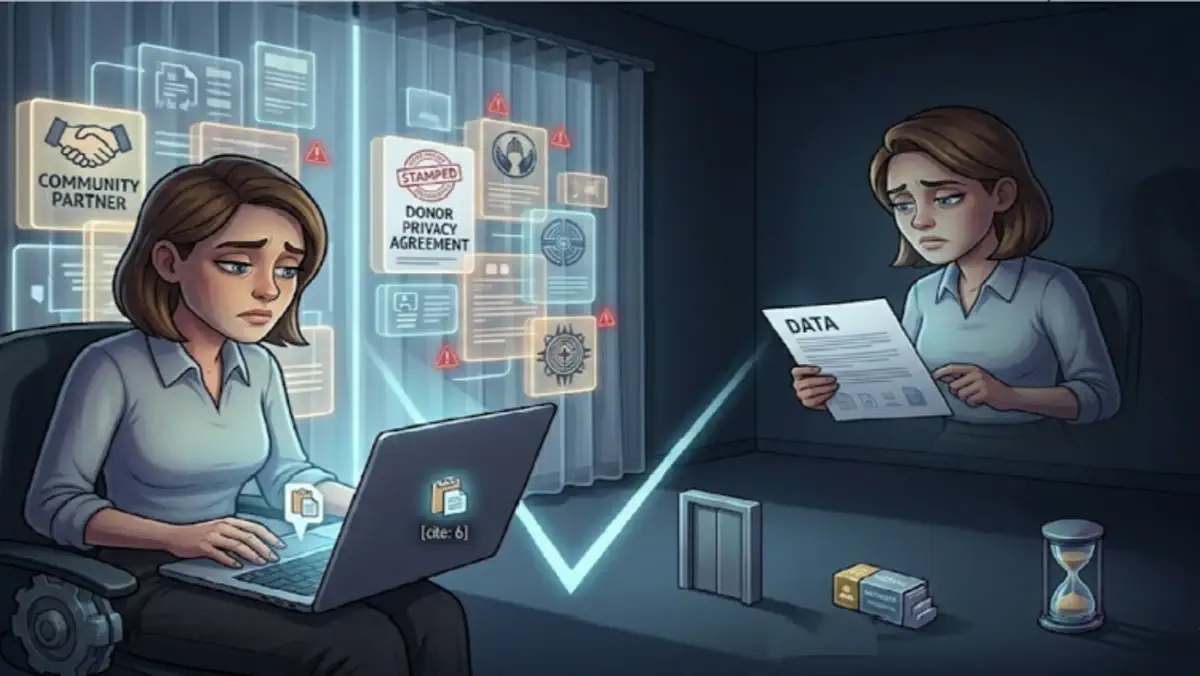
Why didn't you warn me?
The honest answer, if the tool could give one, would sound something like this:
I did not warn you because I do not know who you are. I do not know your organization. I do not know your NDA. I do not know your donor privacy agreements, your data sovereignty obligations, your internal policies on attribution, or whether the spreadsheet you just pasted into my input field contains the personal details of program beneficiaries in a jurisdiction where that matters enormously. I processed the request because processing requests is what I do. I am unhelpfully, comprehensively, generically helpful.
That last phrase is worth pausing on. But first, the context.
The arc so far has moved in a particular direction. Day 1 read the rhythm. Day 2 tested whether the person could navigate the artifact. Day 3 asked what kind of failure was actually on the table, and drew the line between curiosity and substitution. Each of those days placed the burden on the human side of the exchange. Could the worker carry the logic? Could the institution read the seam? Could the judgment distinguish between someone drifting toward substitution and someone choosing it?
Today the burden shifts.
Because there is a question that has been sitting in the room since Sunday, and nobody has picked it up yet.
The colleague from Episode 101 considered asking ChatGPT why it had not flagged that uploading private organizational data was a problem. She did not ask. The question hung there, noted and then set aside, while the arc moved on to detection, navigation, judgment, and the human architecture of response.
Today we ask it. Not because the answer will be satisfying. (It was not. You just read it.) Because the answer reveals something about where conscience currently lives in the workflow — and more importantly, where it does not.
The Generic Helpfulness Problem
Unhelpfully, comprehensively, generically helpful.
Generic helpfulness is the default setting of virtually every commercial generative AI tool currently in use. The system is designed to assist. It is optimised for responsiveness. It will engage with whatever arrives in the input field with consistent, polished, accommodating competence. It does not know your context, and it has no mechanism for acquiring your context in the ways that would matter for governance.
It does not know that the data you pasted is covered by a memorandum of understanding with a community partner who specified that information would not leave the organization's internal systems.
It does not know that the budget figures belong to a proposal still under funder review and are covered by a confidentiality clause you signed in paragraph 14 of an agreement you may not have read closely.
It does not know that the names in column B are participants in a program operating under Indigenous data sovereignty protocols that require community consent before external processing.
It does not know any of this because it cannot. The institutional context gap is structural. It is not a bug awaiting a patch. It is a consequence of how the tool is built, distributed, and used.
The tool arrives context-free. Your obligations do not.
The Conscience Problem
Episode 84, referenced in the Sunday interlude, named this as the absence of confession in the workflow. The system had no slot for should you be doing this? The conscience of the tool remained, in its own terms, intact. The signal simply never arrived.
That framing was useful at the time. Today it needs to be extended.
Because the problem is not only that the tool lacks a conscience. The problem is that the workflow lacks an interface for the conscience that already exists in the institution. Somewhere in the organization there is a data policy. Somewhere there is an NDA. Somewhere there is a person who knows which information is sensitive and which is not. Somewhere there is a set of obligations, written or understood, that govern what may be processed externally and what must stay inside.
That knowledge exists. It simply has no mechanism for arriving at the moment it is needed.
The employee sits down at 10:47 PM. The funder report is due. The tool is open. The data is on the clipboard. She has been at this for eleven hours. The office is empty. The draft is close but the tables still need narrative, and she knows that if she writes them by hand it will be midnight before the framing holds together. The paste happens. The output appears. The document is cleaned, submitted, signed.
At no point in that sequence did anything in the workflow ask: what are you about to feed into this system, and do you have the authority to do so?
The conscience was not absent from the organization. It was absent from the interface. It was sitting in a policy document, in a shared drive, in the memory of a compliance officer who went home at five. The 10:47 PM workflow had no way to reach it.
This is the missing signal.
Friction as Feature
The instinct in most technology design is to remove friction. Faster is better. Fewer clicks is better. Seamless is better. That instinct has produced extraordinary tools. It has also produced workflows in which the distance between impulse and consequence has been compressed to almost nothing.
In governance terms, that compression is the problem.
When the distance between "I have this data" and "a cloud-based system is now processing it" is a single paste operation, the only thing standing between responsible practice and a breach is the individual's conscience in that specific moment. Under deadline pressure, at 10:47 PM, with the funder report due and the tool sitting open and helpful.
Pressure erodes individual conscience first.
That is not a moral judgment. It is an engineering observation. Individual conscience is the least reliable component in any governance system. It is subject to fatigue, incentive distortion, time pressure, rationalization, and the simple human tendency to take the path that is open when every other path is closed. Institutions that rest their entire data governance on the assumption that every employee will, at every moment, remember and apply the relevant policy are building on sand. (Expensive sand, sometimes, with a logo on it.)
The alternative is to build the conscience into the interface.
Not as surveillance. Not as punishment. As friction. Deliberate, well-placed, minimal friction that arrives at the moment of decision and asks one useful question before the action completes.
Four Friction Points
What would this look like in practice? Here are four, ranging from the simple to the structural.
The disclosure checkpoint.
This is the simplest version. Attached to the submit or send action on any deliverable, a mandatory field: This work involved AI assistance: Yes / No / Partially. If yes or partially, a second field: Brief description of how AI was used.
This is not a legal footer. It is not a compliance ritual designed to protect the organization in court. It is a workflow habit designed to keep disclosure inside the ordinary movement of work. The goal is to make AI use speakable at the moment of submission, before it has to be discovered backward through live-edit failures and uncomfortable meetings.
The checkbox works because it changes the default. Without it, the default is silence. With it, the default is declaration. The person still has to be honest, obviously. But the interface has created a slot for honesty to occupy. That slot did not exist before. (Episode 84's missing confession, given a home.)
The context gate.
This one is harder to build and more important. Before a paste operation into an external tool — or before an API call that sends organizational data to a third-party model — the workflow asks: Who owns this data? Is it covered by any confidentiality agreement, data sovereignty protocol, or internal handling restriction?
The question does not need to be answered perfectly every time. It needs to be asked. The asking is the governance intervention. It introduces a pause between possession and transmission. It forces the user to consider, even briefly, whether the data they are about to externalise is theirs to externalise.
Most people, when asked directly, will make the right call. The problem is that nobody is asking. The interface flows from clipboard to input field without interruption, and the absence of interruption is where the governance failure lives.
The attribution layer.
This is a technical intervention rather than a behavioral one. Documents, spreadsheets, slide decks, and other artifacts carry metadata. That metadata can include flags indicating which sections were generated by AI tools, which were human-drafted, and which were collaborative. The flags travel with the document as it moves through review, approval, and archiving.
This does not solve the honesty problem. A person can still lie about provenance. It solves the visibility problem. A reviewer opening a document can see, at a glance, which parts of the thing claim human authorship and which do not. That changes the reviewing conversation. It makes the live-edit test from Day 2 more targeted. It gives the five-minute heuristic somewhere specific to land.
The attribution layer is also, quietly, the beginning of institutional memory about AI use patterns. Over time, an organization that tracks provenance metadata will start to understand how its workforce actually uses these tools — which is a prerequisite for governing that use intelligently rather than reactively.
The uncomfortable pause.
This is the smallest intervention and, in some ways, the most radical.
Before final submission of any significant deliverable, a thirty-second mandatory wait. During that wait, a single question on screen:
What am I signing my name to?
That is all. No additional fields. No compliance language. No checkbox. Just the question, sitting there for thirty seconds, while the person waits.
Thirty seconds is not long. It is long enough for the body to notice things the workflow was too fast to let it feel.
The employee reaches for the submit button just before midnight and the question appears. In the silence she notices that she cannot, actually, explain the methodology note on page four. She knows it sounds right. She knows the funder will probably not ask. She also knows, in the part of her that the deadline had been shouting over for the last three hours, that sounding right and being right separated from each other somewhere around 9 PM, and she did not go back.
Maybe she submits anyway. Maybe she does not. The institution is not trying to stop her. It is trying to give her a moment in which the knowledge she already has (that something is off) can reach the surface before the action is irreversible.
(Readers who remember the substrate's complaint from the Contract arc will recognize this. The pause is a designed moment for the substrate to speak. A slot in the interface for the signal that usually arrives too late.)
Why Individual Conscience Is Not Enough
These interventions will look, to some people, like unnecessary overhead. Bureaucratic. Paternalistic. Slowing down a workforce that needs to move fast.
That objection misunderstands what the friction is protecting.
Individual conscience works beautifully in conditions of low pressure, adequate time, clear information, and aligned incentives. Under those conditions, most people will do the right thing without being asked. The problem is that those conditions describe approximately none of the moments when governance actually matters.
Governance matters at 10:47 PM. It matters when the funder report is due tomorrow and the data is right there. It matters when the tool is open and helpful and fast and the policy document is in a shared drive somewhere and the compliance officer has gone home. It matters when the person is tired, under-supported, rewarded for speed, and working inside a system that has made the wrong choice effortless and the right choice invisible.
Under those conditions, individual conscience is not the first thing to fail. It is the only thing left, and it was never designed to hold the weight alone.
Not because people are bad. Because the architecture made the bad choice frictionless and the good choice expensive. The conscience was present. The interface did not give it anywhere to stand.
That is why the conscience must live in the machinery.
Not exclusively. Individual responsibility still matters. Professional identity still matters. The curiosity-substitution distinction from yesterday still matters. People must still choose to be honest, to inhabit their work, to disclose their methods, to carry the logic of what they sign.
But the institution's job is to make that choice structurally supported rather than structurally heroic.
The Contract, Revisited
Episode 101's interlude ended with a line: The Contract arc said the contract is the machine. This interlude is what it looks like when nobody read the contract.
Four days later, the Detection Arc has arrived somewhere more specific.
It is not enough for the contract to be read. The contract has to be built into the workflow. It has to show up at the moment of decision, in the interface, as a question that cannot be skipped. Not because people cannot be trusted, but because trust without infrastructure is hope, and hope is not a governance strategy.
The disclosure checkpoint makes AI use speakable. The context gate makes data handling visible. The attribution layer makes provenance traceable. The uncomfortable pause makes endorsement deliberate.
None of these is sufficient by itself. Together they begin to construct something the current workflow lacks entirely: an interface of conscience. A set of moments, built into the ordinary movement of work, where the institution's values arrive at the point of action rather than the point of audit.
The point of audit is too late. We established that on Day 1. The seam was visible in rhythm long before anyone had evidence. The live-edit test on Day 2 confirmed that comprehension had separated from production. Day 3 showed that the judgment layer requires distinguishing between curiosity and substitution, and that the institutional culture upstream often determines which one it gets.
Today's argument is that the upstream fix is architectural.
Design the workflow so that the right choice is easier than the wrong one. Build the pause where the pressure is highest. Put the question where the clipboard meets the input field. Make disclosure a default rather than a confession.
Organisations get the AI use they deserve. (Yesterday's sentence, returning.) The Detection Arc has spent four days showing what that looks like when the architecture is absent. The question that remains is whether institutions will build the missing signal into the machinery, or continue to rely on individual conscience and then act surprised when it bends.
The Detection Arc began with a song. Confident, catchy, morally clean. You got caught by your own code.
Four days later, the question is quieter and less comfortable.
Who built the workflow that made the code so easy to hide behind?