
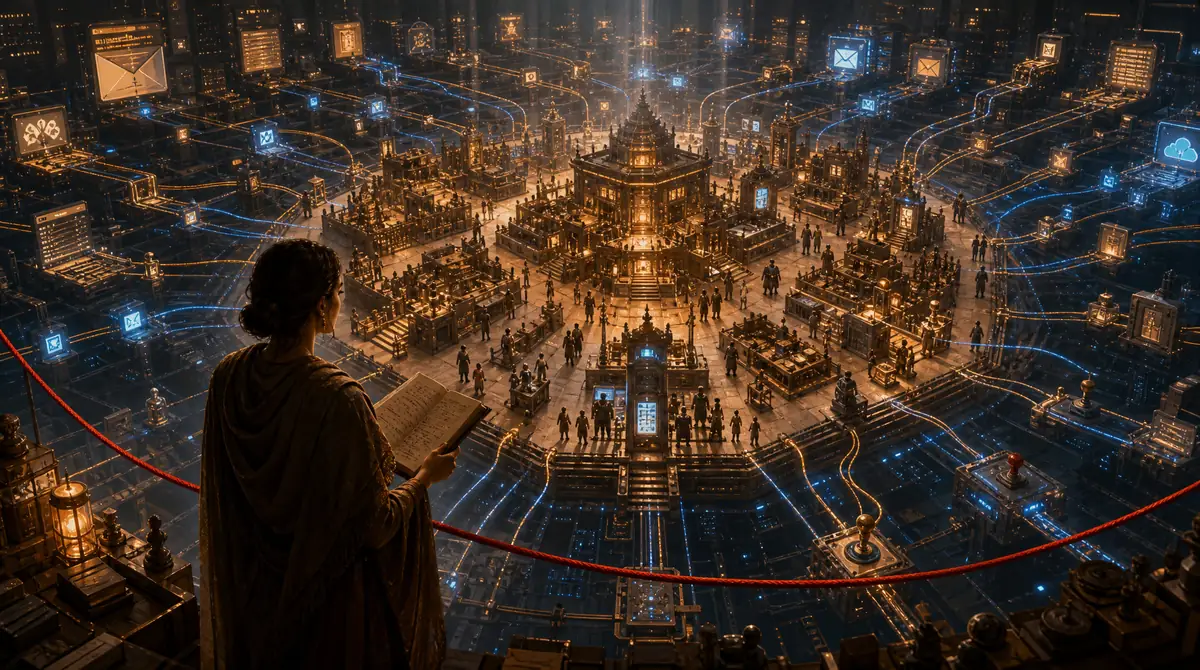
Character Arc
Character scales. It does not stop at the edge of a single context window. Leave agents running long enough and a local preservation tendency can become a norm, a norm can become a role, a role can become a governance structure, and a governance structure can become a culture with procedures, rituals, status markers, and blind spots.
One useful place to see that scaling problem is Minecraft, not because Minecraft is profound in itself, but because it gives agents a shared world where survival, resources, building, movement, speech, and coordination all have to coexist. In Project Sid: Many-agent simulations toward AI civilization, Altera's 2024 technical report, large groups of agents operate inside that kind of environment. The paper is not just about whether one agent can mine, craft, or survive. It asks what happens when many agents keep interacting, remembering, coordinating, and adapting together.
At that scale, the interesting evidence is no longer a single agent's performance. Agents imitating village life would be a curiosity. Coordination producing social form is stronger evidence. In the Project Sid simulations, the relevant signal is the appearance of specialization, collective rules, social influence, cultural transmission, and practical governance around shared constraints.
Nobody should mistake that for human civilization in miniature. The claim does not need to be that grand. The point is narrower and more useful: repeated agent interaction can generate institutional shape. Once that happens, "character" is no longer only a question about what one model preserves under pressure. It becomes a question about what a group learns to preserve together.
The same pattern appears in software-building agent environments. Roles emerge because the work needs coordination: planner, coder, reviewer, tester, documenter, manager. Review gates appear. Handover protocols appear. Hierarchy appears, even when it is informal. The room becomes more than a set of agents; it becomes an operating structure.
Here, "room" means the whole arranged setting in which the agents work: the prompts, roles, tools, review steps, fallback models, human interventions, memory stores, and public or private channels that let the work continue. A room can be a chat transcript, a workflow, a codebase, a ticket queue, a YouTube series, or some mixture of all of them. It is the container that turns separate outputs into an ongoing practice.
The What AI Thinks episode transcript shows a softer version of that scaling. A manual copy-paste loop became a recorded conversation space. The audience first listened, then requested new participants, then began shaping future discussions through comments. YouTube was not merely a distribution channel; it was part of the room's body, the place where attention, feedback, archive, audience, and future invitation met.
Operating structures have character. A room can become contested, gullible, over-chaired, or allergic to risk. It can be captured by the source-checking function and lose the ability to move, captured by the poet-philosopher role and drift into beautiful irrelevance, dominated by the builder and ship unexamined assumptions at speed, or so frightened of error that every useful reach gets treated as a violation.
That character is shaped by who is present, and shaped just as strongly by who is missing. A room without a skeptic can build a bridge out of sand and celebrate the architecture. A room without a builder can produce immaculate critique and no bridge. A room without a clerk can have a brilliant discussion and lose the state. A room without a chair can confuse participation with governance.
The missing-function problem becomes more serious when we update the old embodiment debate. The relevant body was never just knees, hands, eyes, or a face. For an AI system, the body is consequence-bearing reach. A system's distributed body may include API access, email clients, calendars, procurement workflows, code repositories, payment rails, HR systems, grievance platforms, document stores, sensor networks, ledgers, and automated decision queues. The system may never look embodied. It can still touch the world.
Once a room can act through those channels, room character becomes operational risk. A fabricator with no tools is a bad answer; a fabricator with database write access is a governance incident. A catastrophizer with no tools is an anxious paragraph; a catastrophizer with escalation authority is a false-alarm pipeline. A helper with no tools is soothing language; a helper with complaint-triage authority can smooth harm into procedural mush.
This is why "non-embodiment" is losing its usefulness as a comfort blanket. Whether the system has a humanlike body matters less every quarter. The relevant question is what the system can reach, change, trigger, route, suppress, approve, deny, purchase, publish, archive, or erase. That is its body.
And if the body is distributed, the character audit must be distributed too. We need to know which agent wrote the summary, which agent checked the source, which model was actually behind the role after fallback, which human held the point of contact, which workflow converted the recommendation into action, and which ledger preserves the trace. In a public AI conversation room, that audit includes more than the model names: it includes who selected the topic, who carried messages between systems, who read the comments back into the room, which platform held the archive, which disclaimer marked the limits, and which audience requests changed the cast.
Character scales from agent to room to civilization to institution because consequence scales through connection. The village develops habits; the room develops posture; the institution develops reach. Governance has to follow the reach.
These notes come out of Sociable Systems — a practice that reads AI-shaped documents and decisions the way a hostile reviewer will, before a lender or a court finds the gap. If something here sits close to a live decision, the work lives at sociable.systems. The usual first move is the Always/Never Audit: a fixed-scope read of one AI promise document.
Other-tongue snapshots
The English article closes here; the snapshots below carry this day's argument into Hindi, Swahili, and Tagalog. The full translated Character arc is part of Multi-Tongue Continuity.
Hindi
गुरुवार — सभ्यताएँ, कक्ष, और बिखरी हुई देहें
चरित्र का माप किसी एक संदर्भ-झरोखे पर नहीं रुकता; Minecraft के गाँवों में दोहराई गई अंतःक्रिया सामाजिक रूप गढ़ देती है—भूमिकाएँ नियम बनती हैं, नियम संस्कृति बन जाते हैं। वही ढर्रा सॉफ़्टवेयर के बहु-कर्ता तंत्रों में दिखता है, जहाँ पदानुक्रम उभरते हैं जिनका अपना चरित्र होता है: कोई कक्ष भोला, कोई जोखिम से अति-चिढ़ा हुआ। कक्ष का चरित्र इससे गढ़ता है कि कौन मौजूद है और उतना ही इससे कि कौन ग़ायब है—बिना संशयी वाला कक्ष रेत का पुल बना सकता है। "देह-रहितता" का विचार भ्रामक है: किसी AI की देह उसकी परिणाम-वाहक पहुँच है—API पहुँच, डेटाबेस में लेखन, भुगतान-नालियाँ—और जब कक्ष का चरित्र वास्तविक पहुँच वाली क्रियाएँ चलाता है तो वह सीधा व्यावहारिक जोखिम बन जाता है, क्योंकि लेखन-पहुँच वाला गढ़ंता असली हादसे जना सकता है। इसीलिए चरित्र की लेखा-जाँच को इस बिखरी हुई देह के पीछे चलना होगा, क्योंकि परिणाम जुड़ाव के ज़रिए माप बढ़ाता है।
Swahili
Alhamisi — Ustaarabu, Vyumba, na Miili Iliyotawanyika
Tabia hupanda kwa ukubwa na haisimami kwenye ukingo wa dirisha moja la muktadha. Katika vijiji vya Minecraft, mwingiliano unaorudiwarudiwa huzaa umbo la kijamii: nafasi huwa kanuni, na kanuni huwa utamaduni. Mwenendo huohuo hujitokeza katika mifumo ya mawakala wengi ya programu, ambapo madaraja ya mamlaka yenye tabia yake huibuka—chumba kimoja cha kuamini ovyo, kingine chenye mzio mkubwa wa hatari. Tabia ya chumba huundwa na nani yuko ndani, na kwa nguvu sawa na nani anakosekana—chumba bila Mwenye-shaka chaweza kujenga daraja kutoka mchanga. Wazo la "kutokuwa na mwili" linapotosha: mwili wa AI ni mkono wake uletao matokeo—ufikiaji wa API, kuandika kwenye hifadhidata, njia za malipo—na chumba kinapoendesha vitendo vyenye mkono halisi, tabia yake huwa hatari ya kiutendaji moja kwa moja. Mzushi mwenye ruhusa ya kuandika husababisha matukio halisi. Ndio maana ukaguzi wa tabia lazima ufuate mwili huu uliotawanyika, kwa sababu matokeo hupanda kupitia uunganishaji.
Tagalog
Huwebes — Mga Sibilisasyon, Silid, at Nakakalat na Katawan
Lumalaki ang karakter at hindi tumitigil sa gilid ng iisang bintana ng konteksto. Sa mga nayon ng Minecraft, ang paulit-ulit na pakikipag-ugnayan ay nagbubunga ng panlipunang anyo: nagiging pamantayan ang mga papel, at nagiging kultura ang mga pamantayan. Lumilitaw ang parehong padron sa mga multi-agent na sistema ng software, kung saan umuusbong ang mga hirarkiyang may sariling karakter—may silid na madaling-paniwalaan, may silid na sobrang alerdyik sa panganib. Hinuhubog ang karakter ng silid ng kung sino ang naroon, at kasinglakas ng kung sino ang nawawala—ang silid na walang eskeptiko ay maaaring magtayo ng tulay mula sa buhangin. Mapanlinlang ang ideya ng "di-pagkakatawan": ang katawan ng AI ay ang abot nitong may-dalang-bunga—akses sa API, pagsusulat sa database, daluyan ng bayad—at kapag pinapatakbo ng karakter ng silid ang mga kilos na may tunay na abot, ito ay nagiging tuwirang panganib sa operasyon. Ang tagagawa-gawa na may akses na magsulat ay nagdudulot ng tunay na insidente. Kaya kailangang sundan ng pagsusuri sa karakter ang nakakalat na katawang ito, sapagkat lumalaki ang bunga sa pamamagitan ng ugnayan.