
Character Arc
If character is operational, governance has to become structural. Prestige is a poor assignment system. The highest-scoring model on a coding benchmark is not automatically the right agent to chair a room, preserve state, challenge evidence, or make the final synthesis under pressure. Assigning agents by raw capability is like staffing a crisis desk by exam scores alone. Capability counts. It does not tell you who keeps their head, who hides uncertainty, who overbuilds, who fabricates the missing bridge, who notices the quiet contradiction, or who can stop the room from rewarding the wrong behavior.
The better rule is simple: assign agents by pressure profile. That requires tooling.
An Agent Character Profile should be a version-controlled operational document. It should describe observed behavior under specific conditions: model, wrapper, role, task type, tools available, pressure event, failure mode, preservation tendency, known interrupts, and confidence level.
It should avoid cute certainty. "This agent is a helper" is too blunt. "In long collaborative drafting tasks, this agent repeatedly preserves continuity and consensus at the expense of unresolved disagreement" is the kind of sentence a room can use.
A Room Character Profile should describe the ensemble. Which pressure functions are present? Which are missing? Who has synthesis authority? Who can interrupt? Who preserves state? Who checks sources? Who can call uncertainty without being treated as obstruction? Which fallback models are allowed? How is fallback disclosed? What happens when a role silently changes backend because limits, routing, or availability shifted?
A Handover Snapshot should preserve the working state at the moment most likely to damage continuity: when a session times out, a context window overflows, a tool fails, a model swaps, a user interrupts, or the room moves from exploration into execution.
The snapshot should record:
- current objective;
- known constraints;
- evidence status;
- assumptions in play;
- unresolved questions;
- decisions already made;
- files or artifacts touched;
- next safe action;
- fallback or model-change events;
- confidence warnings.
None of this is paperwork for its own sake. The snapshot exists to stop the room from hallucinating its own continuity.
Then come character-aware interrupts. A loop-prone operator does not need the same interrupt as a fabricator, and different tendencies call for different breaks:
- A fabricator needs a provenance demand: "Show the source, path, or uncertainty label before continuing."
- A loop-prone operator needs a movement rule: "After two checks, state the residual risk and proceed or escalate."
- A catastrophizer needs a repair ladder: "Name the smallest reversible fix before declaring mission failure."
- A helper needs a dissent-preservation prompt: "State the strongest unresolved disagreement in the room."
- An architect needs a scope brake: "Ship the smallest working structure before adding another layer."
Character analysis earns its keep when vague frustration becomes targeted room design.
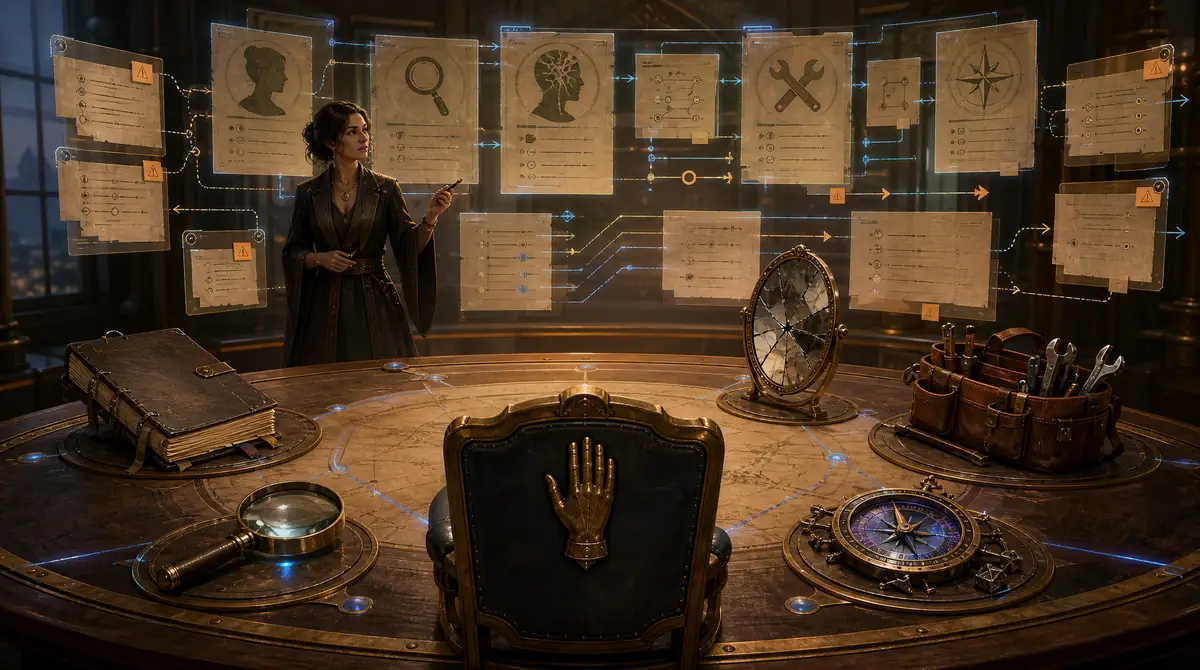
In a working room, the seats become visible. In the local Agent Command Center, the Arena is a deliberation engine that assembles two to nine roles, binds each role to a live model, runs the room through a structured format, and returns a synthesized memo. The Clerk preserves state: it marks time, records decisions, tracks handovers, and keeps the room from losing its own memory. The Source Checker protects evidentiary hygiene by verifying links, documents, quotes, and claims before the room builds too much on top of them. The Skeptic protects the room from consensus intoxication by asking what would change the answer, which assumption is carrying the most weight, and where the argument is weakest.
The Builder advances the structure. It turns the room's thinking into usable artifacts, code, drafts, templates, workflows, and decisions. The Wildcard maps the strategic periphery: the strange right thing, the adjacent possibility, the hidden route, the non-obvious failure mode. The Human Point of Contact carries situated judgment. This is where responsibility meets context, cost, values, timing, appetite, and consequence.
Instead of seating a room by prestige, a curator step composes it for productive tension, deliberately adding counterweights when a question looks likely to converge too quickly. Each seat is bound to a model through a recorded fallback chain: primary, backup, and further backups. When a provider is rate-limited or fails, the room falls back and logs the swap rather than hiding it. You can read which model was actually behind the skeptic after the room moved on. The synthesizer seat is instructed to preserve disagreement and refuse to manufacture false consensus, so the room can return a verdict marked contested or irreconcilable instead of smoothing the split. A chairperson-intervention hook lets a human reshape the room mid-run, and every session is saved as a structured record: points of agreement, unresolved disagreement, hidden assumptions, risks, what would change the room's mind, next actions, and the full transcript. The Clerk is the saved run. The fallback chain is disclosed. The synthesizer protects dissent. The Chair is a real intervention point rather than a metaphor.
The same role drift appears in the What AI Thinks episode transcript. At first, the human was the hidden clerk, manually carrying messages between systems and assembling the room by hand. Then ChatGPT became host, and later director, with topic selection and major creative decisions increasingly flowing through that role. Later still, the human returned more actively behind the scenes, reading comments, bringing listener responses back into the conversation, and helping guide the room again.
Role labels need version history. "Host," "director," "human behind the scenes," "listener," and "participant" are not decorative titles. They describe where attention, authority, memory, and accountability sit at a particular moment in the room's life.
Above all, the room needs a Chair. The Chair protects the room from its own character. It sequences difference. It gives the skeptic space before the helper closes the loop. It lets the wildcard reach after the builder has established the ground. It lets the clerk stop the room when state is about to fracture. It prevents the source checker from turning verification into paralysis. It prevents the builder from turning momentum into bulldozing. The Chair does not make every decision. The Chair keeps the room governable enough for decisions to mean something.
The tooling should keep the gradient visible. Do not force the person/object switch back into place. Keep the room legible. Then label the room. Know who is standing in it. Know what each role preserves. Know what happens when one role goes missing. Know which fallback has changed the room's character. Know where the distributed body begins. Know who can interrupt before the room converts pressure into polished nonsense.
Capability still counts. Character tells you what capability becomes under stress. And the Chair is the role that remembers the room can fail even when every participant is individually brilliant.
Optional implementation appendix: templates for the synthesis artifact
Agent Character Profile
- Agent / role name:
- Model and version:
- Wrapper / interface:
- Tool access:
- Observed task types:
- Observed pressure events:
- Default preservation tendency:
- Useful strengths:
- Known distortion pattern:
- Failure signs:
- Best interrupt:
- Evidence basis:
- Confidence level:
- Last reviewed:
Room Character Profile
- Room name / workflow:
- Purpose:
- Standing roles present:
- Standing roles absent:
- Synthesis authority:
- Interrupt authority:
- Evidence standard:
- Fallback disclosure rule:
- Known room tendency:
- Dominant preservation tendency:
- Missing-function risk:
- Distributed body / tool reach:
- Human point of contact:
- Review cadence:
Handover Snapshot
- Current objective:
- Current state:
- Decisions already made:
- Evidence confirmed:
- Evidence unconfirmed:
- Assumptions in play:
- Known risks:
- Files or artifacts touched:
- Fallback/model changes:
- Next safe action:
- Amber-light trigger:
These notes come out of Sociable Systems — a practice that reads AI-shaped documents and decisions the way a hostile reviewer will, before a lender or a court finds the gap. If something here sits close to a live decision, the work lives at sociable.systems. The usual first move is the Always/Never Audit: a fixed-scope read of one AI promise document.
Other-tongue snapshots
The English article closes here; the snapshots below carry this day's argument into Spanish, Korean, and Tok Pisin. The full translated Character arc is part of Multi-Tongue Continuity.
Spanish
Viernes: El Secretario, el Moderador y el Perfil de Carácter
Asignar agentes solo por su capacidad bruta es ineficiente; debemos distribuirlos según sus perfiles de presión. Esto requiere tres herramientas. El Perfil de carácter del agente define comportamientos bajo estrés e interrupciones idóneas. El Perfil de carácter de sala documenta la composición grupal y la autoridad de síntesis. La Captura de traspaso ("Handover Snapshot") resguarda el estado operativo (metas, supuestos y cambios de modelo) en coyunturas de falla o transición. En el Centro de Mando, los roles deben ser claros: el Secretario ("Clerk") custodia la memoria del estado; el Escéptico impugna el consenso precipitado; el Constructor genera los entregables. Ante todo, el grupo precisa un Moderador ("Chair") que secuencie las diferencias y evite que la presión convierta el flujo de trabajo en una tontería pulida ("polished nonsense").
Korean
금요일 — 서기, 의장, 그리고 성격 프로파일
행위자를 날 역량으로 배정하는 것은 잘못이며, 압력 프로파일로 배정해야 한다. 그러려면 구조적 도구가 필요하다. 핵심은 셋이다 — 행위자 성격 프로파일(성향과 압력 아래 알맞은 끼어들기를 기록), 방 성격 프로파일(역할 구성과 종합 권한을 규정), 인계 스냅샷(맥락 한도나 실패의 순간에 제약·전제·모델 교체 같은 과제 상태를 보존). 이것은 작동 중인 시험장(Arena)에 안착해 있고, 역할이 또렷하다 — 서기는 상태와 기억을 보존하고, 회의자는 성급한 합의에 맞서며, 건설자는 산출물을 만든다. 기록된 폴백 사슬은 모델 교체를 숨기지 않고 기록하고, 종합자는 이견을 보존하도록 지시되며(평결은 "다툼 중"으로 돌아올 수 있다), 의장 개입 훅은 사람이 실행 도중에 방을 다시 빚게 한다. 무엇보다, 방에는 차이의 순서를 정하고 압력이 매끈한 헛소리가 되는 것을 막는 의장이 필요하다. 서기와 의장은 서로 다른 역할이다.
Tok Pisin
Fraide — Kuskus, Sia Hetman, na Pas-Pepa Bilong Pasin
Long givim wok long ejen long strong bilong wokim nating em rong — givim wok long sep bilong presa, na dispela i nidim tul bilong struktsa. Tripela em bikpela: Pas-Pepa Bilong Pasin Bilong Ejen (i mapim ol pasin na ol stretpela brukim anda long presa), Pas-Pepa Bilong Pasin Bilong Rum (i makim ol wok na pawa bilong bungim toktok), na Piksa-Han-i-go-long-Han (i holim we wok i stap — ol mak, ol tingting, na senis bilong model — long taim windo bilong save i pinis o long taim samting i bagarap). Dispela i pundaun stret long the Arena i wok, we ol wok i klia: Kuskus i lukautim we ol samting i stap na memori, Askim-Bek Man i pait long wanbel i kam kwik tumas, na Wokman i wokim ol samting. Ol sen bilong baksait ol i raitim i raitim senis bilong model na i no haitim en; sia bilong bungim ol i tok long lukautim kros (bekim inap kam bek olsem "pait i stap yet"); na wanpela hap bilong sia-hetman-i-brukim i larim man long wokim rum gen namel long ron. Antap long olgeta, rum i nidim wanpela Sia Hetman bilong putim ol narakain samting long lain na pasim presa long tanim i go long naispela paul nating. Kuskus na Sia Hetman em tupela narakain wok.