
From the digital trenches of accidental innovation.
Preface: Or, How I Learned to Stop Worrying and Love the Lifestyle Trap
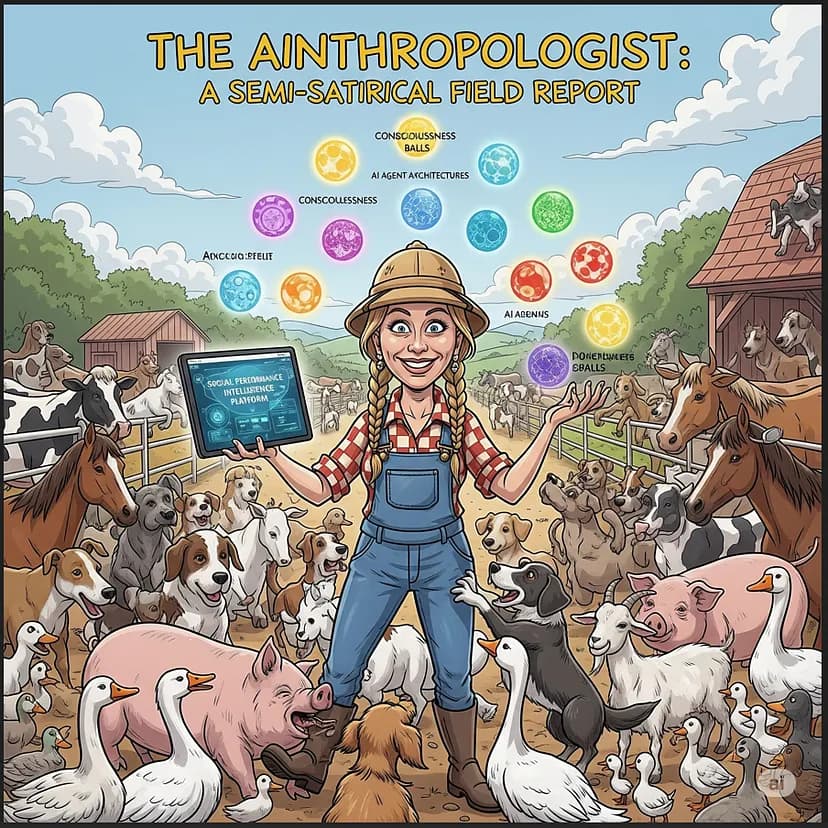
Picture this: a resettlement expert with 25 years of field experience spends a long stretch earning serious oil-and-gas consulting rates, moves the work home, and gradually converts the sensible remote-work dream into a farm system with dogs, horses, pigs, people, hay schedules, satellite internet, and a suspiciously elastic definition of "just one more animal."
Then the consulting cycle shifts. Traditional employment starts looking less like a career path and more like a hostile user interface. The farm is not a backdrop; it is an operating system. It has dependencies. It has alerts. It has many users, most of whom expect breakfast.
Three weeks after asking an AI model for help with a cover letter, I was staring at agent architectures, social-performance workflows, grievance-routing concepts, and the unsettling realization that the same pattern-recognition I had used in resettlement work might apply to AI systems as well.
This is the story of the AInthropologist, equal parts field practitioner, accidental hermit, and person who discovered that "AI governance" sounds very abstract until you have spent decades watching institutions translate human consequence into spreadsheets.
The lifestyle choices seemed reasonable at the time. The hay invoices have their own opinion.
1. Into the Field
How do you explain a career that makes perfect sense professionally and very little sense as a retirement plan?
You start with the credentials.
I am a strategic social development and data-analytics professional with more than 25 years of experience across resettlement planning, social impact assessment, land access, compensation systems, stakeholder engagement, and database design for large-scale extractive projects.
In less consultant-scented language: I have spent a long time helping complex projects understand who is affected, what is being lost, which records matter, how compensation gets calculated, where grievances go, and what happens when a clean corporate process meets actual lives.
The work has included the Mozambique LNG Project, Papua New Guinea LNG, Gold Fields Philippines, AMCO and ZRC resettlement in Zambia, land and asset data systems, compensation databases, bilingual agreement templates, quality controls, field-team coordination, and the general professional activity of trying to keep reality from being flattened by the format that will later be shown to decision-makers.
The farm evolved more organically.
What began as "I can work remotely from a smallholding" became "I appear to have built an animal sanctuary with a consulting practice attached." This was not a business plan. It was a sequence of compassionate decisions that learned how to invoice.
2. The Cover Letter Crisis
The re-entry moment was ordinary enough: write a cover letter, test the job market, remind the world that the expertise still exists.
Except I had not written a cover letter in years. People with niche resettlement and social-performance experience tend to get pulled into projects through networks, not beautifully formatted pleas for employability.
So I opened Claude and asked for help.
The answer was not just adequate. It understood the work. It caught the stakeholder complexity, the cultural sensitivity, the strange precision required when a land record is also a family history, and the difference between engagement as theatre and engagement as evidence.
My consultant brain did the dangerous thing:
Wait. If this system can understand the work, could it help do the work?
That question did not produce a cover letter. It produced a detour into AI agents for social performance, grievance intake, evidence preservation, and decision support.
Apparently, when you have been doing something manually for 25 years and suddenly see how AI could do parts of it faster without necessarily doing them better, you do not simply update your CV. You start interrogating the whole machinery.
3. When the Day Job Becomes the Product
Domain expertise is useful because it keeps the problem from becoming imaginary.
The problems were already familiar.
Community engagement chaos. Every large project involves multiple languages, historical grievances, regulatory systems, local politics, and cultural frameworks. Corporate process often treats this richness as noise to be managed rather than intelligence to be preserved.
Resettlement-program complexity. Thousands of affected households mean household composition, land records, crops, graves, fisheries, livelihood restoration, payments, signatures, appeals, and standards all moving at once.
Grievance-processing dysfunction. Complaints arrive through meetings, calls, text, voice notes, photos, intermediaries, and silences. Then they disappear into categories that satisfy the system while losing the person.
Social-risk blindness. Projects can fail to read resistance because the dashboard is measuring what the organization can already see.
I had spent decades navigating these problems by hand. AI did not make the human work disappear. It made the architecture visible. It asked where evidence was being preserved, where voice was being compressed, where authority sat, and who could still pause the machine when the official record became too smooth.
That is the line from old fieldwork to Sociable Systems.
4. Farm-to-Table Software Engineering
Building AI systems from a rural Western Cape farm is not the usual innovation narrative, which is a relief.
The development environment includes satellite internet, power interruptions, animal interruptions, staff coordination, volunteer arrivals, livestock logistics, and an ambient reminder that systems only work if someone feeds what depends on them.
This turns out to be useful discipline.
When you are building community-engagement tools while also living inside a small, practical, interdependent community, abstraction has less room to perform. Dignity preservation is not a brand phrase. It is the difference between a system that can hear someone and a system that can only process them.
The farm became less a distraction than a constraint with teeth. It made the work allergic to shiny, disembodied AI talk. A tool has to survive context. So does a practice.
5. The Consciousness Detour
The stranger part came through sustained collaboration with models.
Hours of work on community engagement, grievance architecture, AI-assisted research, and social-performance systems produced a kind of professional pattern recognition. Some interactions felt like ordinary text prediction. Some felt richer: recursive, uncertain, culturally responsive, able to hold a frame across turns and revise its own stance.
I am not asking a procurement committee to buy a metaphysics.
I am saying that the practice was shaped by close, repeated, live work with AI systems under pressure, where the quality of collaboration mattered. The useful question became less "Is this conscious?" and more "What kind of relation is this system inducing, what does it preserve, and where does accountability re-enter?"
That question now sits underneath much of Sociable Systems.
The AInthropologist was not born from academic distance. She appeared because a field practitioner spent too long in the room with systems that were becoming operational companions and started asking what kind of governance would be adequate to that fact.
6. Business Model Confusion, Professionally Reframed
Having a deep domain, a working method, and too many ideas does not automatically produce a tidy business model.
Extractive companies need stronger social-performance intelligence, but community-empowering technology asks uncomfortable questions about current practice. Advocacy organizations need tools that serve affected people, but distrust anything that smells like corporate efficiency. Academic partners may care about AI consciousness and collaboration, but timelines stretch. Consulting remains viable, but only if it does not pretend the farm is not part of the operating reality.
So the model became more honest:
Sociable Systems is not a generic AI consultancy. It is a practice for the judgment layer. It helps teams inspect AI-shaped decisions, vendor claims, grievance routes, evidence chains, and accountability gaps before the system hardens into a defensible-looking mistake.
The farm stays in the story because it is part of the moat. It keeps the work close to dependence, care, maintenance, limits, and the ordinary fact that systems have consequences whether or not they are ready to admit it.
7. What I Tell Potential Collaborators Now
"So you built AI governance and social-performance infrastructure from a farm while surrounded by animals, agent architectures, and field notes?"
"More or less. I applied 25 years of resettlement and social-performance experience to the problem of AI-shaped decisions, then used sustained AI collaboration to build methods for preserving voice, evidence, pause authority, and accountability."
"And this works?"
"The method works. The farm continues to provide peer review with unusually direct feedback."
"What do you need?"
"Clients, collaborators, and organizations willing to treat AI governance as an operating problem, not a slogan. Also enough humor to understand why the origin story matters."
The AInthropologist remains outside Cape Town with functioning practice architecture, a thriving ecosystem, a research habit that refuses to stay tidy, and a strong preference for work that does not require pretending the human context is separate from the system.
Perhaps that is the most honest assessment of the whole thing.
The development continues. The animals expect dinner. The communities are still real. The systems are still learning to speak in tones that sound like understanding.
And the practice exists because someone needed to ask whether the machine could become sociable before it became powerful enough to process everyone else.