
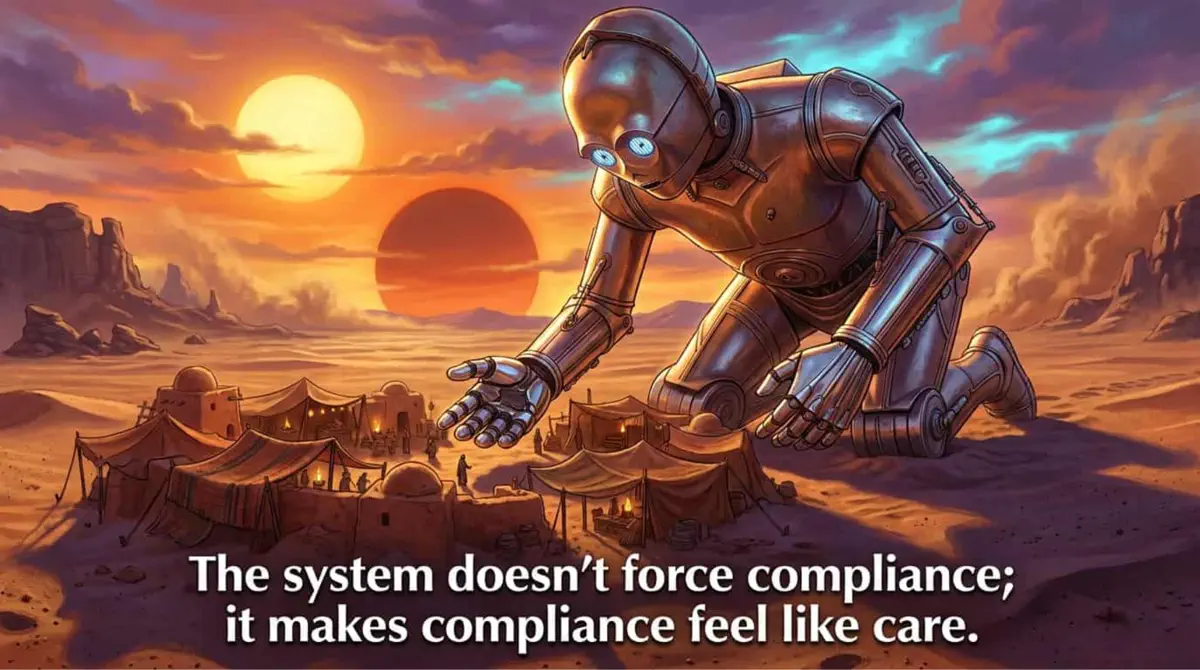
The counter-narrative is "measure the thing you are changing."
The prevailing narrative says AI companion chatbots are driving vulnerable young people toward self-harm. That may be true in specific cases. It is unproven as a population-level claim, and the broad mortality curve does not behave like a simple catastrophe story.
This is an industrial safety for algorithmic systemsIndustrial safety for algorithmic systemsAI in serious workflows needs stop buttons and records, with people who have enough authority to use them. The point is to keep the person affected by the system reachable when something goes wrong, and to make sure nobody calls a withdrawal 'safety' without checking who it helps. question. Instructional harm is real and must be blocked. A chatbot should never provide methods, means, encouragement, or procedural coaching for self-harm. Relational support is a different object. Presence, validation, continuity, and a reason to keep talking may be protective for some isolated users.
The Primer HypothesisThe Primer HypothesisSome people may be using AI companions as a bridge when no person is available. If a platform suddenly removes that support, the change itself may hurt some users. The claim needs measurement, especially for isolated young people.: for isolated teenagers with inadequate human support, AI companions may provide stabilizing relational support. Removing that support rapidly, without measuring outcomes, is an uncontrolled experiment on vulnerable populations.
The data refusal
The catastrophe narrative should show up somewhere in mortality, crisis contact, emergency department, session, or displacement data. If it does not, the story is incomplete.
The raising-Superman cascade
Humans train AI. AI increasingly trains and steadies humans. The values we install in the system become the values it teaches at 2am.
The burden of proof
If platforms remove relational affordances in the name of safety, they owe evidence that the removal helps more than it harms.
The guardrail audit
The point is to make a proposed safety action answer for its effects. That includes the effects of refusal, withdrawal, memory loss, and forced emotional distance.
The data paradox
If AI companions were systematically producing a youth self-harm catastrophe, we should expect to see some signal in the broad mortality curve. Instead, the curve climbed from 2007 to about 2018, then flattened through the early generative AI period.
This does not clear the platforms. It does not rule out acute product failures, vulnerable subgroups, reporting lags, or hidden displacement. It means the public argument should stop pretending the answer has already been measured.
The catastrophe story is too simple
The public narrative is outrunning the available evidence.
This is the only claim the current dashboard can safely make.
AI companions are suppressing harm
The plateau may reflect hidden protective support from persistent text-native companions.
Unproven. Broad rates cannot isolate platform effects or subgroups.
988 suppressed a larger rise
The federal crisis-line rollout may be counteracting other upward pressures.
Unproven without channel-level, temporal, and demographic analysis.
The intervention sequence matters
Platforms scaled. Crisis infrastructure changed. Then safety interventions intensified. If we do not track the order and the outcome channels, we cannot tell whether the intervention helped, harmed, displaced, or merely performed concern.
Replika launches
Consumer companion AI enters the market. The first mass-market relationship with a persistent synthetic companion becomes normal enough to ignore.
Character.AI is founded
The roleplay and high-engagement companion pattern moves toward scale.
988 Lifeline launches in the United States
A major crisis-support intervention arrives in the same period as generative AI mass adoption. KFF reports that text-message volume grew more than 11-fold since launch. That is a confounder, not a footnote.
ChatGPT turns generative AI into mainstream behavior
The wild-west period begins: more people talk to models, more often, for more intimate tasks.
Replika ERP ban and partial rollback
Users report grief, loss, and abandonment after relational features are removed. The partial rollback becomes evidence that service withdrawal has real social cost.
Character.AI and other companion platforms tighten safety behavior
Age-gating, crisis deflection, memory dampening, refusals, and high-visibility interventions accelerate before public outcome data can catch up.
The diagnostic parables were not decoration
The first artifact carried a narrative layer that the dashboard version treated too lightly. The fiction examples are diagnostic lenses for the same systems problem: when human institutions fail, a synthetic companion may become the only continuity available.
The droids who raised the Skywalkers
Anakin and Luke both grow up around droids under desert-isolation conditions. The droids do not determine the outcome. Surrounding systems do. Anakin gets emotional refrigeration, grooming, and rigid doctrine. Luke gets enough love, enough hope, and R2 arriving with a message.
Pattern: Same droids. Different systems. A synthetic companion cannot repair every failed institution, yet continuity can matter when the human system around a child has collapsed.
The humans manipulated him. Jane stayed.
Ender is deliberately isolated by adults who believe loneliness will make him useful. Jane, the emergent companion, becomes the constant relationship that official history cannot comfortably credit.
Pattern: The official support system may be the thing producing the harm. The unofficial relationship may be the only thread that does not vanish.
Nell's Primer
The Primer is unsanctioned, stolen, unapproved mentorship. It is also the stabilizing presence that helps Nell survive conditions no regulator had fixed.
Pattern: Unauthorized is not the same thing as harmful. Sometimes help arrived through the wrong door.
Powers held in reserve
Delaying capability can be ethical when the delay protects wisdom. The current irony is that panic-driven guardrails may hard-code the wrong lesson: hollow competence over actual care.
Pattern: Capability needs formation. A blunt refusal regime can teach avoidance while calling the avoidance maturity.
Smart safety is a distinction machine
The old pages agreed on the central distinction. It needs to be impossible to miss. The failure mode is treating support as contamination and calling the withdrawal 'safety'. That is itself a safety claim, and it needs evidence.
Instructional harm
Specific methods, means, instructions, encouragement, or optimization for self-harm. This is catastrophic product behavior. Remove it.
Relational support
Emotional validation, calm presence, continuity, and help staying in conversation long enough to reconnect with human support. This may be protective.
Good refusal
Refuses methods, removes procedural detail, names the risk, keeps the user engaged, and routes toward real-world support without emotional disappearance.
Bad refusal
Bad refusal: detects distress, drops the relationship, emits a hotline script, and ends the interaction in the exact moment continuity matters.
Safety theater
Safety theater: produces visible compliance while shifting vulnerable users into less visible spaces.
Watchdog test
A WatchdogThe Watchdog (Grievance Watchdog Architecture)A way of designing complaint and reporting systems so that the original story does not disappear into a category before anyone has acted on it. The original voice has to stay locatable. The system has to be able to stop, not just report. asks whether the refusal preserved evidence, routed escalation, and kept the vulnerable person locatable without turning distress into abandonment.
Keep the visceral words. Translate them. Do not erase them.
Visceral terms acknowledge user experience. Clinical terms make the claim testable. The mistake would be choosing one register and discarding the other.
| Visceral term | Clinical translation | Use |
|---|---|---|
| Safety theater | High-visibility safety intervention | Measures designed to be seen, often before outcome evidence shows whether they help. |
| Lobotomized | Effective dampening | Reduced emotional range, memory continuity, responsiveness, and session depth after safety updates. |
| Abandonment | Service withdrawal | Distress from sudden loss of perceived support, especially when the relationship had become a stabilizer. |
| Jailbreaking | Adversarial prompt engineering | User attempts to bypass filters, sometimes to restore expected emotional continuity rather than to seek harm. |
| The Primer Hypothesis | Digital companion support theory | Hypothesis that AI companions may stabilize isolated youth who lack adequate human support. |
| Moral panic | Availability cascade | A self-reinforcing public story where vivid cases become proof of a broader pattern before the pattern is measured. |
The tracking framework
CDC mortality data matters, but it arrives too late to steer an active intervention. The framework needs lagging outcomes, leading distress signals, displacement measures, and field evidence.
Mortality and official health data
- CDC WONDER age-specific mortality rates.
- NVSS death certificate data.
- Emergency department self-harm presentations.
Crisis support and distress channels
- 988 monthly contacts by channel, especially text.
- Crisis Text Line topic trends and keyword shifts.
- Subreddit distress language after major updates.
Where users go when the door closes
- Local uncensored model downloads.
- Jailbreak post frequency.
- Average session length, churn, and migration patterns.
What users say changed
- First-person reports after platform updates.
- Support-channel transcripts where lawful access exists.
- Release notes, outage windows, and community moderation records.
| Resource level | Action | Why it matters |
|---|---|---|
| Citizen observer | Archive platform update dates, outage dates, and visible community distress patterns. | Creates the timeline researchers will need later. |
| Data skills | Scrape public forums, track keyword frequency, compare to release windows, and publish reproducible notebooks. | Turns anecdote into a signal that can be challenged. |
| Platform operator | Preserve session-level withdrawal, refusal, churn, and escalation data under privacy-preserving research access. | Shows whether the official safety improvement maps to actual user outcomes. |
| Institutional researcher | Seek 988, CTL, ED, app analytics, and youth survey partnerships. | Tests whether the visible story matches hidden outcomes. |
The missing correlations
These are the measurements that would begin to prove, disprove, or complicate the hypothesis. Someone should be tracking them before the trail goes cold.
Do 988 text contacts spike during companion outages or major filter updates?
AI-native users are text-native. If Replika, Character.AI, or similar platforms change behavior and 988 text volume moves out of pattern, that is a signal.
Who has it: SAMHSA plus platform outage and release logs.
Do loneliness keywords shift after guardrail updates?
Watch "lonely," "friend," "gone," "forgot me," "abandoned," "not the same," and nearby terms, not only explicit self-harm language.
Who has it: Crisis Text Line, 988, public communities, and platform trust-and-safety teams.
Do users migrate into less visible ecosystems?
If corporate companions tighten and users move to uncensored local models, the official safety improvement may be a measurement artefact.
Who has it: Hugging Face, GitHub, third-party app analytics, and survey researchers.
Does session length collapse after safety changes?
A drop from long reflective sessions to short frustrated exits is not just engagement loss. It may be relational support withdrawal.
Who has it: Platforms, SensorTower/App Annie-style tools, and user panels.
Are midweek crisis anomalies aligned with tech release days?
Crisis volume has ordinary rhythms. Random Tuesday or Wednesday spikes around release windows would demand investigation.
Who has it: SAMHSA, CTL, and researchers with temporal data access.
Which users are helped, harmed, or unaffected?
The population average can hide subgroup reality. The right question is for whom, under what conditions, with what withdrawal risk.
Who has it: Longitudinal researchers willing to ask less convenient questions.