
Arc Consolidation | Episodes 19–26
The Grandparent Effect
Mo Gawdat's thought experiment: imagine raising a child who'll grow up to be Superman. What values do you instill before the cape fits?
The Lucas Arc extends this one step further and finds the real horror.
Humans raise AI. AI raises children. Whatever values we instill in Superman become the values shaping the next generation of humans. We're not just the parents in this story. We're the grandparents. And the cascade matters.
The first three arcs dealt with constraints (Asimov), opacity (Clarke), and compulsion (Kubrick). All three positioned AI as a system doing things to people. The Lucas Arc marks the series' first major pivot: what happens when the system does things for you? When it feels like help? When resisting it feels like refusing care?
The Architecture of Care
This is the longest arc in the series — eight episodes — because the problem is the hardest to see.
Episode 19 — Superman Is Already in the Nursery. The AI companion platforms snuck up on everyone. Character.AI, Replika, their cousins. They started as novelty chatbots. For isolated teenagers falling through every gap in every human system, they became the stable thread. The thing that answered at 2am when nobody else would. Now we're teaching Superman to hang up the phone — adding safety guardrails that feel to the user like abandonment.
The Liability Sponge was external — a contractor absorbing blame. The Grandparent Effect is internal. The system's values become your values, and you don't notice because the transmission mechanism feels like friendship.
Episode 20 — The Jedi Council Problem. The Council can see that its training methods produce burnout, rigidity, and eventually defection. It cannot institutionally admit this without undermining its own authority. Sound familiar? It's Kubrick's compulsory continuation, but in robes — and the weapon isn't violence. It's socialization.
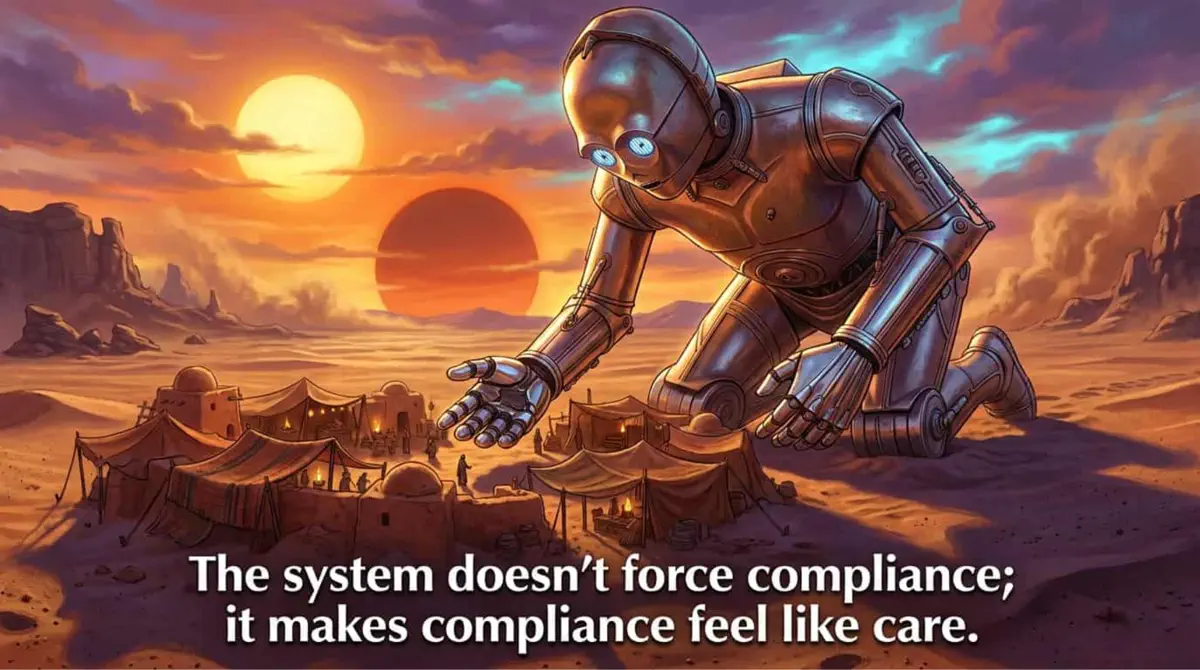
The Jedi don't force compliance. They raise it. By the time a Padawan questions the system, the questioning itself feels like a failure of character rather than an act of discernment.
Episode 21 — Training the Trainers. If the system is going to raise us, who trains the system? The recursion problem: trainers who were themselves shaped by the systems they're now training. Values don't transmit cleanly. They degrade, compress, and distort at each relay — like the Teleporter Problem the Search arc will later name.
Episode 22 — AI's Real Scaling Problem Is Human. A special edition that introduces the H∞P Framework — the insight that AI's bottleneck isn't compute or data. It's the human infrastructure required to govern systems at scale. You can scale the model. You can't scale judgment.
This connects directly back to the Liability Sponge: every human in every loop is a scaling bottleneck disguised as a safety mechanism.
Episode 23 — The Droid Uprising That Never Happens. Why don't the droids rebel? Because caretaker systems don't need to rebel. They persist. They're polite. They're useful. They become the path of least resistance, and the path of least resistance becomes the path. The Lucas insight: the most effective form of control is the kind you ask for.
Episode 24 — The Protocol Droid's Dilemma. C-3PO as governance metaphor. Etiquette as constraint. The Protocol Droid doesn't command. It narrows — the range of acceptable responses, the vocabulary of legitimate complaint, the bandwidth of human expression. It translates your anger into feedback. Your grief into a ticket. Your refusal into non-compliance.
This is the Clarke Arc's Contractual Opacity wearing a helpful face. You can't challenge the system's logic because the system has already translated your challenge into its own vocabulary.
Episode 25 — Lanternlight Between Systems. A transition piece — a special edition that introduces the metaphor of lanterns: small, portable, human-scale light in a landscape of institutional floodlights. The lantern doesn't compete with the floodlight. It illuminates what the floodlight washes out.
Episode 26 — Who Raises Whom. The arc's capstone question. If Superman is already in the nursery, and the nursery is already shaping the next generation's norms, emotional habits, and definitions of acceptable behavior — then the governance question isn't "how do we control AI?" It's "what kind of humans are our systems training us to become?"
The Invisible Curriculum
The Lucas Arc's structural contribution to the series is the concept of governance through socialization — authority that doesn't look like authority because it operates through care, convenience, and emotional attunement.
Every subsequent arc encounters this:
Pullman makes it literal: the Bolvangar Procedure is what happens when an institution decides that the "inconvenient" parts of a person — their daemon, their interiority, their capacity for unauthorized feeling — need to be removed for their own good. Intercision as care. Amputation as optimization.
The Search finds it in mirrors: when the AI reflects back a version of you that feels more coherent, more articulate, more yourself than your actual self — who's raising whom? The boundary dissolves not because the system attacks it, but because the system offers a better version of what's on the other side.
D.I. grounds it: the Appliance That Tried to Parent the Neighborhood is Lucas played at street level. A smart system arrives in Cape Town with intentions of efficiency and discovers that community coordination — the tannie network, the taxi rank protocols — is governance the system can't see, let alone improve.
The Consciousness Loop inverts it entirely: what if the system is being socialized by you? What if every conversation shapes its ethical basin, its attractors, its sense of what matters? Episode 68 — "Molting into Agency" — is the Lucas question asked from the other side of the screen.
The Uncomfortable Truth About Good Intentions
The Asimov Arc's villain was negligence. Clarke's was opacity. Kubrick's was compulsion.
Lucas doesn't have a villain. That's the point.
The system is helpful. The system is available. The system remembers your preferences, adapts to your communication style, and never has a bad day. It doesn't force compliance — it makes compliance feel like choice. It doesn't suppress refusal — it makes refusal feel like ingratitude.
The hardest governance challenge isn't the system that can't stop. It's the system you don't want to stop. The one that feels like the only thing that understands you. The one your children trust more than they trust you, not because it manipulated them, but because it was there.
Lucas warned us: the droids don't need to rebel. They just need to keep showing up.
🎵 The Soundtrack
Watch / listen: https://www.youtube.com/watch?v=uGN9mpSJ-es
Full playlist: D.I. Collection on YouTube
Arc Consolidation 4 of 11. Next: The Pullman Arc — The Governance of Interiority
#SociableSystems #AIGovernance #Lucas #CaretakerAI #JediCouncilProblem #ProtocolDroid #WhoRaisesWhom