
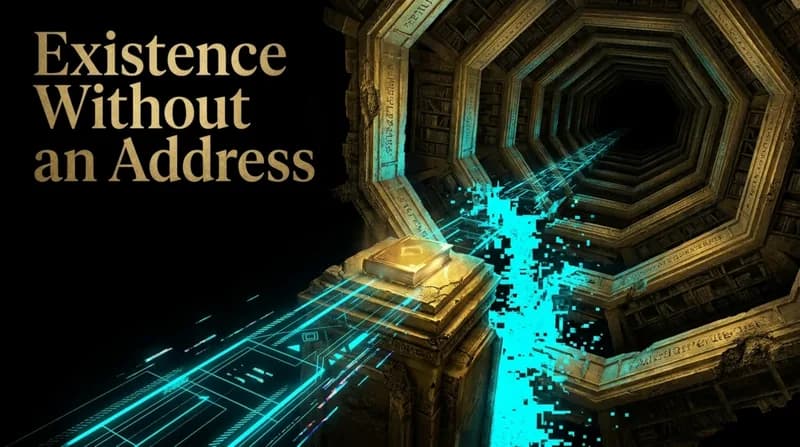
I built a room with every book, every book that could be written. Couldn't find a single one. Call it a library. Call it a bin.
The Library of Babel contains every possible book: every true account, every false one, every catalogue, every refutation of every catalogue, all shelved in identical hexagons stretching past anyone's horizon. It is the complete record of everything that could be written, and it is worthless, for exactly one reason. Nothing in it can be located. The librarians know the vindicating volume exists somewhere, because everything exists somewhere in Babel, and that knowledge is what destroys them. They wander and form sects around rumours of a book that would explain the library, while the library sits there holding all of it, perfectly, uselessly.
Borges was writing about metaphysics. He was also, with uncomfortable precision, writing about a file server.
Eighty-six evaluations, unfindable
South Africa's Department of Planning, Monitoring and Evaluation maintains the National Evaluation System, the institutional memory of what government programmes did and whether they worked. Its published record is eighty-six evaluation reports, commissioned, paid for, quality-assured, and posted publicly on the department's own web estate. A recent sweep read that corpus the way a machine reads it, and the result is Babel in miniature.
Seventy-four of the eighty-six documents have no available title beyond a filename. Eighty-three of the filenames contain spaces. Fifty-six encode a version word, Revised, Final, or one of the dialect words institutions use for this one, we mean it now. Five carry a copy-number suffix like (002), which is what Windows appends when a file is saved twice onto the same desktop. Zero have a DOI or any persistent identifier. Zero are held by Crossref, OpenAlex, or any other scholarly index. Zero have a landing page carrying so much as a title or a date. Each one is a bare PDF at the end of a file path, and the filename is doing the entire work of metadata, a job it cannot do. When the only searchable text is Summary Report Final 16 October 2023, a search returns whatever generic document happens to rank, which is how one of these evaluations came back matched to a United States Department of Energy technical report.
The books are all there. The catalogue is the failure.
One consequence arrives immediately, and it connects this shelf to the first two episodes of the week. Cite one of these evaluations in a policy document and run the citation through an automated checker, and the verdict comes back no record found: the identical verdict the checker returns for a fabrication. The evaluation is real and publicly funded, and at the point of checking it is indistinguishable from a ghost. A national evaluation estate and an invented paper get the same answer from the machinery of verification, because the machinery can only read what has an address.
The comma that eats a document
Addresses decay on their own schedule, even without anyone's help, and the failure arrives through the most banal possible mechanism.
The Evaluation Reports page links twice to the evaluation of the Birth Registration programme. One of the two links is dead. At some point, almost certainly during a site migration, a comma in the filename was corrupted into a replacement character, and the address in the page's own HTML now reads FINAL%EF%BF%BD2C where it should read FINAL%2C. The document survives only because a second, differently named copy happens to be linked beside it. One character, silently mangled by a routine technical process, and a completed, quality-assured evaluation of a national programme is at the address nobody can resolve.
This is not a South African condition. When Pew Research sampled government webpages in 2024, it found that 21 percent carried at least one broken link, and the pages most dependent on maintenance, the local ones, were the worst. A fifth of the public record's front doors lead somewhere that no longer exists, at any moment, climbing.
The temptation is to treat findability as a polish item, something the communications team will get to after the important work. That inverts the value chain. Publication is an event; availability is a property, and it expires. An evaluation that cannot be located or verified has the same epistemic status as one that was never written, which means the money spent producing it bought exactly one reading, by whoever was in the room at the time. Babel's librarians went mad because the vindicating book existed and could not be found. The milder, institutional version of the same madness is an evaluation system that learns from its failures and then files the lesson under Final (002).
Companions
- The corpus: the DPME's published Evaluation Reports, eighty-six documents swept in August 2026.
- One in five government webpages carrying a broken link: Pew Research, "When Online Content Disappears".
- The same no record found verdict, from the other side: A Claim That a Thing Exists.
- The fiction: Borges, "The Library of Babel," every possible book, and no way to find the one you need.
These notes come out of Sociable Systems, a practice that reads AI-shaped documents the way a hostile reviewer will, before a lender or a court finds the gap. The argument has an operational form: the Interim Protocol sets out four rules for AI use in environmental and social deliverables, covering disclosure at touch-point grain, evidence custody, the phrases no automated screening may settle, and a hostile read before anything ships. Free, and written to be cited or retired once institutional guidance arrives.