
The address moved, the paper's fine, the address moved. Fifty-four percent of the shelf points at a room that isn't there.
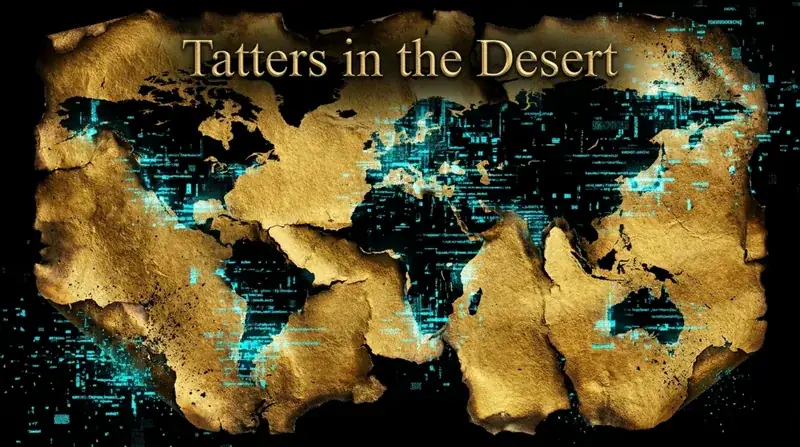
The shortest story Borges ever collected is one paragraph long, and it goes like this. An empire becomes so devoted to cartography that its mapmakers achieve the perfect map: a map of the empire the exact size of the empire, coinciding with it point for point. Later generations, less given to the study, find the giant map useless and abandon it to the weather. In the deserts of the west remain tattered ruins, sheltering animals and beggars.
"On Exactitude in Science" is usually read as a joke about representation, about the absurdity of a copy that adds nothing. Read it as an archivist instead and the paragraph changes temperature. The map did not fail because it was wrong. It failed because it was unmaintained, and what unmaintained precision becomes is tatters, and what tatters become is shelter for whoever is still out there. The record of the empire outlasted the empire's interest in keeping it, and kept decaying anyway.
That is the condition of the web, and it has been measured.
A quarter of a decade, gone
In May 2024, Pew Research drew a random sample of nearly a million webpages from the Common Crawl archive, about ninety thousand pages per year from 2013 through 2023, and checked which of them still opened. A quarter of all pages that existed at any point in that decade were no longer accessible. Decay compounds with age, and it starts immediately: 38 percent of the pages that existed in 2013 were gone by October 2023, while 8 percent of pages from 2023 itself, less than a year old at the time of testing, had already vanished. Most of the loss was individual pages deleted from otherwise living sites, the ordinary unspooling of a record nobody is paid to keep.
Then Pew turned to the pages that act as the record's signposts. A sample of news and government sites found broken links on 23 percent of news pages and 21 percent of government pages. And on Wikipedia, the largest single referencer of sources on the web, 54 percent of pages carried at least one reference link pointing at a page that no longer exists.
The Wikipedia figure carries extra weight because of what Wikipedia now is. It is a primary training source for the systems that will read our record after us, the reference shelf of both the public internet and the machine corpus. More than half of its pages cite something that is gone. The footnotes are in place, formatted, confident. The works they point at have already left the building. We are annotating a record with addresses to a desert.
The footnote chain, unarchived
The scholarly record is supposed to be the hardened case. Journal articles carry DOIs, persistent identifiers whose entire purpose is to survive the failure of any particular address. The identifier is permanent. Martin Paul Eve, working with Crossref's own data, asked the question almost nobody had asked at scale: permanent pointer, yes, but is there anything at the end of it, held safely anywhere?
The answer, published in the Journal of Librarianship and Scholarly Communication in January 2024, came from a random sample of 7,438,037 works carrying DOIs, checked against the holdings of the major digital archives. Of those, 2,056,492 works, 27.64 percent, appeared in no archive at all. Only 58 percent could be confirmed in even one. These are not obscure samizdat. They are the formally published, formally identified scholarly record, the part of civilisation's output that has an entire profession dedicated to keeping it, and more than a quarter of it exists at one remove from disappearance, sustained by the continued solvency and goodwill of whichever publisher currently hosts it.
Eve's summary is the sentence the whole week could carry as an epigraph: "Our entire epistemology of science and research relies on the chain of footnotes." Every claim offers its evidence by pointing. When the pointed-at thing is gone, the claim does not become false; it becomes unverifiable, which for a system built on checking is the same failure wearing a quieter coat. And 27.64 percent is a snapshot of a moving target. Archival funding is patchy and publishers churn, while the identifiers keep minting new pointers into a record whose far end is fraying faster than the near end is preserved.
The mode that is nobody's accident
Everything above is loss by neglect. The map rots because the empire stopped caring, and the strongest thing to say about it is that nobody decided.
The same year supplied the other kind.
In the United States in 2025, more than 8,000 pages were removed from federal websites within days of the January inauguration, and over 3,400 datasets disappeared from data.gov inside a few weeks. The response was archival and improvised: the Data Rescue Project, Harvard Law School Library's capture of more than 300,000 government datasets, the Environmental Data and Governance Initiative documenting climate tools and whole programme sites deleted or renamed into vagueness in a report it called Climate of Suppression. Someone decided each of those, and the deciding is what separates it from the desert.
Running alongside it, the commons has been closing its own doors. MIT's Data Provenance Initiative audited 14,000 web domains and found that inside a single year roughly 5 percent of all tokens in the C4 corpus, and more than 28 percent of its most actively maintained sources, became fully restricted to crawlers, with 45 percent of the corpus now under some contractual restriction. Nothing there was deleted. It was walled, which for anyone standing outside the wall is the same result reached by a more reasonable route.
Decay, deletion and enclosure have nothing in common at the level of motive. A reader arriving later cannot tell them apart, because all three return the same silence, and the silence carries no note explaining which one it was.
The map tatters in Borges's desert sheltered animals and beggars: the users with no other shelter left. Ours shelter a new class of reader. Machines being trained on the documented world are ingesting a record whose citations point, in the majority case on its own flagship reference work, at something that is not there, and no one priced the decay because the decay was always someone else's line item. The tatters turned out to be a measurement taken early.
Companions
- The decay rates: Pew Research, "When Online Content Disappears," 17 May 2024.
- The unarchived quarter of the DOI record: Eve, "Digital Scholarly Journals Are Poorly Preserved," JLSC, January 2024.
- The deliberate mode: EDGI, Climate of Suppression.
- The commons closing: Longpre et al., Consent in Crisis.
- The addresses that fail one comma at a time: Existence Without an Address.
- The fiction: Borges, "On Exactitude in Science," one paragraph, one map, one desert.
These notes come out of Sociable Systems, a practice that reads AI-shaped documents the way a hostile reviewer will, before a lender or a court finds the gap. The argument has an operational form: the Interim Protocol sets out four rules for AI use in environmental and social deliverables, covering disclosure at touch-point grain, evidence custody, the phrases no automated screening may settle, and a hostile read before anything ships. Free, and written to be cited or retired once institutional guidance arrives.