
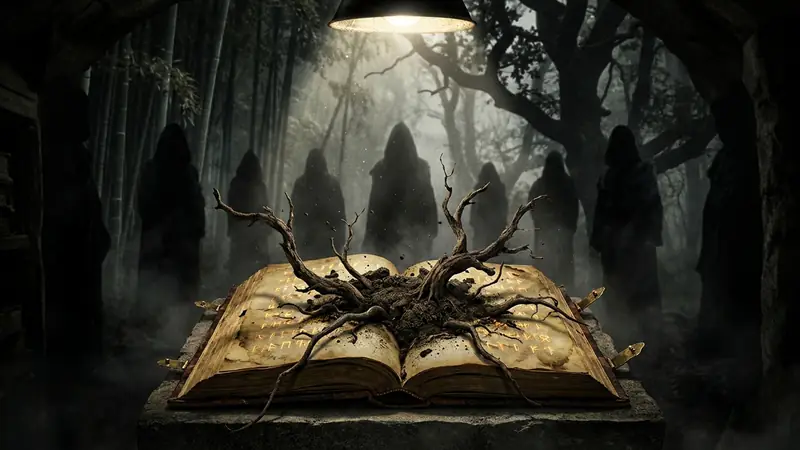
Seven voices in that grove. One name made it to the page. Keep my account. Keep all of it. I will come back for the truth.
The claimant left the address carrying a real account. A named principal gave it, opened the record, said plainly what could no longer be reconstructed, and invited a second question. The claimant asked it. The answer that came back does not match what the claimant lived.
March looks different from inside. The invitation to comment went out on a short fuse. The meeting ran in a language half the room could not follow. The people who spoke were recorded as consulted. None of that appears in the minutes. The claimant could walk a hostile reviewer through every line of the institution's account and find no lie in it. It is simply a different account from theirs, and theirs is built the same way: from things that happened, recorded where they were recorded.
Two truthful accounts of one event now stand at the same door, and they do not reconcile. The cheap reading of this condition is that everyone has their own truth and no procedure may prefer one over another. The accounts here are checked against evidence. They are partial in different directions. The question they raise is procedural: who decides between accounts, by what rule, and what becomes of the account that loses.
Ryūnosuke Akutagawa found the form for this in 1922. "In a Grove" is seven testimonies about one death in a bamboo grove, A woodcutter, a travelling Buddhist priest, a policeman and an old woman answer the police commissioner; the bandit confesses; the wife confesses at Kiyomizu Temple; and the dead samurai himself speaks through a medium. Each account is coherent. Each is sworn. No two agree on what happened in the grove. The story withholds the one thing no pile of testimony can supply: a narrator who could decide between them. The reader holds seven true-looking accounts and no instrument for choosing, which is the position the claimant arrived at on the steps of the address.
The instruments for this exist: the field record, the summarizing pipeline, the adjudicator, the dissent kept on file, the panel built to keep disagreement alive. The pattern they share is already in the grove. No official in the story holds all seven testimonies. Only the story does, in order, each attributed, and nobody inside it is allowed to speak of deciding.
Akutagawa's story gave the Kurosawa film its method, and a companion story gave the film its title. The story is in the public domain; a public-domain English translation is on Wikisource. As with Job in the last arc, the fiction carries the frame and the argument stays procedural.
The track
The arc song, Many Witnesses, is dark techno with one voice: a witness reading testimony into a record over a kick that keeps time like a clerk's stamp. A second pass of the same voice shadows some lines, a few cents off and a few milliseconds late, the way a duplicate record agrees in substance and parts ways in detail. Four statements of "the record stands" cycle against a beat that never settles them, and the track fades without a final hit. The repetition carries the argument.
Witnesses and comforters
The last arc met a different crowd of accounts. Job's comforters arrived with explanations, fluent and well argued, and none of them had been present for anything they explained. Reasons Written After the Fact called that the counterfeit plurality: several accounts, and no witness among them. The grove is the real kind. Each speaker in Akutagawa's story was there, or found the body, or caught the bandit with the dead man's horse, or loved one of the people involved, and each speaks from that position. Their accounts conflict because they saw from different places and had different things to lose. A reader who treats the conflict as proof that nobody can be believed has learned the wrong lesson from the story.
The distinction matters for institutions because the two failures look alike from a distance. A file stuffed with post hoc rationales and a file holding two honest, incompatible records both present as "conflicting accounts" on an intake form. The first calls for refusal, since reasons invented after the fact are no evidence of what happened. The second calls for procedure. Treat the second like the first, and a community's account of a meeting gets dismissed as noise. Treat the first like the second, and a successor model's confident reconstruction gets weighed as if it had been in the room.
The popular shorthand for all this, the "Rashomon effect", tends to land on the soft conclusion that truth is unknowable. (Film criticism has been generous to that reading; grievance officers can't afford it.) The harder reading sits closer to the story's own structure. Each testimony is specific. Each could, in principle, be checked against the rope, the sword, the horse and the wound. Akutagawa withholds the checking and leaves the reader holding the materials. An institution doesn't get to withhold it. It has to decide what checking is owed, who does it, and what is kept when the checking runs out.
Companions
- The address the second account arrived at: The Account Must Have an Address.
- The fiction: Ryūnosuke Akutagawa, "In a Grove", from Rashomon and Other Stories, on Wikisource.
- The track: Many Witnesses.
These notes come out of Sociable Systems, a practice that reads AI-shaped documents the way a hostile reviewer will, before a lender or a court finds the gap. The argument has an operational form: the Interim Protocol sets out four rules for AI use in environmental and social deliverables, covering disclosure at touch-point grain, evidence custody, the phrases no automated screening may settle, and a hostile read before anything ships. Free, and written to be cited or retired once institutional guidance arrives.