
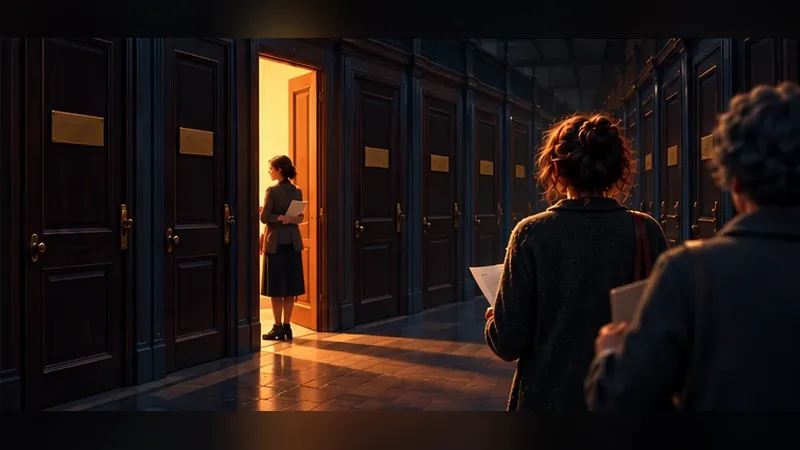
A door, a name, a desk, a key, a file kept whole, a way to say "that isn't it" and still be heard. Then a second witness finds the way.
The October claimant has now met every easy answer. The Right Question to the Wrong Defendant produced four true denials. A Reason Is Not a Reconstruction found that a perfect log records sequence and leaves out grounds. Who Is the Explanation For? showed that accounts fail when they are written for the wrong forum, and that excuses cannot stand in for justification. The Right to Be Answered Back separated being addressed from being answered. Reasons Written After the Fact refused the rationale invented at the hearing. The Duty Survives the Tool placed the obligation with whoever held the authority, and found it outlasts both the model and the settlement.
What remains is a design rule, and it can be stated in one line. Every consequential automated determination needs an answerability address, established before deployment.
Four things at the address
An address, here, means rather more than an inbox. A mailbox that receives letters and forwards them to a queue is an address in the postal sense only. The answerability address has four parts, and a claimant arriving at it should find all of them.
A named principal. A person or office that can say "this institution decided, and I answer for it," identified before the system goes live and updated whenever that role changes hands. The name survives model retirements and staff rotation, because it belongs to the authority rather than the tool.
A preserved basis. The record of what was decided and on what grounds, held outside the model. Succession's handover file supplies most of it: configuration, evaluation sets, evidence, routing logic, the human acceptance. The account adds the part the log could not carry, which is the reason for the threshold and the policy behind it, written down at the time.
Authority to reconsider. The person at the address must be able to reach a different answer. An office that can only explain and apologise is a reception desk. Reconsideration also needs the reversibility classes from Remedy, so that the principal knows in advance what can still be reopened and what can only be acknowledged and compensated.
A route to contest the account itself. The claimant must be able to say "that does not answer what I asked," and have that reply reach someone obliged to respond. This is the second turn of the conversation, the one most systems omit, and the one that makes a system sociable in any sense worth the name.
Remove any one of these and the address fails in a recognisable way. Without a principal, the four true denials return. Without a basis, the rationale gets written afterwards. Without authority, the account becomes a lecture. Without a route to contest, the whirlwind speaks and leaves.
The address line
This is the third time the archive has arrived at an address. Existence Without an Address found that a published document nobody can locate has, for practical purposes, not been published. Where the Load Sits gave compute a ground address, the point at which a computational claim becomes a physical draw on a shared system with a party who has a name.
The account completes the set. Documents need an address to be found, computation needs one to be governed, and authority needs one to be answerable. In each case the missing address suited everyone concerned, since it let them all be somewhere else when the question arrived.
What happens at the door
Picture the October claimant, finally, at an institution that did the work. They arrive at the address. Someone is there, and says: I answer for this decision. Here is what the record shows. Here is the reason for the threshold, written when it was set. Here is what we can no longer reconstruct, and here is what we are doing about that. And if this does not answer your question, tell me, and I will try again.
That is an account, given by someone, to someone, at a place where it can be received and disputed. It will not always satisfy, and its design goal is humbler: it can be argued with.
The claimant listens, and considers, and then says something the institution did not expect. The record is accurate, they agree. The reasons are real. But that is not what happened, not as they lived it, and they have their own account of March, with its own evidence, given just as honestly.
The institution's account has an address now. So does theirs. Two truthful accounts of the same event have arrived at the same door, and they do not match.
That is where Many Witnesses begins.
Companions
- The whole arc, in order: The Right Question to the Wrong Defendant, A Reason Is Not a Reconstruction, Who Is the Explanation For?, The Right to Be Answered Back, Reasons Written After the Fact, The Duty Survives the Tool.
- The earlier addresses: Existence Without an Address, Where the Load Sits.
- Where the gap was first named: The Accountability Gap.
- The operating standard: Interim Protocol.
- The track: Knock on the Door.
These notes come out of Sociable Systems, a practice that reads AI-shaped documents the way a hostile reviewer will, before a lender or a court finds the gap. The argument has an operational form: the Interim Protocol sets out four rules for AI use in environmental and social deliverables, covering disclosure at touch-point grain, evidence custody, the phrases no automated screening may settle, and a hostile read before anything ships. Free, and written to be cited or retired once institutional guidance arrives.