
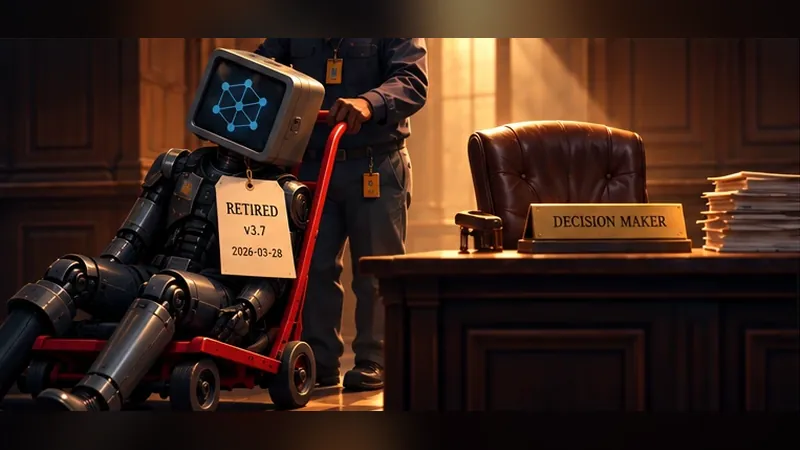
They gave him twice the flocks he'd lost, the sons, the daughters, and the land. The ledger balanced to the cost. The question stayed in Job's own hand.
The Book of Job ends with a settlement. "The LORD gave Job twice as much as he had before" (42:10), and the closing verses count it out: fourteen thousand sheep, six thousand camels, a thousand yoke of oxen, new children, a long life. By any ledger the account is paid in full.
The question Job spent the book asking is never answered. He is compensated handsomely and told nothing, which is a remedy without an account, and readers have been unsettled by the ending for roughly two and a half thousand years.
Where the duty attaches
The same finding has come round several times now, from a different side each time. The claimant's question outlives the tool that made the decision. The log records sequence and omits grounds. Explanations routed to the wrong forum fail as accounts. Addressing someone is not answering them. Reasons written later describe decisions nobody made.
The constructive conclusion follows directly. The obligation to give an account never attached to the model. It attaches to whoever exercised institutional authority over the person, which in the October hearing is the institution whose name is on the letter. The model instantiated part of that authority for a while. The vendor supplied part of the machinery. The reviewer carried part of the judgement. None of them held the authority, and so none of them can carry the duty away when they leave.
Retiring a model cannot retire the duty to explain, any more than a company retires its obligations by replacing its photocopier.
What the duty contains
It helps to be concrete about what survives, because "the duty to explain" can sound like a duty to send a letter. In the October hearing, after the tool is gone, the institution still owes the claimant several things.
It owes an explanation of whatever can still be recovered: the record, the configuration, the threshold, and the history of how it was set, stated in terms the claimant can use. Where the reasoning cannot be recovered, it owes a plain statement to that effect, with the gap described rather than papered over (Reasons Written After the Fact made the case against the alternative). It owes a reconsideration on the merits, by someone with authority to reach a different answer, if the original grounds cannot be shown. And where the determination turns out to have been wrong, or cannot be shown to have been right, it owes correction and whatever compensation the harm warrants.
Those obligations stack. Compensation without explanation is Job's epilogue. Explanation without the possibility of reconsideration is a lecture. The duty only works when the whole sequence is available.
Reconsider what, exactly
Here Remedy's findings return. Before the Commit argued that every consequential action needs a reversibility class assigned before it executes. The duty to reconsider is only real to the extent something can still be reconsidered. A declined application can be reopened. A contract awarded to someone else, a resettlement completed, a site cleared, a benefit stopped for eight months: these can be compensated and acknowledged, and they cannot be undone.
An institution that assigned reversibility classes in advance knows, at the October hearing, which of these it is facing. One that did not discovers it in front of the claimant.
The judgements that cannot be delegated
The Interim Protocol already lists the judgements in environmental and social work that no automated screening may settle: eligibility, impact significance, mitigation adequacy, compensation, consent and consultation scope. The list was drawn up to keep those calls in human hands at the moment of decision.
Read along the axis of the account, it doubles as a list of where the duty to account is non-delegable in the strongest sense. For each of those judgements, somebody with authority must be able to say "I decided this, and here is why," long after the tools used to inform the decision have been replaced. If nobody can say that, the judgement was delegated whatever the process document claimed.
Honesty as part of the account
There is one more element, easy to overlook because it sounds like an admission of failure. Sometimes a faithful account is simply no longer available. The model is gone and the configuration was never archived. In that case the duty does not vanish. It changes form. The institution owes the claimant the truth about what has been lost, and that statement itself should open remedy, since an institution unable to show why it decided cannot fairly insist that the decision stand.
Job's restoration was generous, and it left him holding a question nobody would answer. An institution that pays and says nothing has done the same. The duty to account survives the tool, and it also survives the settlement.
Companions
- The case against invented reasons: Reasons Written After the Fact.
- Reversibility classes: Before the Commit.
- The succession clause: End of Support.
- The list of non-delegable judgements: Interim Protocol, Rule 3.
- The fiction: the Book of Job, chapter 42, King James Version, Project Gutenberg ebook 10.
These notes come out of Sociable Systems, a practice that reads AI-shaped documents the way a hostile reviewer will, before a lender or a court finds the gap. The argument has an operational form: the Interim Protocol sets out four rules for AI use in environmental and social deliverables, covering disclosure at touch-point grain, evidence custody, the phrases no automated screening may settle, and a hostile read before anything ships. Free, and written to be cited or retired once institutional guidance arrives.