

A president can receive a warning about a guest and invite him onto the plane anyway. If the warning becomes public months later, the guest may lose his job while the invitation gets remembered as a scheduling detail. The person becomes the scandal. The decision that admitted him still needs an explanation.
Jensen Huang, then chief executive of the AI-chip supplier Nvidia, joined President Donald Trump’s May 2026 delegation to China en route. He boarded Air Force One in Anchorage, Alaska, during a refueling stop on May 12. According to the New York Times, Huang was initially left off the invitation list, then Trump invited him to meet the aircraft during the stop.
The same account reports that Secretary of State Marco Rubio reminded Trump of intelligence concerning Huang’s relationship with a businesswoman suspected of links to Chinese intelligence before Huang joined the flight. Trump disputed knowing about the relationship at the time. The confidential intelligence remains outside public view. The invitation and Huang’s arrival aboard the aircraft can be examined separately from it.
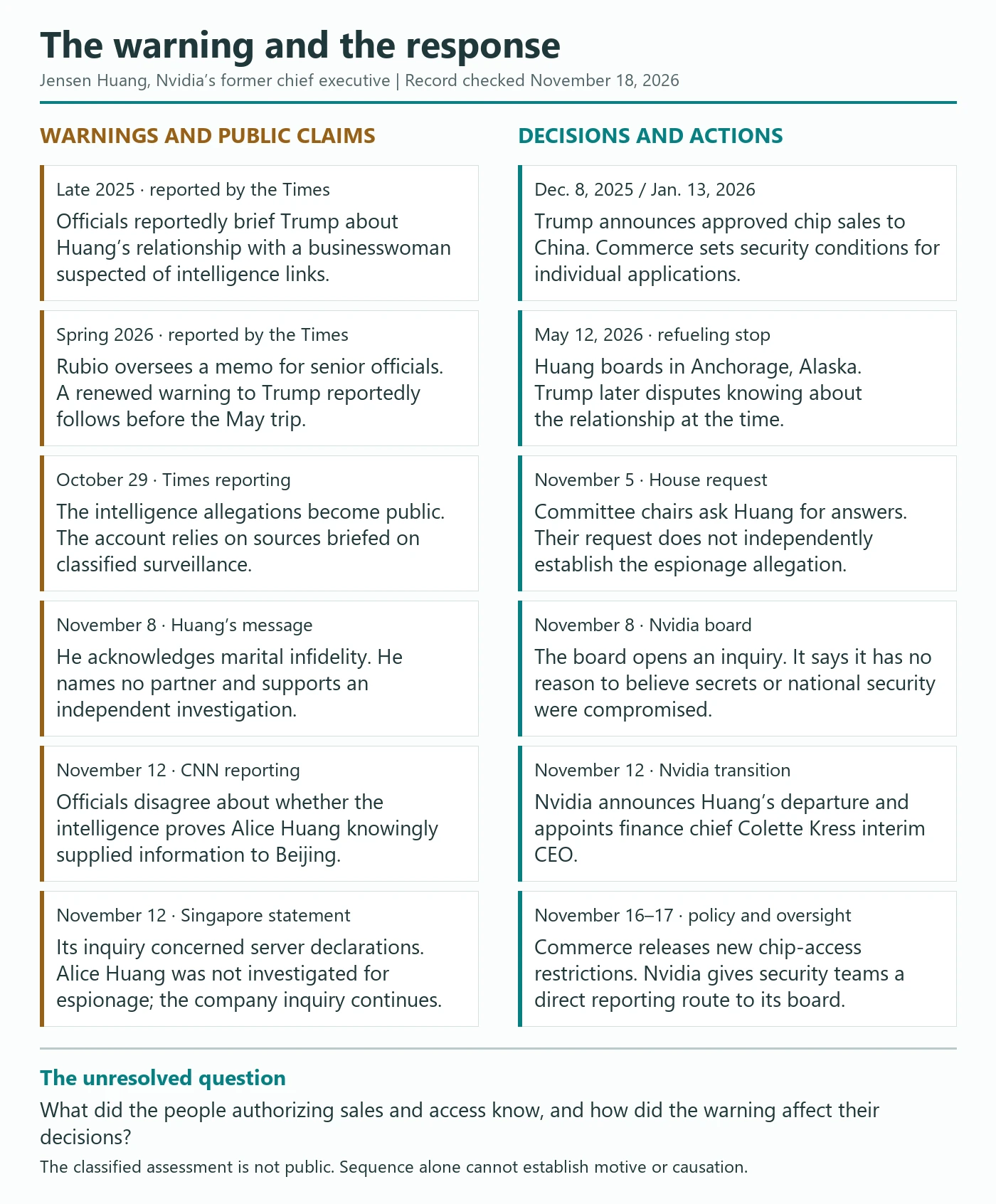
The dates place the reported warnings beside the decisions that followed. They leave open how officials weighed the intelligence. The full chronology and sources, in a timeline with filters, retain the conflicting accounts and identify future interviews as scheduled. The question is what a warning needs to accomplish before an institution counts it as dealt with.
The concern was received
Organizations are good at producing evidence that a concern entered the building. A committee can discuss it and leave a careful record of the meeting. The minutes can be immaculate while the person who raised it lives with the problem.
In the account of Huang’s relationship, the information reportedly reached the president in late 2025. Secretary of State Marco Rubio later oversaw a memo for senior officials and reportedly renewed the warning before the May trip. That is a substantial amount of official attention. How that attention affected subsequent decisions remains unclear.
During the interval, the administration opened a route for approved Chinese customers to buy Nvidia’s H200 chips, powerful processors used for AI computing. Trump announced the policy in December 2025, and the Commerce Department explained the conditions in January 2026. The policy calls for officials to review each application and buyers to meet security requirements.
One possible explanation is that officials judged particular sales acceptable despite the concern. That judgment should leave something a reviewer can inspect: what the officials deciding on the sales knew, and why they thought the conditions sufficient. The calendar cannot supply those reasons. It can show where to ask for them.
Another possibility is that the concern circulated without reaching the right decision-maker in a useful form. An intelligence office can send a warning while another office continues to approve customers. If the officials approving the sales received only a softened summary, the briefing may look more effective in the institutional history than it was in the decision itself.
A warning should arrive with someone’s name beside the next step. Otherwise each office can point to the competent work it completed before passing the problem along. The paperwork reaches its destination. Responsibility keeps traveling.
A familiar man is a persuasive safeguard
Huang’s standing gives these decisions their weight. He helped build the computing technology on which the AI industry depends and argued for American companies to sell it abroad. He also represented a supplier asking government to permit sales. Assessing his case requires enough independence to question the assumptions that favor his business.
That is difficult when a valued person appears in several roles. The executive who can explain how a technology works can also be a useful adviser to a president. A good relationship with him may help officials negotiate with industry. The same relationship can make a concern about his access awkward to raise. An institution needs a way to examine that concern even when the person who must hear it likes the person it concerns.
The protection comes from making an exception explainable. If an official permits access after receiving a warning, the record should identify the reason and any conditions. A later reviewer can then ask whether those conditions held. Personal confidence may form part of the judgment. It cannot do the job of checking what happened.
For a community facing an industrial project, the corresponding problem is familiar. A manager trusts a contractor’s assurances after years of work together. Residents report harm. Their complaint deserves examination on its evidence even if accepting it would upset a relationship the company values. A well-attended meeting offers little comfort if everyone leaves with the same problem and a better attendance record.
The scandal creates a new queue
When the allegations became public, several institutions acquired reasons to demand answers. Nvidia’s board opened an inquiry. Legislators used the story to press for restrictions they already favored. The inquiries concerned different decisions, even when the headlines used the same names.
Huang’s message to employees acknowledges that he was unfaithful to his wife. It names no partner. The intelligence allegations come from separate reporting. Reports of relationships involving Nvidia employees raise another question: whether people whose careers depend on the chief executive can refuse him or raise a concern safely. A board’s obligation to examine those conditions can remain urgent while an intelligence allegation is disputed.
Nvidia subsequently announced Huang’s departure and appointed finance chief Colette Kress interim CEO. That resolves who can run the company while a permanent successor is sought. It leaves the government responsible for its own decisions about sales and access.
Senators Jim Banks and Elizabeth Warren invoked the allegations while pressing for the AI OVERWATCH Act, legislation restricting China’s access to advanced AI chips. The scandal strengthened a public argument for action. The resulting policy still needs to be judged by what it prevents and what it asks of people outside the scandal. An urgent headline can fill a hearing room faster than it can answer that question.
Keep the version written before everyone knew
A particularly useful demand came from Senators Warren and Chris Coons. They asked the White House and the Commerce and State departments to retain the original records concerning chip-export decisions and the reported warnings. Retaining those records lets investigators compare later explanations with the information officials had at the time.
Retrospective accounts are wonderfully well informed about how the story ends. A dated assessment may show a more uncertain discussion, including objections that the final account leaves out. Keeping that version gives reviewers a way to test whether officials accepted a risk deliberately or failed to put it before the person who could act.
The request establishes what the senators want preserved. Compliance and access to the documents need to be checked separately. Huang and Nvidia’s chief legal officer, Tim Teter, also agreed to interviews with House committees in December. Their answers can be tested against those records. An invitation to explain is the beginning of that work.
Some evidence may need to remain confidential. An authorized reviewer can examine it without publishing every intercepted communication. The public can still be told who owned the decision and whether the recommended safeguards were followed. Secrecy about evidence need not leave responsibility equally obscure.
Huang’s departure gives the story a visible consequence. The less visible decisions continue to govern who can buy the machines and who can influence the rules around them. An inquiry earns its value when it makes those decisions easier to question before the next scandal supplies the audience.
A warning has a recipient. A decision needs an owner.