
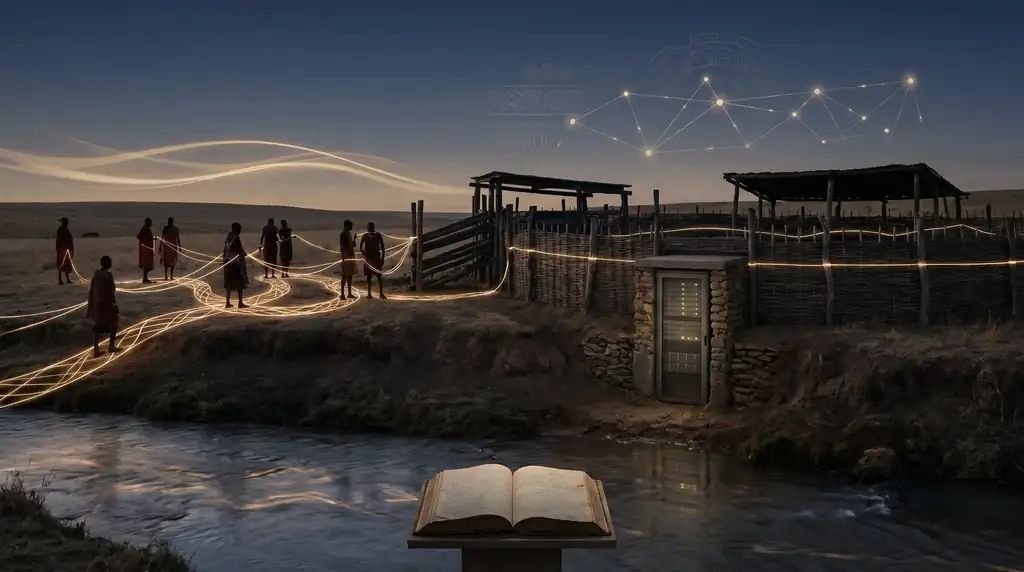
Ubuntu, Indigenous data sovereignty, and the person who was never alone
The week ends away from the marble room, the archive, the lab, the war room, and the borrowed thunder.
It ends where the Western question finally starts to look too small.
What is a person?
Western AI governance often asks this as if the answer lives inside the individual. A body. A mind. A rights-bearing unit. A user. A consumer. A data subject. A voter. A worker. A plaintiff. A patient. The list is long, and every entry shares the same hidden assumption: that personhood arrives sealed.
Ubuntu changes the frame.
A person is made and sustained through relation, beyond the skin's imagined seal. I am because we are gets repeated often enough to risk turning into décor. Here it needs to be restored to force.
If personhood is relational, then AI governance must ask more than individual consent, individual explainability, individual redress, or individual user control can carry on their own.
The system enters a web.
It changes the web.
The harm may appear first at the level of relation, before anything that looks like isolated individual injury shows up on a dashboard.
Mhlambi, and the unit of analysis
This is why Sabelo Mhlambi's Ubuntu work is such a strong close for the arc. It changes the unit of analysis. AI harm becomes a violation of relational personhood and communal world-making, with rational autonomy and individual rights held inside a larger field.
The point of contact is where a system meets a human world dense with dependencies, histories, languages, permissions, injuries, and obligations.
Te Mana Raraunga, and jurisdiction
Te Mana Raraunga and Māori data sovereignty supply an operational architecture. The claim is jurisdictional. Māori data should be subject to Māori governance. Data about a people carries authority, obligation, and provenance before any institution arrives with compute and lawyers.
The river has standing in the ledger, the community has jurisdiction over its record, and machine-readable data still belongs inside a web of authority.
Abundant Intelligences extends the same argument into AI design. Intelligence exceeds the narrow band Western AI has decided to measure, simulate, optimize, and sell. Indigenous knowledge systems may conceptualize intelligent action differently, especially when intelligence is bound to land, relation, responsibility, non-human life, and continuity across generations.
Where the ledger earns its frame
Here the Sisterhood frame changes shape.
The sister has been moving through the Houses asking what each can see that the others miss. By now, the ledger itself has changed. The audit has become a test of the Western question itself.
The question has been provincial all along.
The Vatican asks what dignity protects the individual human person from the machine.
Ubuntu asks what happens to personhood when the machine enters the relations that make persons possible.
Māori data sovereignty asks who governs the record of the people.
Indigenous AI asks whether intelligence can be designed from continuity, with extraction refused at the root.
That is the close.
Ubuntu and Indigenous frameworks reveal the hidden assumption beneath much of Western AI governance: that the individual is the natural unit, the community is context, and relation is secondary.
The ledger reverses that.
Relation is infrastructure.
The sister closes the ledger and notices the book has become heavier.
One tradition has changed what the ledger is for.
Governance hook
If AI enters relations, then individual consent carries too little of the moral load. Community jurisdiction, data sovereignty, and relational personhood belong in the architecture from the start.
The machine arrived among people already made by one another.
That is where governance begins.
Stay leaky.
Below are today's companion snapshots in Swahili, Tok Pisin, and isiXhosa: three relational closes from the same ledger, carrying Ubuntu, data sovereignty, and the insistence that relation is infrastructure into the wider multilingual arc. The full 15-language snapshot suite and the complete Bene Gesserit arc across other tongues are linked below for readers who want the whole map.
Swahili sw
Snapshot summary: Utawala wa AI wa Magharibi unashindwa kwa kumchukulia mtu binafsi aliyejitenga kama kitengo huru cha uchambuzi. Ubuntu hugeuza mantiki hii: mtu anaundwa kutokana na uhusiano ("mimi nilivyo kwa sababu sisi tuko"). Kwa hivyo, idhini ya mtu binafsi haitoshi ikiwa AI inaharibu muundo wa jamii. Kwa kuongezea, uhuru wa data wa Māori (Te Mana Raraunga) na mradi wa Abundant Intelligences unasisitiza kuwa data ya jamii ni mali ya mamlaka yao ya pamoja, na si ya uchimbaji wa bure na mashirika makubwa. Utawala wa AI lazima uhame kutoka kwenye mantiki ya unyonyaji hadi kwenye mantiki ya uhusiano. Uhusiano si muktadha tu wa sekondari; ni miundombinu yenyewe. Daftari linafungwa kwa kuonyesha kwamba maswali ya Magharibi yalikuwa ya kikanda tu: mwanadamu hakuwahi kuwa peke yake.
Tok Pisin tpi
Snapshot summary: Bosim AI bilong ol Westen i save pundaun long wanpela bikpela as tingting: ol i lukim wanwan man tasol olsem as bilong olgeta wok. Tasol Ubuntu i tanim dispela tingting: man em i man long narapela man ("mi stap long wanem yumi stap"). So, wanwan man i tok "yes" long masin em i no inap sapos masin i wok long bagarapim komunitis. Wankain olsem Māori data soverenti (Te Mana Raraunga) na Abundant Intelligences project, ol i tok data bilong komunitis em i bilong komunitis yet, na ol bikpela kampani i no ken kam na stilim nating. Bosim AI i no ken kisim ol samting nating tasol (extractive); em i mas lukluk long pasin bilong stap wantaim. Pasin bilong stap wantaim em i no samting nating; em i as bilong olgeta wok. Buk i pas long soim olsem ol askim bilong Westen i bin makim hap sait tasol: man i no bin stap wanpis bipotaim.
isiXhosa xh
Snapshot summary: Ulawulo lwe-AI lwaseNtshona luyasilela ngokuthatha umntu ozimeleyo njengeyunithi eziphetheyo yohlalutyo. U-Ubuntu uyiguqula le ngqiqo: umntu ubanjwe ngobudlelwane ("Ndinguye ngenxa yokuba singabo"). Ngoko ke, imvume yomntu ngamnye ayikwanelanga ukuba i-AI yonakalisa ubudlelwane boluntu. Ukongezelela, ulongamo lweenkcukacha zamaMāori (Te Mana Raraunga) kunye noyilo lwe-AI lwemveli (Abundant Intelligences) zithi iinkcukacha zoluntu zezoluntu ngokwalo, hayi ukutsalwa simahla ngamaqonga amakhulu. Ulawulo lwe-AI kufuneka lusuke kulwazi lokutsalwa luye kubudlelwane. Ubudlelwane ayisiyompembelelo yesibini; bubume besiseko sokusebenza. Incwadi iyavala ibonisa ukuba imibuzo yasentshona yayiyeyengingqi encinci: umntu zange abe yedwa.