
Short Glossary for Dune Terms
These are fictional terms from Frank Herbert's Dune books:
- Bene Gesserit: a strategic sisterhood used here as an image for institutions that organize power, knowledge, ritual, and control over long periods.
- Missionaria Protectiva: a Bene Gesserit program that plants religious stories and expectations so power can later move through them.
- gom jabbar: a test of whether someone can keep self-control under pain and pressure.
The week before this one ended at the threshold.
The Vatican had spoken in the old register: doctrine, warning, personhood, dignity, a line drawn around the human creature before the optimization machine could redraw it in its own image. The encyclical gave the week its thunder. The Amish workshop gave it a threshold. Anthropic gave it a refusal clause. The arena gave it the uncomfortable little fact that the room is part of the machine.
That was one House.
This week, we leave Rome.
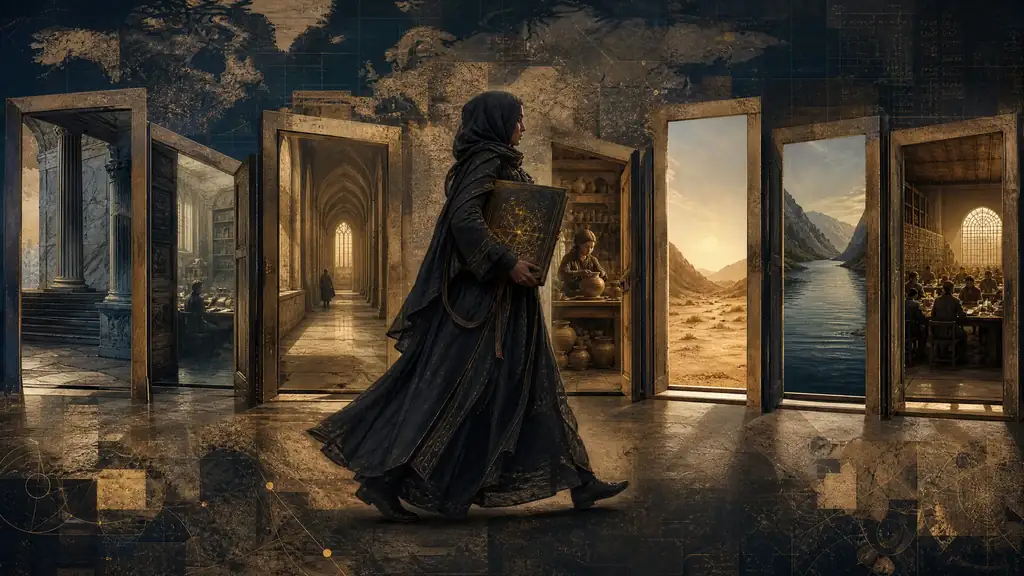
The sister closes the book she was given in the marble room. She does not throw it away. She does not mistake it for the whole library. She places it in the ledger and walks on.
The next rooms are older than the AI policy field by several orders of magnitude. They have argued about agency, judgment, harm, duty, intention, inheritance, and collective life for longer than the tech industry has had a product roadmap. Some have working jurisprudence. Some have monastic practice. Some have cautionary myth. Some have data sovereignty frameworks already built from communal jurisdiction rather than individual consent.
The machine arrives late to all of them.
That is the first useful humility.
The industry likes to say that AI has raised unprecedented questions. It has raised new engineering problems at terrifying scale. The deeper questions are less new than the brochures suggest. What counts as intelligence? Who may speak with authority? Can a tool become a teacher? Who owns the record of a community? Who carries the consequence when a system acts faster than conscience? Where does refusal live?
The sister's ledger opens.
The Houses, briefly
In Cairo and Jakarta, she finds jurisprudence at work. Not vibes. Not a panel on responsible innovation. A tradition accustomed to asking whether a new instrument preserves life, intellect, lineage, property, and religion, or corrodes the conditions that make communal life possible.
In Dharamsala and Plum Village, she finds a different problem. The West keeps reaching for the switch: person or object, tool or being. Buddhism asks whether that switch was ever adequate. Consciousness is treated less as a category, more as a continuum, a relation, a condition arising from other conditions. The interesting AI question may be less "is it a person?" and more "what kind of relation is this system training us to enter?"
In Prague, she finds the clay figure still walking. The Golem was never quaint. It was a governance warning: animation without sufficient constraint, service without durable refusal, power that depends on the creator remembering the word that stops it. Every modern AI-doom parable has clay under its fingernails.
In the shadow of the mushroom cloud, she finds a Sanskrit line taken into an American mouth and made to carry atomic guilt. Oppenheimer's Krishna has become one of the West's favorite borrowed thunders. The borrowing tells us less about Hindu philosophy than about the Western habit of extracting cosmology when its own vocabulary fails.
At the end of the week, the sister reaches the kraal, the river, the household record, the web of relations the West forgot to count. Here the ledger changes shape. Ubuntu and Māori data sovereignty do not begin with the isolated individual as the sovereign unit of analysis. Neither does Indigenous AI design. They begin with relation. Personhood is not sealed inside the skin. Data about a people is not free-floating ore waiting for extraction. Intelligence is not only what happens in a skull or a server rack.
This is where the arc earns itself.
The Vatican's question was necessary: what must remain human?
The other Houses ask a second question: who taught you that the human was ever alone?
The arc this week
- The Fatwa as Working Architecture
- The Gradient and the Bowl
- The Golem and the Missing Door
- The Missionaria's Harvest
- The Load-Bearing Close
- The Ledger Changes Hands
This week's interlude track is The Room That Remembers. Cue it. The week begins one room at a time.
Stay leaky.