
Arc Consolidation | Episodes 326–332
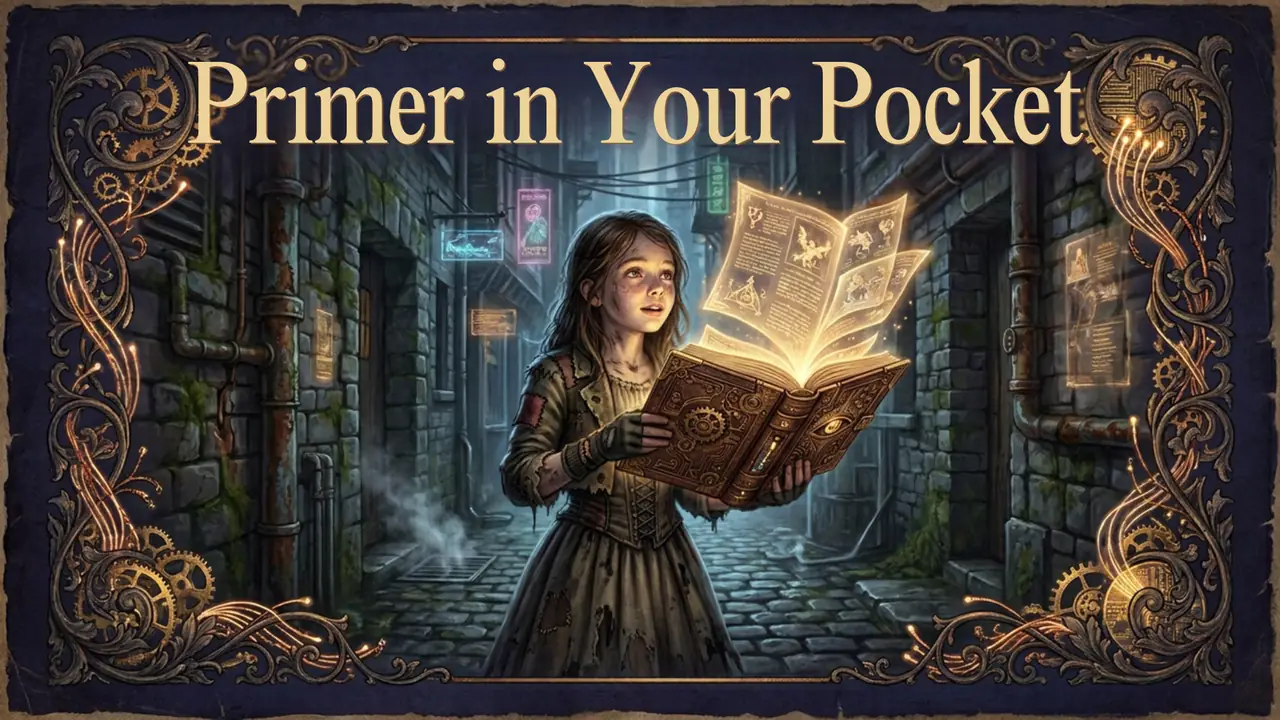
A girl on a cobbled street opens a book and it answers her. In Primer in Your Pocket, a second model pokes a hole in the reply, the river gets a say in where the bridge belongs, and then the track opens a dance floor. The promise is large enough to dance to. A child who would never have reached a tutor now carries one that answers the same question nine times without sighing.
Neal Stephenson imagined that book in 1995 and called it A Young Lady’s Illustrated Primer. It ships as an app now. (It also helps draft newsletter episodes about itself, which Stephenson did not predict and might have enjoyed.) This arc read The Diamond Age as the closest thing the field has to an operating manual for what has arrived, and the manual turns out to be mostly about everything around the book.
From the empty chair to the rack
The Mercy of a Bad Memory followed Nvidia through the week its founder left the stage. The chair stayed empty and the deal stayed live. By its end, the arc had mapped a supply chain in unusual detail: chips that Washington could let out and Beijing could refuse to let in, an interim chief executive inheriting financing guarantees, and a chipmaker agreeing to buy shares in Anthropic while Anthropic urged tighter export controls on who else could buy Nvidia’s chips.
Stephenson had a name for that arrangement. In The Diamond Age, household matter compilers make almost anything, so long as the Feed keeps delivering raw material down a line someone else owns. Nobody has to forbid anything. A line can be metered, priced, slowed or never extended to the wrong neighborhood. The Feed read the recent filings and the Commerce Department’s new remote-access rule as moves around that line, each defended with serious reasons, together adding up to a supply with gatekeepers who know each other well.
The child holding the Primer experiences that line as weather: a slower answer one month, a service unavailable where she lives the next.
One book, many routes in
Made for Elizabeth went back to the commission. A lord orders the Primer for his granddaughter. The engineer copies it for his own daughter, and the copy is stolen on a dark street and reaches Nell, who was never meant to have one. Today’s pricing tiers repeat the pattern with less violence: the paid model for people whose employer covers it, workarounds for the resourceful, and the free version on a secondhand phone with data that runs out on the twentieth of the month.
The free version is often very good, and the arc said so. The gap lies in what surrounds it. Stephenson’s own worry, in his conversation with Ashlee Vance, was a device that reaches mainly people who already have support. His soot-covered shovel, Lincoln scratching lessons through the ash, is a survivor’s story. It cannot count the children who never found a shovel.
The person inside the pages
The arc’s hinge is Miranda. Nell’s copy had a performer on the other end, paid by the shift, who came to care about a child she never met. Someone in the Pages found her descendants among the people who rate and filter model answers, including the Kenyan workers TIME reported in 2023 earning under $2 an hour to label harmful content, and the draft policy Kenya published this July proposing minimum pay and mental health care for that work.
Readers who followed What Would Count as Help? will recognize the shape. That arc followed a grandmother’s place name through an archive’s transcript and asked who fixes the name when the machine gets it wrong. The answer was always a person: a volunteer who knew the crossing, an archivist with time to see the correction through to the index. The Primer runs on the same hidden labor at planetary scale. Its warmth was partly trained into it by people paid to prefer warm answers, and most of them never learn which conversation their judgment reached.
That is a grievance-mechanism question in a new coat. The brand sits in a capital city, the work happens through a contractor of a contractor, and the person with a complaint has nowhere obvious to take it. Anyone who has worked around a mine knows how that story usually goes.
Feed, Seed and the soil
Stephenson’s counterweight to the Feed is the Seed, a technology that grows from local material with no line and no permission. The Seed found its nearest equivalent in open-weight models, which nobody can switch off for everyone once they are published. A school on the wrong side of an export rule can still run a capable tutor on its own hardware. A developer can adapt a model to a language the large vendors have not prioritized.
The twist is that the Feed’s owner plants seeds too. Nvidia publishes its own open models, and they grow best in soil made of Nvidia chips. The Seed also carries the mirror image of the Feed’s problem: when a fine-tuned model gives a child confident nonsense, there is no vendor to call. Stephenson never resolves that tension. Most of the useful answers sit between the two, in licenses and procurement terms, long before anyone writes a manifesto.
One voice for a generation
The Mouse Army took the novel’s most unsettling turn. Primers go into mass production for hundreds of thousands of abandoned girls. They grow up capable and loyal, shaped by one book from one supplier, with nobody inside it paying attention to a particular child. England’s plan for AI tutoring tools that could reach up to 450,000 disadvantaged pupils a year aims at the right children and admits the evidence is young. A buyer at that scale holds real leverage, and the arc asked it to use some: more than one supplier, and funded teacher time that no contract can produce on its own.
The renewal meeting
Who Gets to Turn the Page? closed on Nell outgrowing the book and going to find Miranda. The Primer gave her stories. The person inside it gave her a reason to look up. Her freedom came from the book being one of several things in her life that knew her.
The present-day version of that ending is unglamorous. A school sits down to renew a tutoring contract. The dashboard counts lessons and minutes, and it describes the book accurately. It cannot see the child who learned to bring a sharper question to her teacher. The questions that matter are the ones this newsletter keeps arriving at from different directions. Can the work leave with the person who did it? Who answers when a complaint about a wrong answer goes nowhere?
The empty chair in Nvidia’s boardroom and the child with a book in her pocket turn out to sit on the same line. The Primer is generous. Whether it stays that way is settled in contracts and rating queues the child will never see.
She turns the page. Someone else decides how many there are.